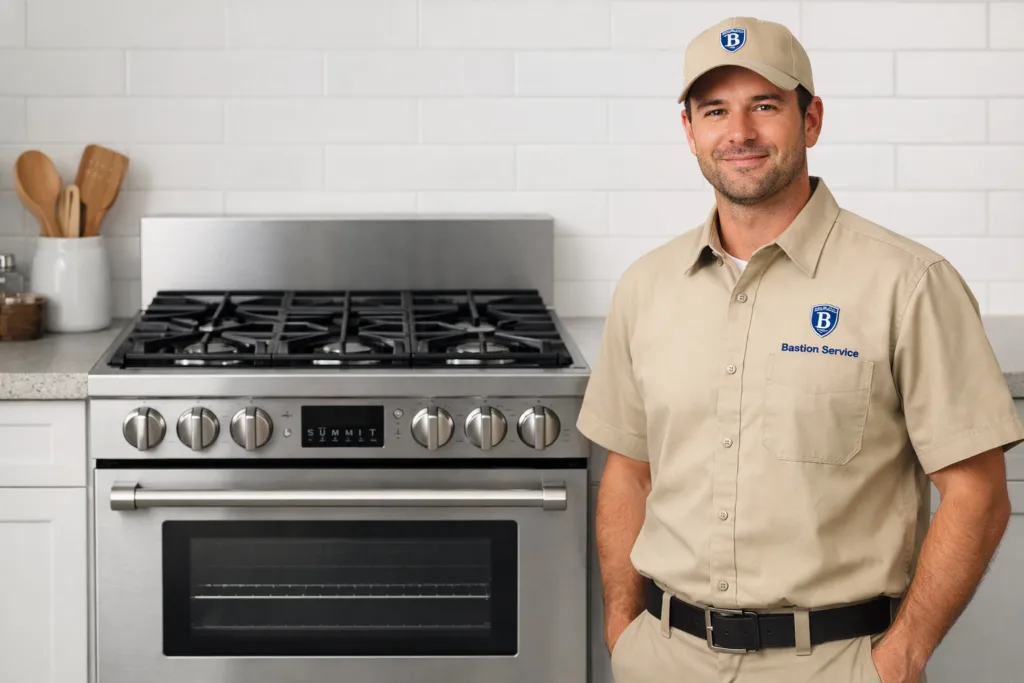
Cooking problems usually become obvious at the worst time: a burner keeps clicking, the oven takes forever to preheat, or dinner comes out uneven for the third night in a row. With a Summit range, those symptoms can come from different systems, so the best next step is to match the repair approach to what the appliance is actually doing.
Start with the symptom, not the part
A range combines surface cooking, oven heating, ignition, temperature sensing, and electronic controls. Because of that, one outward problem can have more than one cause. A burner that will not light may involve the igniter, burner cap alignment, switch, or fuel delivery. An oven that seems too cool may have a weak igniter, a failing element, or a sensor reading issue.
That is why symptom-based troubleshooting is more useful than assuming the first likely part has failed. For homeowners in Santa Monica, this helps avoid spending money on a guess while the original problem continues.
Common Summit range problems and what they often suggest
Burner clicks but does not ignite
Repeated clicking without flame often points to an ignition problem, but not always the same one. Moisture after cleaning, food debris around the burner, misalignment, a worn spark component, or a switch problem can all create similar behavior. If one burner is affected, the fault may be limited to that burner assembly. If several burners act up, the issue may involve a shared ignition component or control-related problem.
If you smell gas and ignition is delayed or inconsistent, stop using the burner until the cause is checked.
Burner lights but flame is weak or uneven
An uneven flame can affect cooking speed and pan heating. This may be caused by clogged burner ports, burner cap placement, ignition irregularities, or a gas flow issue. In day-to-day use, homeowners usually notice this as one side of the pan heating faster than the other or food taking longer than expected to cook.
Electric burner gets too hot or does not respond to settings
On electric configurations, a burner that stays too hot or cycles poorly may point to a failing switch or control issue. This is especially noticeable when low and medium settings do not behave normally. If heat output seems stuck in one range regardless of the knob position, the control side of the circuit often needs attention.
Oven will not heat
When the oven appears to turn on but never reaches cooking temperature, common suspects include the igniter, bake element, broil element, sensor, or electronic control. On some models, partial function can be misleading. The clock may work, lights may come on, and the unit may look normal while the heating system itself is not operating correctly.
Oven takes too long to preheat
Slow preheating is one of the easiest symptoms to overlook because the oven still produces some heat. In many cases, though, a weak igniter or underperforming element is already on the way to full failure. The range may eventually stop heating altogether, but before that happens it often shows up as extended preheat times and unreliable baking results.
Food bakes unevenly
If cookies brown more on one side, casseroles stay cool in the center, or cooking times vary from one use to the next, the problem may involve temperature sensing, element performance, calibration drift, or airflow inside the oven cavity. Uneven baking does not always mean the whole range is failing, but it usually means one part of the heating system is no longer doing its job consistently.
Controls work partly, but heating does not
When the display, light, or timer still functions but the burners or oven do not, the issue may be isolated rather than a total power failure. In those cases, testing usually focuses on switches, relays, heating components, and the circuits that send power where it needs to go.
Signs the problem is getting worse
Some range issues stay minor for a while, while others tend to progress quickly. It is smart to stop putting off service if you notice:
- burners that ignite only after multiple tries
- clicking that continues after ignition
- preheat times getting longer week by week
- temperature swings that affect normal cooking
- controls that respond inconsistently
- heating that cuts out during use
These patterns often mean a component is weakening rather than failing all at once. Catching that earlier can prevent extra stress on related parts.
When to stop using the range immediately
Some symptoms are more than a convenience issue. If you notice a persistent gas smell, delayed ignition with gas present, overheating, visible sparking, or signs that wiring or controls may be overheating, stop using the appliance until it has been evaluated. Safety comes first, especially when ignition and heat regulation are involved.
For gas-related concerns, deal with the immediate safety issue before thinking about appliance repair. Once the area is safe, the range can then be assessed for the underlying fault.
Repair or replace: what usually makes sense
Many Summit range problems are repairable when the failure is limited to one component, such as an igniter, element, sensor, switch, or similar control part. In those cases, fixing the affected system can restore normal daily use without replacing the appliance.
Replacement becomes a more serious consideration when the range has multiple major faults, repeated problems, heavy overall wear, or repair costs that no longer line up with the condition of the unit. Age alone does not decide the issue. What matters more is whether the appliance has one contained problem or several signs of broader decline.
What a useful service visit should clarify
Most homeowners do not need a long explanation of every possible range failure. They want to know what is causing the symptom, whether continued use could make things worse, and whether the repair is worth doing. A good appointment should narrow the problem to the correct system and explain the realistic path forward in plain language.
For households in Santa Monica, that usually means getting past guesswork quickly. Whether the issue involves ignition, burner control, oven heating, or temperature regulation, the goal is the same: identify the actual fault and determine whether a targeted repair can bring the Summit range back to reliable cooking.