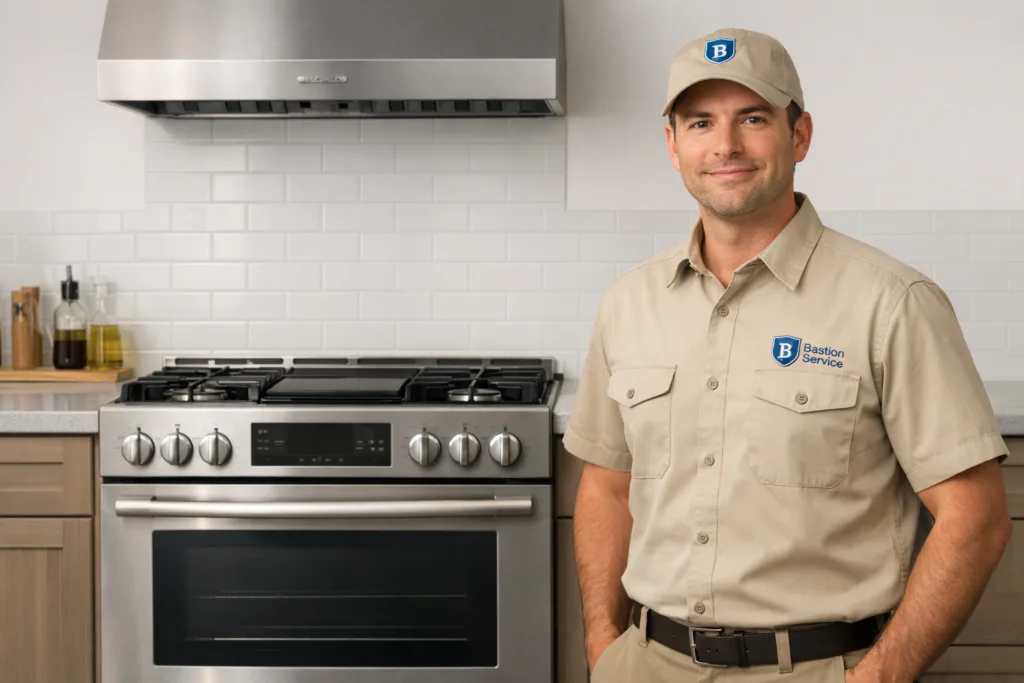
Electrolux ranges often show trouble in patterns that are easy to notice in daily cooking: a burner that keeps clicking, an oven that takes too long to preheat, or temperatures that no longer match the setting on the display. Looking closely at those patterns helps separate a minor use issue from a component failure that needs service.
Common Electrolux range problems in Santa Monica homes
Most range issues fall into a few symptom groups. Understanding what the appliance is doing, and when it does it, can make the next step much more straightforward.
Burners that will not ignite or keep sparking
On gas models, repeated clicking without ignition can come from misaligned burner caps, blocked burner ports, moisture around the igniter, a worn spark switch, or a fault in the ignition system. If the burner eventually lights after several tries, that usually points to a condition that is getting worse rather than fixing itself.
If sparking continues after the flame is on, the issue may be with the ignition switch or related electrical parts. That kind of constant clicking is more than a nuisance; it can lead to further wear if ignored.
If a burner will not light and there is a strong or persistent gas smell, stop using the range and address the gas concern first before arranging appliance repair.
Oven not heating or heating too slowly
An oven that stays cold may have a failed bake element, weak igniter, sensor problem, control issue, or power-related fault depending on whether the unit is gas or electric. Slow preheat is also a useful clue. Many homeowners first notice that meals take longer than usual, even before the oven stops heating altogether.
When preheat drags on, the cause is often a part that still works partially but no longer performs at full strength. That is why the oven may seem usable one day and unreliable the next.
Oven temperature drifting or baking unevenly
If food comes out overdone on one rack and underdone on another, the issue may be more than normal cooking variation. A failing sensor, weak heating component, convection fan problem, or worn door seal can all affect heat distribution.
Temperature complaints are especially noticeable in homes that use the range often. If familiar recipes suddenly need extra time or burn around the edges, the appliance may not be holding temperature consistently.
Surface burners that heat weakly or not at all
Electric surface elements can fail because of a bad element, damaged receptacle, faulty infinite switch, or wiring problem. Gas burners with low or uneven flame may be dealing with clogged ports, cap placement issues, or ignition-related faults.
A burner that works only on certain settings, cycles oddly, or takes much longer to boil water is usually giving early warning that a component is wearing out.
Display, keypad, or control problems
Electronic issues often begin intermittently. The display may flicker, settings may reset, buttons may respond only sometimes, or the oven may start and then stop mid-cycle. On some Electrolux ranges, these symptoms can point to a failing user interface, control board, fuse, or power supply issue.
Because controls manage heating, timing, and sensor communication, electrical faults can create symptoms that look mechanical at first. That is one reason accurate testing matters before parts are replaced.
What certain symptoms usually mean
Homeowners do not need to diagnose the exact failed part, but noticing a few details can make the problem easier to understand.
- Clicking before ignition: often related to burner alignment, debris, moisture, or spark system trouble.
- Clicking after ignition: may suggest a switch or ignition system fault.
- Long preheat times: commonly linked to a weak igniter, aging element, or temperature sensing issue.
- Food consistently overcooking: may indicate a sensor or control problem rather than a simple calibration issue.
- Only one burner affected: often points to a localized burner, element, switch, or ignition issue.
- Both cooktop and oven acting up: can suggest a broader power, control, or wiring problem.
When to stop using the range and arrange service
Some problems are inconvenient but manageable for a short time. Others should be treated as urgent. It is best to stop using the appliance if you notice any of the following:
- A strong or repeated gas odor
- Burners that spark continuously
- The oven overheating or failing to regulate temperature
- Visible signs of scorching, melted wiring, or electrical burning smell
- Controls changing settings on their own during cooking
- Breakers tripping when the range is used
These symptoms can point to conditions that are unsafe or likely to cause additional damage if the range stays in regular use.
Why symptom-based diagnosis matters
Two Electrolux ranges can show the same outward problem for very different reasons. An oven that will not heat may have an element issue on one unit and a control failure on another. A burner that will not light may be dealing with something simple like cap alignment, or something deeper in the spark system.
That is why a practical repair plan starts with the exact behavior of the appliance. Knowing whether the issue is isolated, intermittent, worsening, or affecting multiple functions helps determine whether repair is likely to be straightforward or whether a larger decision may be needed.
Repair versus replacement for an Electrolux range
Many range problems are repairable when the appliance is otherwise in solid condition. Igniters, sensors, elements, switches, spark components, and some control-related parts are common examples of serviceable failures.
Replacement may be worth considering if the range has multiple major issues at the same time, if there is evidence of broader electrical deterioration, or if the cost of repair is close to the value of the appliance. The most useful comparison is not simply age alone, but age plus condition, performance history, and the scope of the current fault.
What to note before scheduling service
A few observations can help narrow down the problem faster:
- Whether the issue affects the oven, cooktop, or both
- Whether the range is gas, electric, or dual fuel
- If the problem is constant or comes and goes
- Any error codes or flashing display messages
- Whether the symptom began as slow heating, uneven heating, no heating, or constant clicking
- If one burner is affected or several
Even simple notes like “left front burner clicks but does not light when warm” or “oven reaches temperature late and then burns food” can be more helpful than a general description that the range is not working right.
What homeowners in Santa Monica can expect from a focused repair approach
In many cases, the best outcome comes from matching the repair to the actual symptom instead of replacing parts based on guesswork. Whether the problem involves ignition, temperature control, surface heating, or the electronic interface, the goal is to identify what has failed and whether fixing it makes sense for the appliance as it stands today.
For households in Santa Monica, that kind of diagnosis-first service is often the fastest path back to a range that heats properly, responds consistently, and can be used with confidence during everyday cooking.