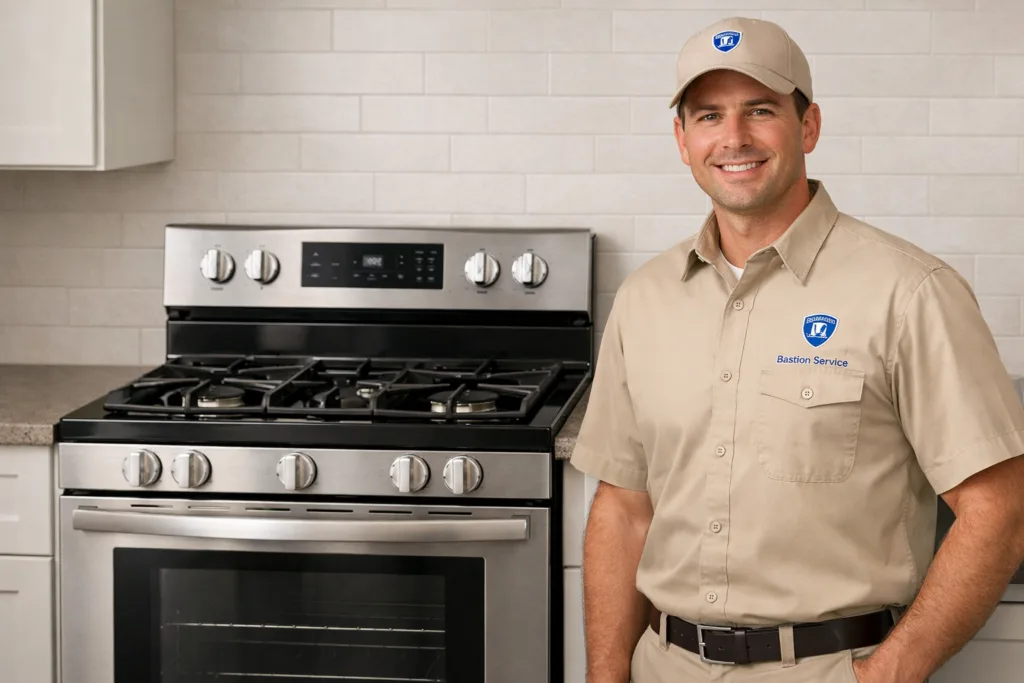
Range problems often start small: a burner that clicks longer than usual, an oven that suddenly needs extra time, or a control panel that responds inconsistently. With Whirlpool ranges, those symptoms can come from different underlying faults, so the most useful next step is to match the repair plan to the exact behavior of the appliance rather than replacing parts by guesswork.
Symptoms that usually point to a serviceable Whirlpool range issue
Many household range problems are tied to one failing component or one affected system. That is often good news for homeowners in Santa Monica, because a targeted repair may restore normal cooking without replacing the appliance.
- One surface burner does not heat or ignite properly
- The oven preheats slowly or does not reach the set temperature
- Food bakes unevenly even after normal rack adjustment
- The display flashes, resets, or stops responding
- The door does not close tightly or heat seems to escape
- The range shuts off during use or trips power intermittently
When the symptom is repeatable, diagnosis is usually more productive than trial-and-error part replacement.
Burner problems: what the symptom may mean
Electric burners that do not heat correctly
On electric Whirlpool ranges, a surface element that stays cold, heats unevenly, or cycles strangely may be caused by a worn element, a damaged receptacle, a failed infinite switch, or heat-damaged wiring. In some cases, the burner itself is not the only failed part. If a connection has been loose or overheating for a while, the related socket or wiring may also need attention.
A burner that gets too hot and does not regulate well can be just as disruptive as one that does not heat at all. That type of symptom often points toward a control issue behind the knob rather than the element alone.
Gas burners that click but do not light
On gas models, repeated clicking without ignition can be caused by clogged burner ports, moisture around the igniter area, a spark ignition fault, burner cap misalignment, or a gas flow problem. If the burner eventually lights after multiple clicks, the issue may still be developing and should not be ignored.
When only one burner is affected, the fault is often localized. When several burners show ignition trouble at once, the problem may involve a broader ignition or supply issue that needs closer inspection.
Oven heating issues and uneven cooking
Slow preheating or no heat
A Whirlpool oven that takes too long to preheat or never gets hot enough may have a weak bake element, failed broil support during preheat, a worn gas igniter, a temperature sensor problem, or an electronic control fault. Some ovens appear to run normally from the outside while still heating poorly inside, which is why cooking performance matters as much as whether the display turns on.
Food cooks unevenly
If cookies brown more on one side, casseroles take longer than expected, or the bottom of food scorches while the center stays underdone, the oven may not be regulating temperature accurately. That can be tied to the sensor, heating element performance, door sealing, or control calibration. Uneven baking is often one of the first signs that a heating system is drifting out of spec.
Temperature swings that affect everyday use
Some homeowners notice the issue only after several meals come out wrong. That pattern matters. Inconsistent oven behavior usually does not correct itself, and continued use can add stress to elements, igniters, and controls as the range struggles to maintain heat.
Control panel, display, and electronic problems
Modern Whirlpool ranges rely on electronic controls for temperature management, timing, and safety functions. If the display is blank, partially lit, beeping unexpectedly, or showing error codes, the issue may involve the control board, touchpad, wiring harness, or incoming power to the appliance.
Intermittent failures deserve attention because they can create confusing cooking results. A range that resets mid-cycle or drops power briefly may still appear usable, but oven timing and temperature accuracy can suffer in ways that are not obvious until meals are affected.
Door and seal issues that mimic heating failures
A range door that does not close properly can let heat escape and make the oven seem weaker than it really is. Worn hinges, a damaged gasket, or alignment problems can all contribute to longer cook times and inconsistent baking. On self-cleaning models, prolonged high heat may also contribute to latch or door-related wear.
Because heat loss changes oven performance, a door problem can easily be mistaken for a failed heating component. Checking the full condition of the oven helps avoid replacing the wrong part.
When to stop using the range and schedule service
Some symptoms are more urgent than others. If the appliance shows signs of electrical damage, unstable heating, or repeated ignition failure, it is best not to keep testing it.
- Visible sparking from a burner or control area
- Burn marks around an element receptacle
- Breaker trips during normal cooking
- Oven temperature climbs unpredictably
- Ignition keeps clicking without lighting
- Controls shut down during operation
If there is a strong or persistent gas odor, stop using the range immediately and address safety before arranging appliance service.
Repair or replace: how homeowners usually decide
Many Whirlpool range repairs are worthwhile when the problem is limited to an igniter, surface element, sensor, switch, door component, or another defined part. Repair tends to make sense when the appliance has otherwise been reliable and the overall condition is still good.
Replacement becomes more reasonable when the range has multiple failing systems, recurring electronic faults, heavy wear across both cooktop and oven functions, or repair costs that approach the value of the appliance. Age alone does not decide the issue, but age combined with repeated breakdowns often changes the calculation.
For most households in Santa Monica, the decision comes down to three things: whether the fault is isolated, whether the appliance is safe to continue using after repair, and whether the expected repair cost fits the condition of the range.
What a helpful service visit should clarify
Homeowners usually want straightforward answers: what is failing, whether the range is safe to use, and what the next step should be. A useful appointment should narrow the fault, explain which component or system is causing the symptom, and make it easier to weigh repair against replacement without overselling either option.
That kind of symptom-based evaluation is especially valuable when a Whirlpool range still works part of the time. Partial function can make a problem seem minor, but repeated burner, ignition, or oven performance issues often point to wear that should be addressed before it interrupts daily cooking completely.