Common LG range symptoms and what they often mean

Range problems can look simple at first, but the same symptom can come from several different failures. An oven that will not preheat, a burner that clicks, or controls that behave unpredictably all need to be checked in context so the repair plan matches the actual fault.
Burner clicks but does not light
If a surface burner keeps clicking without igniting, starts only occasionally, or lights after several tries, the issue may involve the spark igniter, burner cap alignment, moisture around the burner head, a dirty ignition path, or a failing switch in the ignition system. In many homes, this starts as an inconvenience and gradually becomes a reliability problem during normal meal prep.
If you notice a strong or persistent gas smell, stop using the range and address safety first. A gas odor is different from a simple ignition complaint and should not be ignored.
Oven will not heat or takes too long to preheat
When the oven stays cold, warms very slowly, or never seems to reach the set temperature, the cause may be a bake element problem, broil assist failure, temperature sensor issue, electronic control fault, or a power supply problem affecting how the appliance heats. Some homeowners describe this as an oven that “turns on but does not really cook,” which usually points to incomplete or poorly regulated heat.
Uneven cooking and temperature swings
If one side of a baking sheet browns faster than the other, dishes need extra time for no clear reason, or the oven seems to run hot one day and cool the next, the range may have a weak heating component, sensor drift, calibration issues, or airflow problems inside the oven cavity. These are especially frustrating symptoms because the appliance still appears usable while producing inconsistent results.
Display, keypad, or control issues
A blank display, nonresponsive keypad, interrupted cooking cycle, or settings that change unexpectedly can point to a control board, user interface, wiring, or incoming power issue. With modern ranges, control faults can affect more than the display alone. They can also interfere with preheat, burner operation, timing functions, and temperature regulation.
Why symptom-based diagnosis matters
Many cooking problems overlap. A burner that will not ignite could be caused by debris and alignment, or it could involve a deeper ignition circuit issue. An oven that seems weak may have a sensor problem, a heating failure, or an electronic control fault. That is why the most helpful first step is testing based on the exact symptom pattern rather than guessing from one visible behavior.
For Santa Monica homeowners, this matters because it helps avoid unnecessary parts replacement and gives a clearer picture of whether the repair is likely to restore normal daily use. It also helps show whether the problem is isolated or part of broader wear in the appliance.
Signs your LG range should be serviced soon
It is smart to schedule service when performance has become unreliable, even if the range still works some of the time. Cooking appliances often worsen gradually before they fail completely.
- Burners ignite only after repeated attempts
- Clicking continues after ignition
- Oven preheat takes much longer than usual
- Food is repeatedly undercooked or overbrowned
- Temperature settings no longer match real cooking results
- The display flickers, goes blank, or stops responding
- Cooking cycles cancel or behave inconsistently
If you are constantly adjusting cooking times, rotating dishes to compensate, or restarting burner or oven functions to finish a meal, the range is no longer operating in a stable way.
When continued use can make the problem worse
Using a malfunctioning range over and over can increase wear on related components. Repeated ignition attempts can strain parts in the spark system. An oven that cycles incorrectly may keep running with poor temperature control, which can turn a smaller repair into a more involved one if the root issue is ignored for too long.
You should stop using the appliance and have it checked promptly if it is tripping power, showing erratic control behavior, overheating, or producing a persistent gas odor. Problems that affect safety or electrical stability are not good candidates for wait-and-see use.
Repair or replace: what usually makes sense
Repair is often worth considering when the range is in otherwise good condition and the problem appears limited to one main system, such as ignition, heating, sensing, or controls. Replacement becomes more likely when the appliance has multiple developing faults, heavy wear, or repeated failures that make dependable daily cooking unlikely.
A careful diagnosis makes that decision easier. Instead of judging the range by one frustrating symptom, you can weigh the current failure, the overall condition of the unit, and whether the expected repair path is likely to restore reliable performance.
What homeowners in Santa Monica usually want from range service
Most households are not looking for a complicated explanation. They want to know why the range is misbehaving, whether the issue is likely to spread, and whether the fix is sensible for the appliance they have. That is especially true when the range still powers on but no longer cooks predictably.
For an LG range in a busy kitchen, the practical questions are usually straightforward: Is the burner fault isolated? Is the oven heating correctly? Are the controls responding the way they should? Once those answers are clear, it is much easier to decide on the next step with confidence.
Focused help for everyday cooking problems
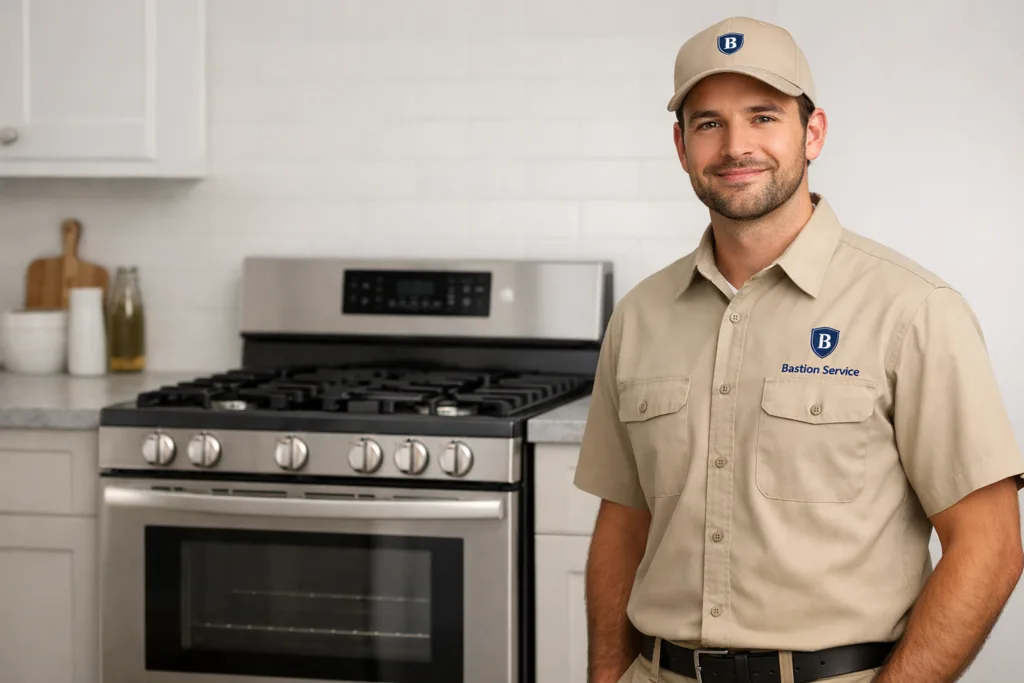
Whether the issue involves burner ignition, oven heating, temperature inconsistency, or control failure, good service should translate symptoms into a repair decision that makes sense for the home. Bastion Service helps Santa Monica homeowners evaluate LG range problems based on real appliance behavior, overall condition, and the repair path most likely to return the range to normal use.