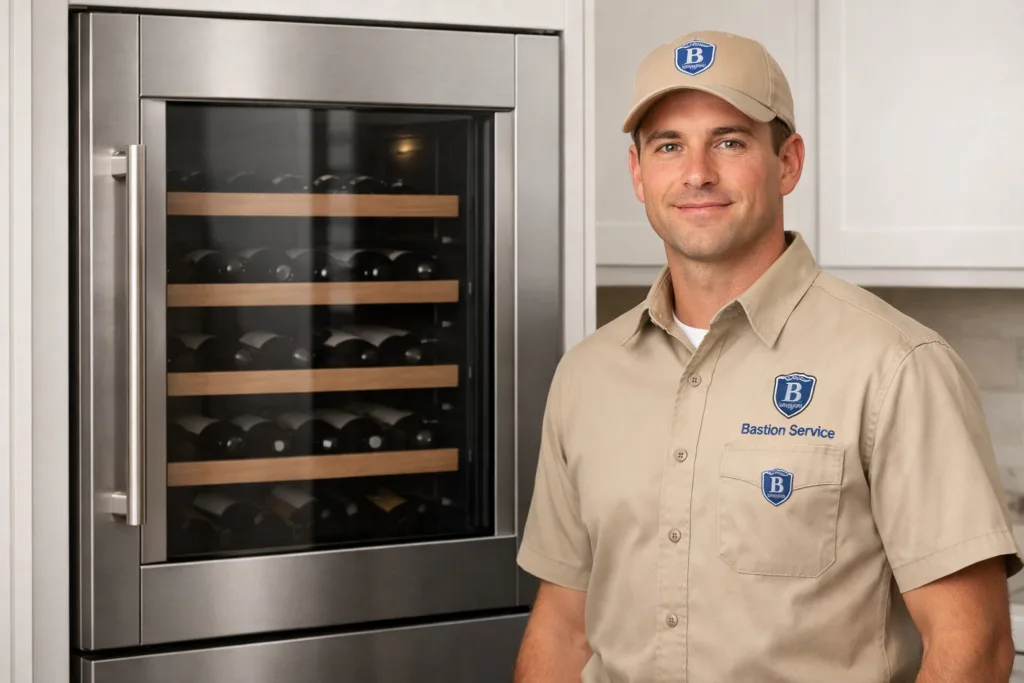
A Monogram wine cooler that stops protecting a steady storage range can put both everyday bottles and long-kept collections at risk. Small changes in temperature, humidity, or airflow often show up before a complete failure, so the most useful approach is to pay attention to the exact pattern: whether the cabinet runs warm all the time, cools unevenly, collects moisture, or becomes noticeably louder during normal operation.
What the symptoms usually mean
Wine coolers rely on balanced airflow, accurate sensing, and a tight door seal. When one part of that system is off, the symptoms can look similar on the surface while coming from very different causes underneath. That is why a symptom-based inspection matters more than guessing from a single sign such as “not cooling” or “making noise.”
Cabinet runs warm or drifts above the set temperature
If bottles feel warmer than expected or the displayed temperature does not match the actual cabinet conditions, the issue may involve weak cooling performance, restricted condenser airflow, a faulty fan, or a sensor problem. Some units warm gradually over several days, while others cycle between normal and too warm. A cooler that cannot hold a stable range should not be treated as a minor inconvenience, because repeated temperature swings can affect storage quality even before the appliance fully stops cooling.
Uneven cooling from shelf to shelf
When one section feels colder than another, airflow is often part of the problem. Internal fan trouble, blocked vents, frost buildup, or control issues can all create hot and cold spots. In a Monogram wine cooler, uneven cooling may show up first on upper shelves, near the door, or in one zone if the unit has multiple temperature sections. This kind of inconsistency usually points to a system that is still operating, but not distributing cooling correctly.
Condensation on the glass or moisture inside the cabinet
Moisture around the door, sweating on the glass, or dampness inside the compartment often suggests warm air is entering where it should not. A worn gasket, slight door misalignment, or repeated failure of the seal to close evenly can all contribute. Excess moisture can also appear when temperature regulation is off and the unit cycles improperly. If ignored, condensation can lead to longer run times, frost accumulation, and added stress on fans and controls.
Buzzing, rattling, humming, or constant running
Not every sound means a major repair, but a change in sound usually means something has changed in operation. A rattle may come from vibration or mounting issues. A louder hum can point to a compressor working harder than normal. A fan that clicks, scrapes, or runs continuously may be struggling with airflow or wear. When noise appears together with warming or condensation, it is more likely that the unit is compensating for a developing fault rather than simply operating normally.
Display, touch controls, or lighting acting irregularly
If settings do not respond properly, the display flashes, interior lights behave unpredictably, or the cooler appears powered on without cooling as it should, the problem may involve the control board, user interface, wiring, or sensor feedback. These issues can be misleading because the appliance may still seem partly functional. A lit display does not necessarily mean the cooling system is receiving the right commands.
Common causes behind Monogram wine cooler problems
In Manhattan Beach homes, the most common repair causes tend to fall into a few categories:
- Fan motor wear or reduced airflow
- Dirty or restricted condenser areas
- Door gasket deterioration or alignment issues
- Temperature sensor or thermistor faults
- Control board or interface failures
- Defrost-related problems in models that depend on proper moisture management
- Compressor or sealed-system performance issues
The important distinction is whether the fault is isolated to a serviceable component or tied to a larger cooling-system failure. That difference usually determines whether repair is straightforward or whether replacement becomes part of the conversation.
When the problem is no longer minor
Some wine cooler issues start subtly, but there are signs that should not be ignored. Service becomes more urgent when:
- The cabinet stays warm for hours after the door has remained closed
- The unit runs almost nonstop without recovering temperature
- Condensation keeps returning even after basic cleaning and door checks
- Noise becomes repeatable and noticeably louder than normal operation
- The display shows inconsistent behavior or settings change unexpectedly
- The appliance trips power or shuts off intermittently
Continued use in those conditions can turn a limited repair into a broader one, especially if a fan motor is failing or the compressor is being forced to overwork.
Repair or replacement: how homeowners usually decide
For Monogram wine cooler repair in Manhattan Beach, the decision usually comes down to the age of the unit, the condition of the cabinet and shelving, and the exact failed component. Repairs are often worthwhile when the issue is limited to controls, sensors, fans, gaskets, or other accessible parts and the appliance is otherwise in good shape.
Replacement becomes more likely when there is a significant sealed-system problem, multiple major components have failed, or the repair cost approaches the value of the unit. Built-in wine coolers often deserve a closer look before replacement because fit, finish, and cabinetry integration matter. If the cooler matches the surrounding space and the failure is contained, repair may make more sense than starting over with a different unit size or configuration.
What to check before scheduling service
A few basic observations can make diagnosis faster and more accurate. Before a visit, it helps to note:
- The set temperature and the actual interior temperature, if measured
- Whether the entire cabinet is affected or only one area
- Whether the noise is constant, intermittent, or tied to startup
- If moisture appears on the door glass, around the seal, or inside the cabinet
- Whether the problem started suddenly or gradually worsened
- If the display remains normal while cooling performance changes
It is also worth confirming that the door is closing fully and that ventilation space around the unit has not been blocked. These quick checks do not replace service, but they can help separate a simple airflow issue from a more technical control or cooling fault.
Why accurate diagnosis matters with premium wine storage
Premium wine coolers are less forgiving than a standard refrigerator when temperatures drift. Bottles may still feel cool to the touch while the actual storage environment is no longer stable enough for proper preservation. Because symptoms can overlap, replacing parts by guesswork often adds cost without solving the real issue. A good repair path starts by identifying whether the problem is with airflow, sensing, control, sealing, or the cooling system itself.
For homeowners in Manhattan Beach, that means looking past the surface symptom and focusing on how the Monogram unit behaves over time. The more consistent that symptom pattern is, the easier it is to determine whether the repair is simple, moderate, or a sign that the appliance is nearing the point where replacement should be considered.