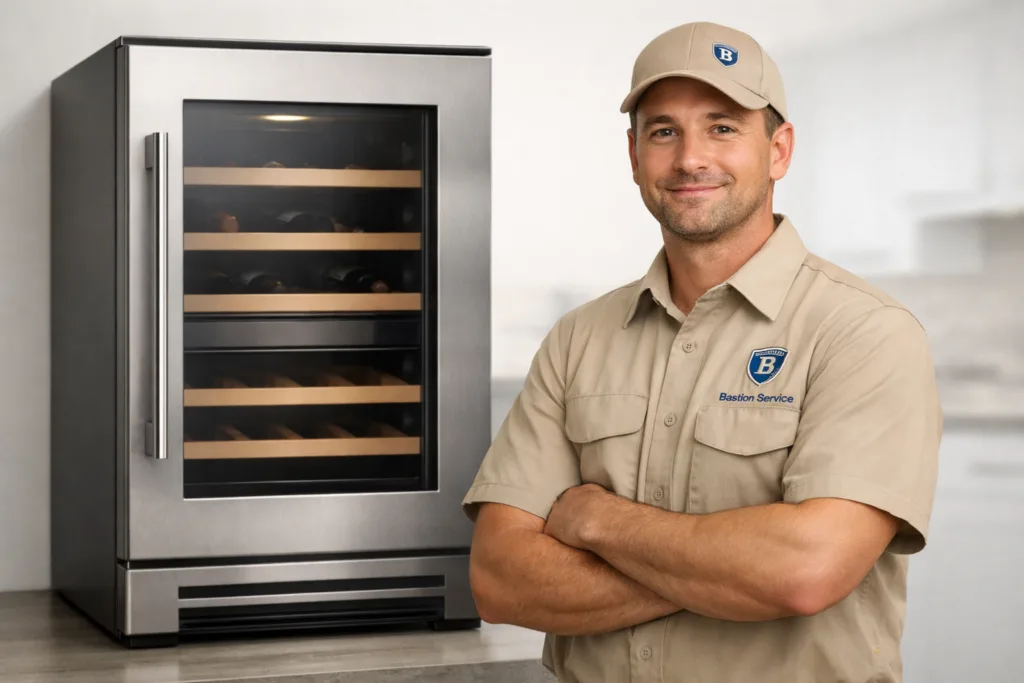
A KitchenAid wine cooler that stops holding temperature, runs too long, or begins collecting moisture can put both the appliance and the bottles inside at risk. Because wine storage depends on steady conditions, small changes often matter more here than they would in a standard refrigerator. What looks like one problem from the outside may actually come from airflow trouble, a failing fan, a sensor issue, a weak door seal, or a more serious cooling-system fault.
Common KitchenAid wine cooler symptoms and what they can mean
Most wine cooler problems start with a pattern rather than a complete failure. The unit may still turn on, the display may still light up, and the cabinet may still feel somewhat cool, but performance becomes inconsistent. That is usually the point where symptom-based troubleshooting is most useful.
Not cooling enough
If the cabinet feels warmer than the selected setting, the cause may be as simple as restricted airflow or as involved as a failing cooling component. Common possibilities include condenser buildup, evaporator fan trouble, inaccurate temperature sensing, control issues, or sealed-system problems. Homeowners often notice this when bottles no longer feel consistently cool or the unit takes too long to recover after the door is opened.
Temperature swings during the day
Temperature fluctuation can happen even when the wine cooler is technically still cooling. A sensor reading may be off, the control may not be responding correctly, or air circulation inside the cabinet may be uneven. In a dual-zone or multi-shelf layout, one section may seem fine while another feels noticeably warmer or colder.
Overcooling or freezing near the back
When bottles become too cold or items near the rear wall start to freeze, the issue often points to a thermostat, thermistor, control board, or airflow problem. This is worth addressing promptly because excessive cold can affect cork condition, labels, and the overall quality of stored wine.
Condensation, drips, or water under the unit
Water inside or below a KitchenAid wine cooler may come from a blocked drain path, excess humidity inside the cabinet, a damaged gasket, or a leveling issue that changes how moisture drains. In built-in spaces, even a small leak can become a bigger problem if surrounding cabinetry or flooring starts absorbing moisture.
Buzzing, rattling, or new fan noise
Some operational sound is normal, but a noticeable change in noise level or sound pattern usually means something has changed mechanically. Rattling can come from vibration, buzzing may point to compressor strain, and a scraping or uneven hum can indicate fan wear or obstruction. If the sound is new and persistent, it is usually best not to ignore it.
Running constantly
A wine cooler that rarely cycles off may be losing cooling efficiency, struggling with poor airflow, compensating for warm air entering through a weak seal, or dealing with a control problem. Constant running creates extra wear and can eventually turn a manageable issue into a no-cooling breakdown.
Warning signs homeowners in Manhattan Beach often notice first
Wine coolers in residential kitchens, bar areas, and dining spaces often decline gradually. Instead of a sudden shutdown, the unit may show subtle warning signs for days or weeks. Watch for patterns like these:
- The display shows the right setting, but the cabinet does not feel right.
- Bottles near one shelf feel colder than bottles on another.
- The door no longer closes with the same firm seal.
- Moisture appears around the frame, glass, or nearby cabinet surfaces.
- The unit seems hotter on the outside than it used to.
- The compressor or fan sounds louder or runs longer than normal.
These early symptoms matter because one failing part can create extra strain elsewhere. A circulation problem can increase run time. A sealing problem can drive both condensation and temperature drift. A control issue can cause the cooler to overwork even when the selected temperature looks correct on the panel.
Useful checks before scheduling service
There are a few homeowner checks that can help rule out simple causes before repair is scheduled. Make sure bottles are not blocking interior vents, verify the temperature setting has not been changed accidentally, and inspect the door gasket for gaps, debris, or sections that no longer sit flush. It also helps to confirm the unit has enough space for ventilation if it is installed in cabinetry.
If those basic checks do not change performance, the next step is usually professional diagnosis. With wine coolers, guessing can lead to unnecessary part replacement while the real issue continues.
When continued use can make the problem worse
Some wine cooler problems are inconvenient but stable for a short time. Others can worsen quickly. If the unit is warming up, freezing bottles, leaking, making sharp new noises, or running nonstop, continued operation may add stress to the compressor, fan motors, or electronic controls.
If valuable bottles are inside and the cabinet can no longer hold a dependable temperature, moving the collection to a more stable environment is often the safer choice until service is completed. If you notice an electrical smell, repeated breaker trips, or obvious overheating, stop using the appliance until it has been evaluated.
Repair or replacement depends on the failure pattern
Many KitchenAid wine cooler problems are still good repair candidates. Issues involving fans, sensors, controls, gaskets, drainage components, or accessible electrical parts are often more straightforward than homeowners expect. In those cases, repair can restore normal cooling without the disruption of replacing a built-in unit.
Replacement becomes a more realistic discussion when the cooler has major sealed-system trouble, multiple failing components, a history of repeated breakdowns, or repair cost that no longer makes sense for the condition of the appliance. Built-in fit, surrounding cabinetry, and ventilation design also matter, so the right decision usually comes after inspection rather than before it.
What a symptom-based service visit should clarify
For KitchenAid wine cooler repair in Manhattan Beach, the goal is not just to confirm that the appliance is malfunctioning. It is to identify why the symptom is happening and whether the repair path is reasonable. A service visit should help clarify:
- Whether the problem is airflow, controls, moisture management, or the cooling system itself
- Whether the issue is isolated to one component or affecting several systems
- Whether the cooler is safe to continue using while awaiting parts
- Whether repair is likely to restore stable temperature performance
- Whether the unit’s age and condition still support further investment
That kind of assessment is especially important with wine storage appliances because the complaint is often “it feels off” long before the unit fully stops. Interpreting those small changes correctly can prevent spoiled bottles, avoid repeat failures, and lead to a more sensible repair decision for the home.
KitchenAid wine cooler service for Manhattan Beach homes
In Manhattan Beach homes, wine coolers are often part of finished kitchen layouts, bar areas, or other built-in spaces where temperature control, cabinet fit, and moisture issues all matter. When a KitchenAid unit starts showing inconsistent cooling, condensation, fan noise, or control problems, the most useful next step is a practical repair plan based on the exact symptom pattern. That approach helps protect the collection, reduce unnecessary downtime, and determine whether the appliance should be repaired or replaced.