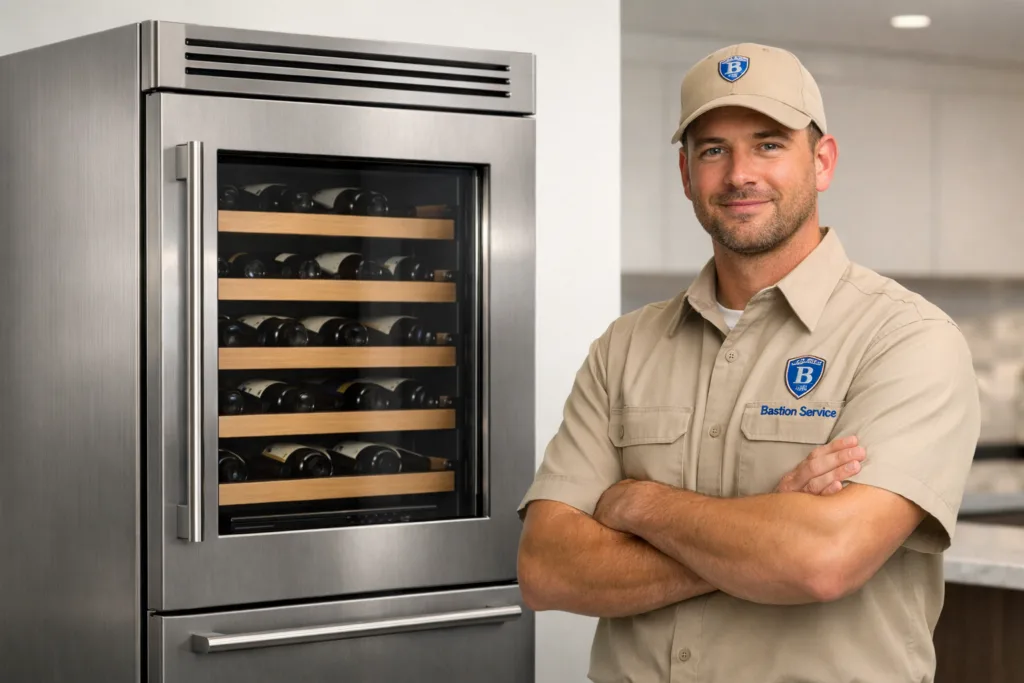
A Sub-Zero wine cooler that starts drifting out of range, running too long, or collecting moisture around the door can put both storage conditions and long-term appliance reliability at risk. In many Manhattan Beach homes, the most useful next step is to match the repair approach to the exact symptom pattern rather than assuming every cooling complaint points to the same failure.
Start with what the wine cooler is actually doing
Wine coolers often show smaller warning signs before they fail completely. A few degrees of temperature drift, intermittent fan noise, or recurring condensation may seem minor at first, but those patterns usually narrow the diagnosis quickly. On a Sub-Zero unit, the difference between a sensor problem, airflow restriction, fan issue, door seal leak, or sealed system fault matters because each one affects performance in a different way.
Pay attention to whether the cabinet is warm all the time, only fluctuates during certain periods, cools unevenly from top to bottom, or seems to recover slowly after the door is opened. Those details help determine how urgent the issue is and whether continued use is likely to make the repair more involved.
Common Sub-Zero wine cooler symptoms and what they can mean
Cabinet not cooling enough
If bottles feel warmer than usual or the displayed temperature does not match actual conditions inside, possible causes include restricted condenser airflow, a weak evaporator fan, sensor or thermostat problems, control faults, or compressor-related issues. A unit that is clearly warming up should not be written off as a simple settings problem without testing, especially if it is also running longer than normal.
In dual-zone models, one section may stay closer to the set temperature while the other drifts. That can point to an airflow problem, frost buildup, fan trouble, or a control issue affecting only part of the cooling process.
Temperature swings during the day
Fluctuating temperatures can be harder on a collection than a single obvious failure because the appliance may seem to be working while storage conditions remain unstable. Temperature swings may come from an inaccurate sensor, inconsistent fan operation, door sealing problems, intermittent control behavior, or a refrigeration system that cannot maintain the target range efficiently.
If the unit cools, then warms, then cools again without a clear reason, it is worth having checked before the problem becomes a no-cool condition.
Runs constantly or rarely shuts off
A Sub-Zero wine cooler that runs almost nonstop is usually telling you it is struggling to reach or hold the set point. Common reasons include dirty condenser surfaces, warm air leaking past the gasket, poor internal airflow, a control problem, or reduced cooling capacity. Even when the cabinet still feels somewhat cool, long run cycles add wear and can signal a larger issue developing in the background.
Condensation, water, or frost buildup
Moisture inside the cabinet, water near the base, or visible frost along interior panels often points to a door seal problem, drain issue, excess humidity intrusion, or a defrost-related fault. Frost matters because it can block normal airflow and make the appliance appear to have a more severe cooling failure than it actually does.
Recurring condensation around the door should also be taken seriously. Warm air entering the cabinet can affect temperature stability, increase run time, and lead to further icing if left unresolved.
New or louder noise
Wine coolers are never completely silent, but a change in sound usually means something has changed mechanically or electrically. Rattling can come from vibration or installation shift. Clicking may point to a starting or control issue. Harsher humming can be associated with compressor stress. Fan noise that comes and goes may indicate obstruction, blade contact, ice interference, or a worn motor.
Noise by itself does not always mean major failure, but noise paired with poor cooling, frost, or nonstop operation should not be ignored.
Display, control, or alarm problems
If the panel is unresponsive, settings do not hold, or alarms return shortly after being cleared, the fault may involve the interface, sensors, wiring, or the main control system. Repeated resetting may temporarily hide the symptom, but it rarely corrects the underlying cause. When controls begin acting unpredictably, symptom-based testing is often the fastest way to determine whether the issue is isolated to electronics or tied to a broader cooling problem.
When service should be scheduled promptly
It is usually best to arrange service soon when the wine cooler is no longer maintaining a stable temperature, moisture keeps returning after cleanup, frost continues to spread, or the unit runs almost continuously. Service is also a good idea when the appliance begins making a new sound and cooling performance changes at the same time.
- The cabinet is warming instead of recovering to the set point
- One zone is noticeably off while another seems normal
- Condensation or water keeps reappearing
- Frost is restricting shelves, vents, or airflow
- The cooler shuts down unexpectedly or trips power
- The controls are inconsistent or alarms keep returning
These are the kinds of symptoms that tend to worsen with delay rather than stabilize on their own.
When continued use can make the problem worse
There is a difference between an appliance that is showing a warning sign and one that is already operating in a damaging condition. Continued use becomes more risky when the cabinet is clearly failing to cool, the compressor seems to run without reaching temperature, frost buildup is spreading, or water is collecting repeatedly inside or around the unit.
If you notice overheating, a burning smell, repeated electrical interruption, or severe temperature loss, it is better to stop using the wine cooler until it can be checked. Running the unit in that condition can increase stress on major components and turn a manageable repair into a more expensive one.
Repair versus replacement considerations
Many Sub-Zero wine cooler problems are repairable, especially when the issue involves airflow, fans, controls, sensors, drainage, door sealing, or other accessible components. In those cases, restoring proper operation is often more sensible than replacing the appliance.
Replacement becomes a more serious discussion when there are multiple major failures at the same time, when the cooling system has a high-cost fault combined with age-related wear, or when the unit has a long pattern of repeat problems. The right decision usually depends on confirmed test results, overall condition, and the expected reliability after repair.
That is why a clear diagnosis matters so much. A symptom that sounds severe may trace back to a targeted repair, while a seemingly minor complaint can sometimes uncover a larger refrigeration issue.
What homeowners should expect from the repair process
Useful service should do more than identify a bad part. It should determine why the symptom is happening, whether the wine cooler is safe to keep running in the meantime, and what repair path makes sense for the condition of the appliance. On a Sub-Zero wine cooler, that often means checking temperature response, verifying airflow, evaluating door sealing, inspecting for frost or drainage issues, and separating control-related faults from cooling-system faults.
For homeowners in Manhattan Beach, the goal is straightforward: protect the collection, restore stable storage conditions, and avoid replacing parts based on guesswork. When the symptom pattern is understood early, the repair decision tends to be faster, more accurate, and easier to evaluate.