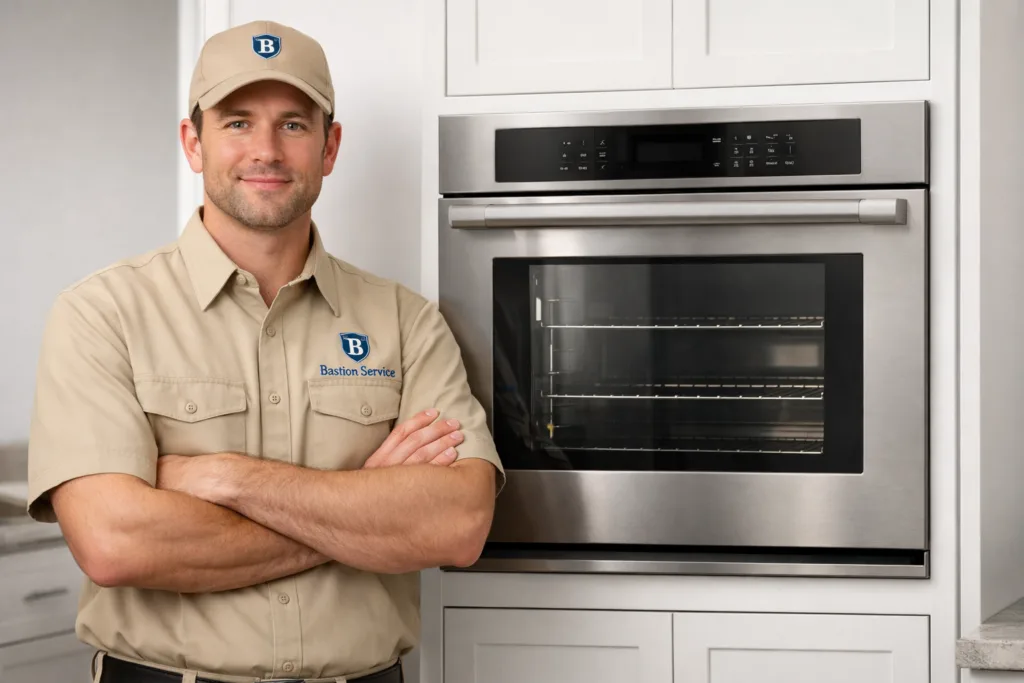
Cooking problems rarely start with a completely dead oven. More often, a Monogram wall oven begins with small warning signs such as longer preheat times, inconsistent browning, a temperature that feels off, or controls that respond intermittently. Those symptoms matter because they usually point to a specific failure path rather than a vague “oven problem.”
In Los Angeles homes, wall ovens often see frequent use for weeknight meals, batch cooking, and holiday entertaining, so even a minor performance issue can quickly become disruptive. Bastion Service helps homeowners evaluate Monogram wall oven problems based on the actual symptom pattern, the appliance condition, and whether repair is likely to restore reliable daily use.
Common Monogram wall oven problems and what they may indicate
Several different parts work together in a wall oven, including heating components, sensors, cooling systems, door hardware, and electronic controls. When one part starts failing, the oven may still appear to run, but performance usually changes first.
Not heating, heating slowly, or stopping mid-cycle
If the oven turns on but does not heat properly, the issue may involve the bake element, broil element, temperature sensor, control relay, thermal protection component, or incoming power problem. Some ovens will light up normally and still fail to produce full heat, which is why a working display does not rule out a meaningful repair issue.
Homeowners often notice this when:
- Preheating takes much longer than usual
- Food comes out undercooked even after extra time
- The oven reaches temperature and then drops off
- The cycle stops before cooking is complete
When an oven is struggling to maintain heat, continued use can put extra stress on relays, wiring, and control components.
Uneven baking or temperature that seems inaccurate
Uneven baking is often one of the earliest signs that the oven is no longer regulating heat correctly. A failing sensor, calibration drift, weak heating circuit, convection issue, or control problem can all produce similar cooking results.
You might see this as:
- One rack browning faster than another
- Cookies baking unevenly on the same tray
- Casseroles finishing on the edges but not in the center
- Dishes that suddenly need a different cook time than they used to
Because these symptoms can overlap, testing matters more than assumptions. Changing temperatures or cookware may temporarily work around the issue, but they do not solve the underlying fault.
Display problems, beeping, or controls not responding
Monogram wall ovens rely on electronic coordination between the interface, control board, sensors, and safety components. If the display flashes errors, the oven beeps unexpectedly, or buttons stop responding, the root cause is not always the panel itself.
Possible causes can include:
- Failing user interface components
- Main control board faults
- Sensor readings outside normal range
- Connection or harness problems
- Heat or moisture stress affecting electronics
Intermittent control issues are especially important to address early, because they can progress from occasional glitches to complete loss of oven function.
Door not closing, locking, or unlocking correctly
A wall oven door that does not seal properly can affect temperature stability and cooking results. In some cases, the problem is mechanical, such as worn hinges, latch issues, or alignment changes. In others, it involves a lock motor, switch, or control-related error.
This is often noticed when:
- The door looks closed but heat escapes
- The self-clean cycle will not start
- The oven remains locked after a cycle ends
- A latch or lock error appears on the display
If the problem began right after a self-clean cycle, that timing can be useful because high-heat cycles sometimes expose weak switches, latches, and electronics.
What certain symptoms can mean in everyday use
Wall oven problems are often easier to understand when translated into what happens during normal cooking.
Roasts taking longer than expected
This can point to reduced heating output, inaccurate sensor feedback, or an oven that is not actually reaching the selected temperature. The oven may appear functional while still cooking too cool overall.
Top browning too quickly while the center stays underdone
This may suggest a temperature regulation problem, uneven heat distribution, or a bake-versus-broil imbalance. It is common when one heating function is no longer cycling as intended.
Preheat tone sounds, but the oven is not really ready
Some homeowners notice that the signal says preheat is complete, but food clearly needs much longer to cook. That often indicates a sensor or control issue rather than a simple user setting problem.
Oven works sometimes, then suddenly does not
Intermittent operation can be caused by failing relays, control instability, loose connections, or heat-sensitive electrical components. These problems tend to worsen over time rather than stay occasional.
When to stop using the oven
Some issues can wait a short time for service, but others are reason to stop using the appliance until it is inspected. Continued operation may increase damage or create avoidable safety concerns.
It is best to stop using the oven if you notice:
- A breaker tripping during operation
- A burning electrical smell
- The cabinet or door becoming unusually hot
- The oven shutting off unexpectedly during cooking
- Error codes tied to overheating or door lock failure
- Temperatures that seem far higher than the selected setting
For busy households in Los Angeles, it can be tempting to keep using the oven “carefully” until it fails completely. In practice, early service often helps limit both inconvenience and repair scope.
Repair or replacement for a Monogram wall oven
Many Monogram wall oven issues are repairable, especially when the problem is limited to a sensor, heating component, fan system, latch assembly, or electronic control failure. If the oven structure is in good condition and the repair addresses the actual cause, restoration can make sense.
Replacement may be more reasonable when there are multiple major failures at once, severe interior wear, repeated electronic problems, or a repair cost that no longer aligns with the age and overall condition of the appliance.
A useful decision usually comes down to:
- Which part has actually failed
- Whether the issue is isolated or part of a larger pattern
- The condition of the oven cavity, door, and surrounding systems
- Whether the repair is expected to return stable everyday performance
What a service visit should help you understand
A worthwhile service appointment should do more than confirm that the oven is malfunctioning. It should clarify whether the problem is related to heating output, temperature feedback, power supply, control response, or door and lock operation, and how those findings affect repair options.
For homeowners dealing with Monogram Wall Oven Repair in Los Angeles, that means understanding not just what symptom showed up first, but what failed behind it and whether the next step is timely repair, monitored short-term use, or replacement planning.
When a wall oven stops being predictable, the goal is to restore confidence in daily cooking, not just get the display to turn back on. A targeted diagnosis and repair plan makes it easier to decide what is worth fixing and what should not be put off.