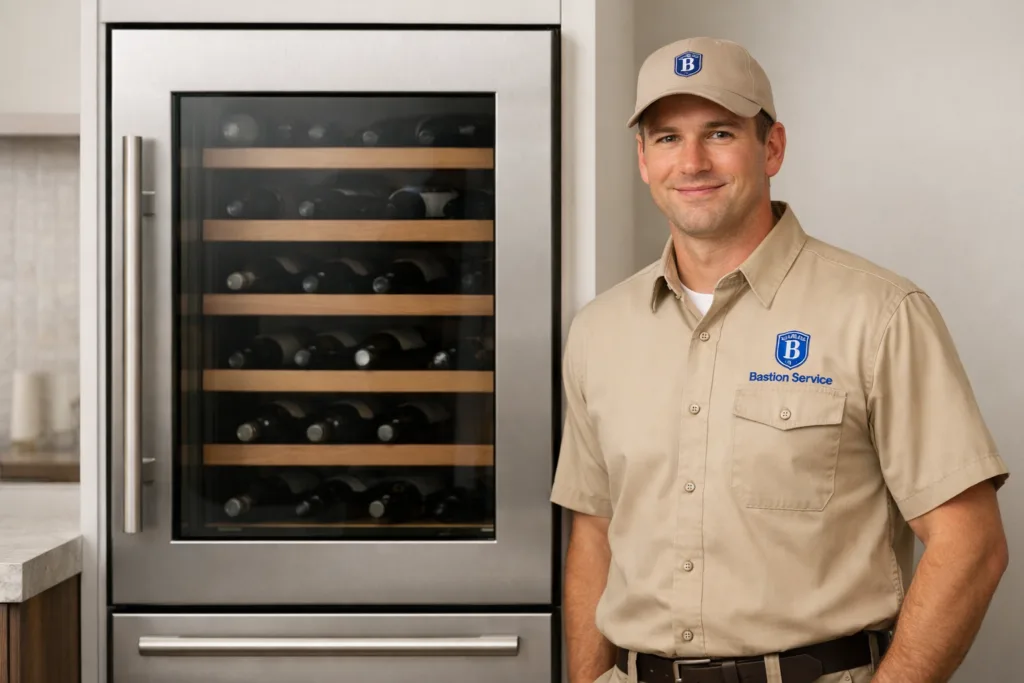
Wine coolers tend to show problems in patterns. A cabinet that is a few degrees warm, a door area that keeps sweating, or a fan noise that starts gradually can each point to a different repair path. For a Monogram unit, the most useful approach is to match the symptom to the likely system involved instead of assuming every cooling complaint means the same failure.
What common symptoms usually mean
If bottles are not staying at the set temperature, the cause may be as simple as restricted airflow or as involved as a cooling-system problem. A Monogram wine cooler may lose temperature control because of a weak evaporator fan, dirty condenser area, inaccurate sensor feedback, control failure, or trouble in the sealed system. On dual-zone models, one zone warming while the other still works can provide an important clue during diagnosis.
Noise complaints also matter. A steady low hum is expected, but louder buzzing, rattling, clicking, or a fan sound that rises and falls can suggest worn fan parts, vibration against cabinetry, loose internal components, or compressor strain. If the sound changed at the same time cooling performance changed, those symptoms should be evaluated together rather than treated as separate issues.
Moisture is another common warning sign. Interior condensation, fogging on the glass, damp shelving, or water under the unit can come from a poor door seal, drain blockage, temperature imbalance, or repeated warm air entering the cabinet. In Los Angeles homes where wine coolers are often installed into finished kitchen or bar areas, small leaks and persistent sweating can quickly become a cabinetry concern in addition to an appliance issue.
Signs your Monogram wine cooler needs service soon
Some issues can wait a short time for scheduling, but others should not be ignored. If the cabinet is warm and the unit runs almost nonstop, if it repeatedly restarts without stabilizing, or if the controls stop responding correctly, continued operation can add wear to major components. Service is also a good idea when the display is blank, the interior light behaves erratically, or the appliance trips power.
Symptoms that should not be put off
- The cabinet is noticeably warmer than the set temperature for more than a day.
- The fan becomes much louder or starts making intermittent scraping or rattling sounds.
- Condensation keeps returning even after the door is fully closed.
- The compressor seems to run constantly with little cooling improvement.
- There is a burning odor, repeated clicking, or obvious electrical irregularity.
These symptoms do not always mean a major repair, but they do mean the unit should be checked before the problem grows into a larger failure.
Temperature swings and uneven cooling
Temperature inconsistency is one of the most frustrating wine cooler complaints because the unit may appear to be working while still exposing bottles to unwanted variation. When the temperature drifts up and down, the source may be an inaccurate thermistor, a control issue, airflow loss, or a door that is not sealing tightly. In built-in installations, poor ventilation around the unit can also affect performance.
Homeowners sometimes notice that the display reading looks normal while the bottles feel warmer than expected. That difference is important. It can indicate that the control is receiving bad information, that circulation inside the cabinet is uneven, or that the cooling system is not keeping pace under load. A symptom-based inspection helps separate a simple control-side problem from a deeper refrigeration issue.
Fan noise, humming, and vibration
Monogram wine coolers rely on proper air movement to maintain stable storage conditions. When a fan motor weakens, airflow drops and noise often increases before cooling fails completely. A rattling sound may come from shelving, trim, or installation vibration, but it can also point to a fan blade issue or stress near the compressor compartment.
If the sound is only present during startup, that may suggest compressor-related strain or a mounting issue. If the sound continues whenever the unit runs, the fan system is often a strong possibility. Because noise and cooling performance are closely linked in refrigeration appliances, it helps to evaluate them together rather than replacing parts based only on sound.
Condensation, leaks, and door seal problems
Excess moisture inside a wine cooler usually means warm air is entering where it should not, or condensation is not draining properly. A worn gasket can allow humid air into the cabinet, leading to sweating, water droplets, and uneven temperatures. A drain issue can leave water collecting inside or beneath the unit. In some cases, control problems cause the cabinet to run at the wrong balance of temperature and humidity.
Door alignment should also be considered, especially on built-in models that are opened frequently in entertaining spaces. If the door does not close cleanly or the gasket no longer contacts evenly, the cooler may run longer, develop moisture problems, and struggle to hold the set temperature.
Control and display issues
When the control panel becomes unresponsive, flashes unexpected readings, or fails to hold settings, the issue may involve the user interface, sensor feedback, wiring, or the main control board. These faults can mimic cooling failures because the unit may receive the wrong commands even when the refrigeration components are still capable of working.
A display problem by itself does not always mean the cooler has stopped cooling, but it does remove a reliable way to monitor storage conditions. That matters when you are trying to protect temperature-sensitive bottles over time. Testing the control system alongside actual cabinet performance is often the best way to determine the next step.
Repair or replace: what usually makes sense
For many households, repair is worth considering when the issue is isolated to a fan motor, sensor, control component, gasket, drain problem, or another targeted failure. Built-in Monogram wine coolers are often integrated into finished spaces, so replacement may involve more than swapping appliances. Fit, trim alignment, surrounding cabinetry, and overall appearance all affect the decision.
Replacement becomes more likely when the unit has a major sealed-system failure, multiple overlapping problems, or an age-and-cost combination that no longer makes sense. The value of diagnosis is that it clarifies whether you are dealing with a manageable component repair or a larger investment question.
What homeowners in Los Angeles should watch for
In many Los Angeles residences, a wine cooler is part of the kitchen, dining area, or home bar rather than a tucked-away extra appliance. That means changes in sound, temperature, or condensation are noticed quickly, and even a minor issue can become disruptive. If your Monogram wine cooler is not performing the way it used to, paying attention to the exact symptom pattern can help determine whether the problem is likely airflow-related, control-related, or part of the cooling system itself.
The goal is not to guess at parts. It is to identify why this unit is warming, sweating, or making noise and decide whether repair is the right next move for the appliance and the space around it.