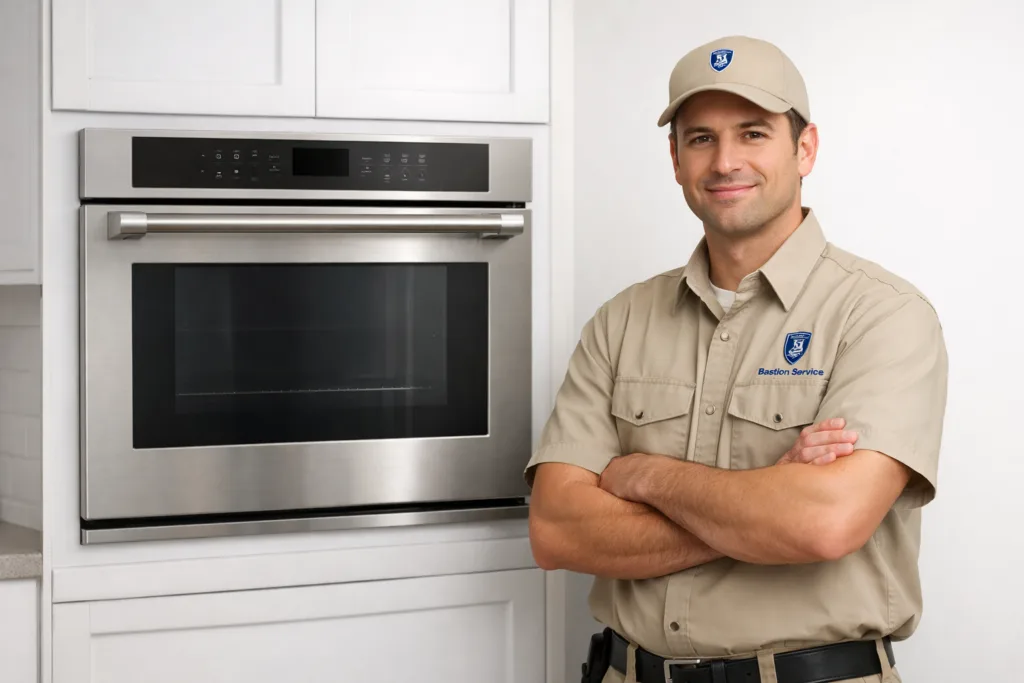
Wall ovens tend to give warning signs before they fail completely. You might notice longer preheat times, batches that come out uneven, a display that responds inconsistently, or a unit that suddenly stops midway through cooking. With a built-in KitchenAid wall oven, those symptoms usually point to a specific heating, sensing, control, or power problem that should be tested before any parts are replaced.
Common KitchenAid wall oven symptoms in Los Angeles homes
Most service calls start with one main complaint, but the underlying cause is not always obvious from the symptom alone. A wall oven can have one failed part that creates several different cooking problems, or several smaller issues that show up as poor performance over time.
Not heating at all
If the oven will not heat, the issue may involve the bake element, broil circuit, thermal protection component, electronic control, wiring, or incoming power. On some units, the display may appear normal even though the oven is not producing heat. On others, the oven may start a cycle but never warm up enough to cook.
Slow preheating
Slow preheat often points to a weak heating circuit, a sensor problem, a relay issue, or a control fault. Homeowners sometimes first notice this when meals take longer than expected or the oven says it is preheated before the cavity is actually ready.
Uneven baking or temperature swings
Cookies browning unevenly, casseroles cooking inconsistently, or food coming out overdone on one rack and underdone on another can suggest sensor drift, airflow problems, partial element failure, convection component trouble, or heat loss around the door seal. These issues can be subtle at first but usually become more noticeable with regular use.
Display or touch controls not working correctly
A blank screen, unresponsive keypad, intermittent beeping, or controls that reset during a cycle may indicate an interface problem, control board failure, wiring issue, or power supply fault. Because a wall oven is built into cabinetry and often hardwired, electrical symptoms should be checked carefully rather than treated as a simple reset issue.
Error codes and self-clean problems
Fault codes often appear when the oven detects a problem with temperature sensing, door locking, fan operation, or electronic communication. Trouble after a self-clean cycle is also common, since prolonged high heat can stress controls, wiring connections, and latch components.
What these symptoms often mean
Some wall oven problems sound straightforward but can come from different sources. For example, an oven that is not reaching temperature could have a bad sensor, a failing relay, a weak element, or a control issue. An oven that shuts off during baking could be dealing with overheating protection, a loose electrical connection, or a board problem.
That is why a symptom-based approach matters. Instead of assuming every no-heat complaint needs an element or every temperature complaint needs calibration, the better path is to verify which system is failing and whether other components have been affected.
When continued use can make the problem worse
Some issues are inconvenient but manageable for a short time. Others should be addressed quickly because they can lead to larger failures or safety concerns.
- Breaker trips when the oven starts or during preheat
- Burning odor, sparking, or signs of heat damage
- Repeated error codes that return after clearing
- Oven shutting off mid-cycle
- Door lock problems during or after self-clean
- Major temperature inaccuracy that affects cooking results
If any of these are happening, it is usually better to stop using the oven until the cause is identified. A heating or control problem that starts small can sometimes damage additional parts if the unit keeps running under stress.
Why built-in wall ovens need careful diagnosis
A built-in appliance is different from a freestanding range in both access and repair planning. Cabinet fit, ventilation space, mounting, and electrical configuration all affect how service is performed. In Los Angeles homes, where kitchen layouts vary widely, those installation details can influence both the diagnosis and the repair path.
That also matters when a problem looks larger than it is. A wall oven that appears fully dead may be dealing with a specific control or power issue, while one that still turns on may have a hidden heating fault that makes cooking unreliable. Testing the actual failed system helps avoid unnecessary part swapping and gives the homeowner a better idea of whether repair is practical.
Repair or replacement: what usually drives the decision
Replacement is not always the best first move just because a wall oven is acting up. Many KitchenAid wall oven problems are repairable when the issue is limited to a sensor, heating component, fan motor, latch assembly, user interface, or control-related part. When the fault is isolated and the oven is otherwise in good condition, repair often makes sense.
Replacement becomes more likely when there are multiple major failures, severe internal wear, repeated electronic problems, or repair costs that do not line up with the condition of the unit. For a built-in model, homeowners also have to consider trim fit, cabinet opening size, and whether replacing the oven could create additional installation work.
What useful wall oven service should address
A good repair process should do more than restore power to the display. It should confirm whether the oven is heating correctly, sensing temperature accurately, cycling normally, and operating safely through the full cooking process. That includes looking at the parts directly related to the complaint as well as any connected systems that may have been affected.
For household use, the real goal is consistent daily performance. That means:
- Preheating within a normal time range
- Holding temperature more consistently
- Producing even cooking results
- Responding properly to control inputs
- Running without shutdowns, fault codes, or electrical symptoms
Choosing KitchenAid wall oven repair in Los Angeles
When a KitchenAid wall oven starts showing repeated heating, control, or temperature problems, the smartest next step is to base the repair decision on the exact symptom pattern and the condition of the appliance. That gives homeowners a more realistic picture of whether the issue is a targeted fix or part of a larger failure.
For Los Angeles households that rely on a built-in oven for everyday cooking, timely service can prevent a frustrating performance issue from turning into a full loss of use. When the problem is identified correctly, the repair plan is usually much clearer and easier to evaluate.