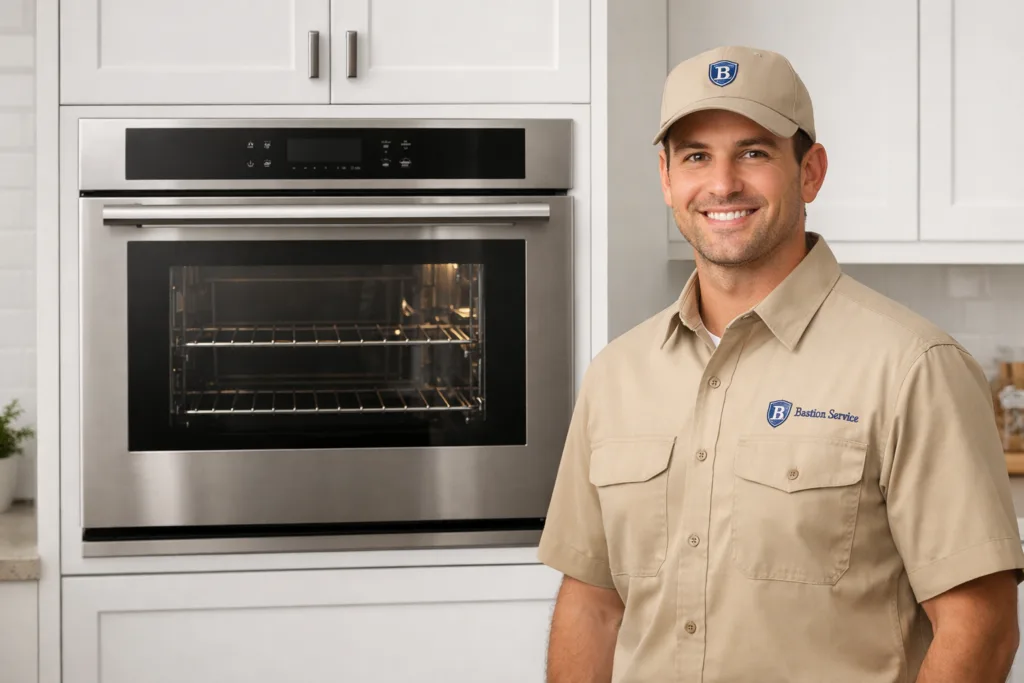
Performance problems in a Dacor wall oven usually show up in everyday cooking before the appliance fails completely. You may notice cookies baking unevenly, casseroles taking much longer than usual, or a preheat cycle that seems to stall without ever reaching the set temperature. In other cases, the display works normally while the oven cavity stays cool, which often points to a failed heating component, a sensor problem, or a control issue rather than a simple settings mistake.
Common Dacor wall oven symptoms and what they can mean
The same complaint can come from several different faults, so symptom patterns matter. Paying attention to how the oven behaves during bake, broil, and preheat helps narrow the source of the problem.
Not heating or only partially heating
If the oven powers on but food remains undercooked, the problem may involve the bake element, broil element, temperature sensor, relay, or electronic control. Some units warm slightly but never get close to the selected temperature. Others may heat during broil but not during bake, which can help identify which part of the heating circuit is failing.
Uneven baking and temperature fluctuations
When one side of a dish browns faster than the other, or identical recipes turn out differently from one use to the next, the oven may be cycling improperly. A weak sensor, calibration problem, failing control board, or airflow issue can all create inconsistent temperatures. These problems are especially frustrating in a wall oven because they often look random until the appliance is tested under normal cooking conditions.
Slow preheat
Slow preheat is a common complaint in household ovens and should not be ignored when it becomes noticeably worse. A Dacor wall oven that once heated normally but now takes far longer to reach temperature may have an element that is weakening, a sensor that is reading inaccurately, or a control system that is not regulating heat correctly. Even when the oven eventually reaches temperature, the overall cooking result can still suffer.
Error codes, shutdowns, and control issues
Fault codes, an unresponsive touchpad, intermittent power loss, or a blank display can point to control panel problems, wiring faults, terminal issues, or power supply trouble. If the oven shuts off during a cooking cycle or needs to be reset repeatedly, the failure may be electrical rather than mechanical. Because wall ovens operate on high voltage, these issues should be evaluated carefully.
Door and latch problems
A door that will not close tightly, will not unlock, or triggers problems after a self-clean cycle may have a latch assembly fault, switch problem, warped component, or heat-related control damage. If the door is not sealing correctly, cooking performance can drop quickly and repeated use may place more stress on surrounding parts.
Why accurate diagnosis matters
Dacor wall ovens use multiple systems that work together to heat, regulate temperature, and manage safety functions. A symptom that appears straightforward on the surface may have more than one possible cause. For example, poor temperature control may come from the sensor itself, but it may also come from a control board that is interpreting sensor readings incorrectly. Replacing parts based on guesswork can increase cost without resolving the real failure.
That is particularly important in Los Angeles homes, where built-in appliances are often integrated tightly into cabinetry. Access can take more time than with a freestanding range, and it helps to determine the likely cause before any repair path is chosen. One careful inspection can also clarify whether the problem is isolated to a repairable component or whether broader age-related wear is beginning to affect the appliance.
Signs you should stop using the oven
Some issues can wait a short time for service, but others call for immediate caution. Stop using the wall oven if you notice any of the following:
- Burning smells that are not related to leftover food residue
- Sparking or visible electrical arcing
- Repeated breaker trips
- The oven shutting off mid-cycle again and again
- A door that will not latch or close properly during operation
- Excessive heat affecting nearby cabinetry or trim
These symptoms may indicate an electrical or overheating problem that should be inspected before the appliance is used again.
Repair or replace?
Many Dacor wall oven problems are worth repairing when the issue is limited to a defined part such as an element, sensor, cooling fan, latch component, or other isolated failure. Repair also tends to make sense when the oven has otherwise been operating reliably and the condition of the appliance supports continued use.
Replacement becomes more reasonable when the oven has multiple active problems, repeated control-related failures, or significant wear that makes additional repairs likely. With a built-in wall oven, the decision is also influenced by kitchen fit and installation factors. Cabinet opening size, electrical compatibility, and finish matching can all affect the total replacement cost in ways homeowners do not always expect at first.
Helpful details to note before service
If your wall oven is acting up, a few observations can make troubleshooting more efficient. Try to note:
- Whether the issue happens during preheat, mid-cycle, or after the oven has been on for a while
- Whether bake and broil behave differently
- Any error code shown on the display
- Whether the problem started after a power outage or self-clean cycle
- Whether the failure is constant or intermittent
- If the oven appears to reach temperature but cooking results are still off
These details can help connect the complaint to the most likely heating, sensor, latch, or control problem.
Built-in oven service with a household focus
A wall oven issue affects more than a single meal. It changes how a household cooks day to day, especially when baking, roasting, or preparing family meals depends on stable temperature and predictable performance. For Los Angeles homeowners, Dacor wall oven repair is most useful when the service approach stays focused on the exact symptom pattern, the condition of the appliance, and the most sensible next step for the kitchen as a whole.