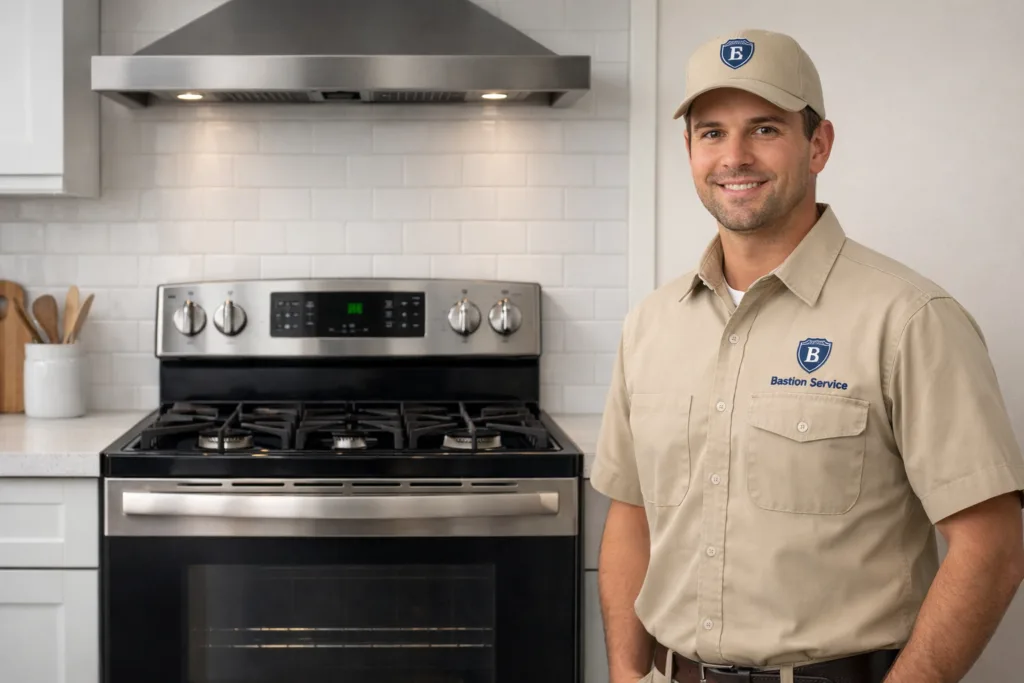
Common GE range symptoms and what they can mean

GE ranges can develop problems in the cooktop, oven, ignition system, or electronic controls, and the same appliance may show more than one symptom at once. The most useful starting point is to match what you are seeing in daily use with the system most likely involved.
Surface burners not heating properly
If an electric surface element stays cool, heats only partway, or cycles far too hot, the issue may involve the burner element, receptacle, switch, wiring, or control circuit. Homeowners often first notice this through slower boil times, difficulty maintaining a low simmer, or one burner behaving differently from the others.
When a burner works intermittently, that usually points away from simple user error and more toward a worn connection or failing control component. If the burner overheats or does not respond normally to the setting, stop using that position until it is checked.
Gas burner clicking or delayed ignition
On gas models, repeated clicking, delayed lighting, uneven flame, or a burner that lights only after several tries can come from buildup around the burner head, moisture near the igniter, an electrode issue, or a fault in the ignition system. In some cases the burner will eventually light, but that does not mean the condition should be ignored.
Signs that the problem needs prompt attention include:
- Clicking that continues after ignition
- A burner that lights with a “whoosh” after delay
- Flame that looks weak, uneven, or unstable
- A burner that works one day and fails the next
If there is a strong or persistent gas odor, stop using the range and address safety first.
Oven not heating, heating slowly, or baking unevenly
When the oven preheats too slowly, does not reach the set temperature, or cooks unevenly from rack to rack, the fault may involve the bake element, broil element, igniter, temperature sensor, control board, or convection-related airflow. These issues often appear gradually. Meals may start taking longer, cookies may brown unevenly, or casseroles may come out done on top but cool in the center.
For many households, this is the most disruptive type of range problem because it affects everyday cooking without making the appliance seem completely broken. That can lead to weeks of workarounds before service is scheduled.
Display, keypad, or control failures
If the display flashes, the keypad does not respond, settings change on their own, or the oven will not start a cycle, the problem may be electronic rather than mechanical. A control complaint can also overlap with a heating complaint, which is why symptom tracking matters. For example, an oven that will not bake may have a failed heating component, but it may also be receiving bad instructions from the control.
What Los Angeles homeowners often notice before complete failure
Range problems rarely begin with total shutdown. More often, small signs show up first during regular meal prep. A burner may need to be turned higher than usual. The oven may need extra preheat time. A gas burner may click more often on humid mornings. Controls may work normally for a week, then freeze during one cycle.
Those details are useful because they help separate a one-function problem from a broader appliance issue. Before scheduling service, it helps to note:
- Whether the symptom happens every time or only occasionally
- Whether the problem affects the cooktop, the oven, or both
- Whether it started suddenly or got worse over time
- Whether any error code appears on the display
- Whether the issue began after a power interruption or heavy holiday cooking use
In Los Angeles homes where the kitchen sees frequent daily use, even a “minor” range problem can quickly become a routine disruption. Catching the pattern early often makes the repair path more straightforward.
Symptoms that should not be ignored
Some range issues are inconvenient. Others can affect safe operation and should move to the top of the list.
Stop using the affected function if you notice:
- A burner that gets much hotter than the selected setting
- An oven that overheats or burns food unusually fast
- Sparking, arcing, or signs of melted wiring
- Breaker trips tied to range operation
- Controls that turn functions on or off unpredictably
- Ignition problems paired with gas odor
Even when the appliance still “sort of works,” inconsistent operation can lead to cooking failures, additional wear, or a larger repair if the original fault spreads to related parts.
How a repair is usually narrowed down
Because a GE range combines multiple systems in one appliance, diagnosis is less about guessing the most common part and more about matching the symptom to the correct circuit or component. A burner issue is approached differently from an oven temperature complaint, and a control failure is approached differently from an ignition problem.
A thorough evaluation typically focuses on:
- Which function has failed
- Whether the failure is constant or intermittent
- How the appliance responds when a cycle is started
- Whether related components are working normally
- Whether the unit shows signs of wear beyond the main complaint
This matters because similar symptoms can come from very different causes. An oven that will not heat can point to an igniter on one model, a bake element on another, or a control issue on a third. Replacing parts based on guesswork is often what turns a manageable repair into a frustrating one.
Repair or replace: what usually makes sense
Many GE range problems are worth repairing when the issue is isolated and the rest of the appliance is in good working condition. Common examples include a single failed burner component, an igniter problem, a temperature sensor fault, or a switch or control issue limited to one function.
Replacement becomes more reasonable when several major problems are appearing together, the range has developed reliability issues across both oven and cooktop functions, or the cost of restoring full operation starts approaching the value of the appliance. For households trying to make the right call, the question is usually not just whether the unit can be fixed, but whether the repair is likely to restore normal daily use without a chain of follow-up problems.
What good GE range service should help you understand
By the end of a service visit, a homeowner should have a clear picture of what failed, what is required to restore the range, and whether the repair is sensible for the age and condition of the appliance. That is especially important when the symptom seems simple but the cause is not.
For GE range repair in Los Angeles, the most helpful outcome is not just getting the appliance running again for the moment. It is understanding whether the problem is isolated, whether continued use affected anything else, and what to expect once the repair is completed. That makes it easier to get back to reliable cooking without the uncertainty that often comes with recurring burner, ignition, or oven temperature issues.