Common GE washer problems homeowners notice

Washer trouble often starts with one change in performance: clothes come out wetter than usual, a cycle takes too long, or the machine sounds different during spin. With GE washers, the visible symptom does not always point to a single cause. A drain problem, lock issue, sensor fault, or worn mechanical part can all show up as a cycle failure, which is why symptom-based testing matters.
For households in Los Angeles, washer downtime can quickly disrupt the week. The most useful approach is to pay attention to exactly when the problem happens: during fill, wash, drain, spin, or at the very end of the cycle. That timing often helps narrow the likely source of the failure.
Washer not draining
If water remains in the tub after the cycle, the issue may involve a blocked drain path, a weak or failed pump, control problems, or a condition that prevents the washer from entering a proper spin. In some cases, the machine pauses because it detects an out-of-balance load or a door or lid condition that is not reading correctly.
Signs that point to a drain-related issue include:
- Standing water left in the basket
- A humming sound without full draining
- The cycle stopping before spin finishes
- Clothes staying unusually heavy and wet
Running repeated loads in this condition can put extra stress on the pump and drive system, so it is best not to force continued use.
Washer not spinning properly
A GE washer that will not spin at all, spins slowly, or leaves laundry soaked may have trouble with the lid lock or door lock assembly, motor operation, suspension components, load sensing, or the drain system. Since many washers will not reach full spin unless water drains correctly, a spin complaint is not always a direct drive failure.
What homeowners often notice first is not “no spin,” but a change in results. Towels stay damp, bulky items collect on one side of the basket, or the cycle seems to end without the usual high-speed spin sound.
Leaks under or around the machine
Water on the floor can come from more than one location. Fill hoses, internal hoses, the drain system, door boot tears on front-load models, and overfill conditions are all possible sources. Some leaks only appear during fill, while others show up during drain and spin when water is moving quickly through the system.
A few clues can help identify the pattern:
- Water appears at the start of the cycle: possible inlet or fill-related issue
- Water appears during agitation or wash: possible internal hose or tub-area leak
- Water appears during drain or spin: possible pump, drain hose, or high-flow leak
- Moisture near the door on front-load units: possible boot or seal problem
Even a small recurring leak should be addressed early to help prevent damage to flooring and nearby walls.
Washer won’t start or stops mid-cycle
When a washer does not respond to the start button, the problem may involve power supply, user interface faults, a door or lid lock failure, or a control issue. If it starts and then shuts down, the cause may be related to draining, motor protection, sensing errors, or communication faults between components.
Intermittent issues are especially frustrating because the washer may appear to work normally for a load or two before failing again. That pattern usually points to a part or connection that is weakening rather than a one-time glitch.
Shaking, banging, or unusual noise
Loud thumping during spin is often linked to imbalance, suspension wear, or a problem with how the washer is stabilizing the load. Grinding, scraping, or rumbling can suggest more serious mechanical wear. If the machine is moving across the floor, stopping mid-spin, or repeatedly trying to rebalance itself, there may be a deeper issue than an overloaded basket.
Noises that deserve attention include:
- Grinding during spin
- Repeated banging against the cabinet
- Rumbling that grows louder over time
- Buzzing or humming with little movement
Why the same symptom can have different causes
One of the most common repair mistakes is assuming the first visible symptom tells the whole story. A washer that will not spin may actually have a draining problem. A leak that seems to come from the front may have started farther back and traveled underneath the machine. A unit that appears dead may have power, but cannot begin because the door or lid is not locking properly.
Because GE washers rely on multiple systems working in sequence, one failed part can interrupt the entire cycle. Identifying where the sequence breaks down is often the key to an efficient repair.
Signs the washer should not keep running
Some washer problems are inconvenient but manageable for a short time. Others should be treated as stop-use conditions. It is wise to stop using the machine if you notice any of the following:
- Active leaking during any part of the cycle
- Burning smell or signs of overheating
- Harsh grinding or metal-on-metal noise
- Repeated failure to drain with standing water left inside
- Violent shaking or impact during spin
- Tripped breakers or electrical irregularities when the washer runs
Continuing to use the washer in these conditions can turn a single failed part into broader damage affecting the motor, controls, suspension, or surrounding laundry area.
When service is worth scheduling promptly
It is usually time to schedule GE washer repair in Los Angeles when the machine is no longer completing cycles reliably, the same symptom keeps returning, or the washer is showing signs of water, electrical, or mechanical stress. Early service is often the most cost-effective when a problem is still limited to one system.
Prompt attention is especially helpful when:
- The washer has begun leaving clothes wet after every load
- Cycle times have become unpredictable
- The machine stops at the same point repeatedly
- You hear new sounds during drain or spin
- Water appears under the unit more than once
Repair or replace?
The right decision depends on the washer’s age, overall condition, the type of failure, and whether the issue is isolated or part of broader wear. Many repairs make sense when the problem is limited to a pump, valve, lock assembly, hose, suspension part, or another targeted component. Replacement becomes a more serious consideration when the washer has multiple developing issues, significant cabinet or tub wear, or a major failure combined with declining overall performance.
A good decision usually comes after the fault is identified rather than before. Two washers with the same symptom can have very different repair outlooks depending on what testing shows.
What homeowners can observe before service
Before a service visit, it helps to note a few details about the washer’s behavior. This does not replace diagnosis, but it can make the problem easier to isolate:
- Does the issue happen on every cycle or only sometimes?
- Does the failure occur during fill, wash, drain, or spin?
- Are there unusual sounds, odors, or vibration?
- Is the problem worse with towels, bedding, or large loads?
- Is there visible water under the front, back, or side of the machine?
Details like these can help separate a balance issue from a drain problem, or a control interruption from a purely mechanical fault.
What a useful washer service visit should accomplish
A worthwhile service visit should do more than get the machine through one more load. It should identify the failed part or system, check whether related components have been affected, and explain whether the issue appears isolated or part of a larger wear pattern. For homeowners, that makes it easier to decide on next steps with confidence instead of guessing based on symptoms alone.
When a GE washer begins leaking, shaking, stopping mid-cycle, or leaving laundry too wet, the most helpful outcome is a repair plan based on what the machine is actually doing, not just what the symptom seems to suggest at first glance.
Recent field repair note

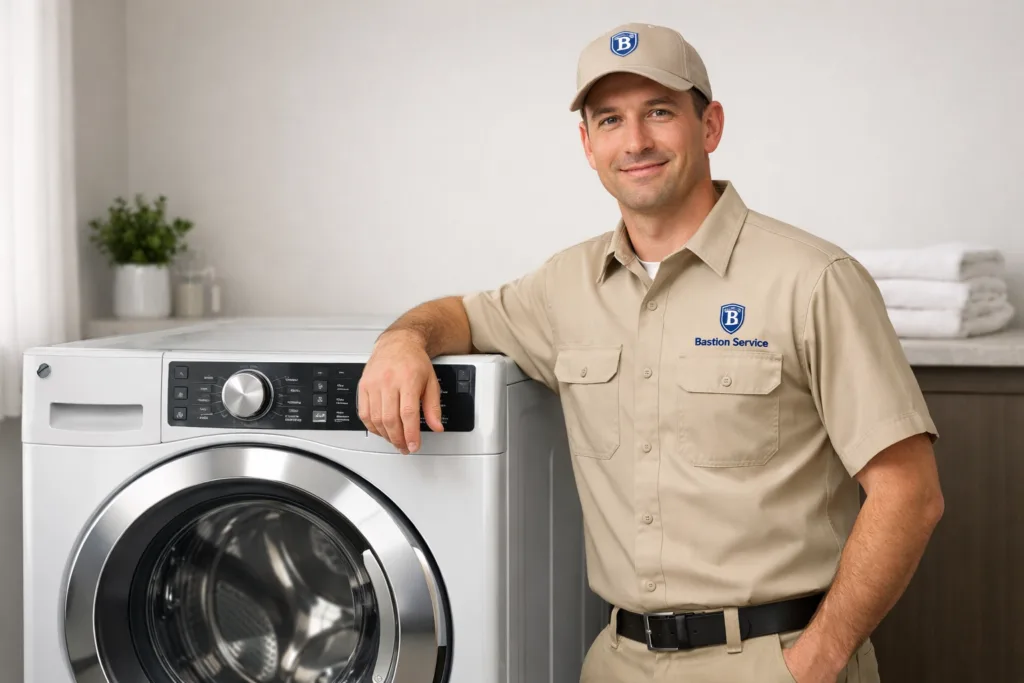
Bastion Service completed a washer repair in Los Angeles on a GE unit that was not draining properly. During the visit, the technician inspected the machine and confirmed that the drain pump needed to be replaced. The failed pump was preventing normal water removal and affecting the washer’s ability to complete cycles as intended.
After identifying the issue, the technician replaced the drain pump and restored the washer’s drainage function. This type of repair is important when a washer holds water after a cycle or stops operating because it cannot drain. With the new pump installed, the appliance was returned to normal operation and is now able to move water out of the tub as designed.
GE washers are common in many Los Angeles homes, and drainage problems can happen from wear over time, frequent use, or buildup that affects pump performance. Prompt service helps prevent further interruption to laundry routines and can reduce the risk of additional strain on related components.
Bastion Service provided the completed repair on site and verified that the washer was working properly after the pump replacement. Customers in Los Angeles can rely on timely appliance service when a washer stops draining or begins to show signs of pump failure.