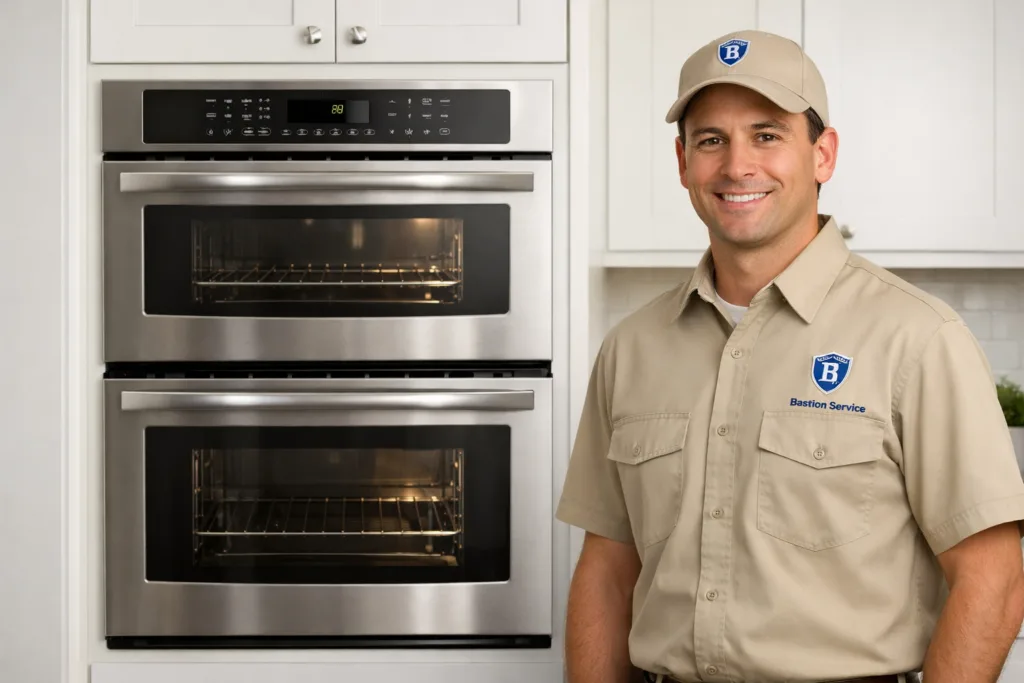
Cooking problems often show up before a GE oven fails completely. You may notice longer bake times, food that browns too fast on one side, a cavity that never seems to reach the set temperature, or controls that behave inconsistently. Those patterns matter because two ovens can appear to have the same issue while needing very different repairs.
In Los Angeles homes where the oven is part of daily meal prep, even a “still working” unit can become disruptive fast. A model that preheats slowly or cycles poorly can throw off weeknight dinners, batch baking, and holiday cooking just as much as an oven that stops heating altogether.
Symptoms that usually point to GE oven trouble
Oven will not heat
If the display comes on but the oven does not heat, the likely causes depend on the type of unit. Electric models may have a failed bake element, wiring issue, sensor problem, or control fault. Gas models often show this symptom when the igniter weakens and can no longer draw enough current to open the gas valve properly. In many homes, the cooktop may still work while the oven does not, which can make the problem seem more confusing than it is.
Slow preheat
When preheat starts taking much longer than it used to, the oven may still be producing heat, just not enough of it or not in the right way. Weak igniters, tired elements, temperature sensor drift, and control issues are all common possibilities. This often shows up gradually, with recipes that once finished on time suddenly needing an extra ten to twenty minutes.
Uneven baking or roasting
Uneven cooking is one of the most frustrating oven complaints because the appliance appears functional while results get worse. Cookies may brown heavily at the back, casseroles may stay cool in the center, or one rack may cook far faster than another. Causes can include a heating problem, poor temperature regulation, or an issue affecting airflow and heat distribution inside the cavity.
Temperature swings
Some cycling is normal, but large swings are not. If the oven overshoots the set temperature, cools too far, or struggles to recover after the door is opened, food quality can suffer. A bad sensor, failing control board, or weak heating component may be behind the instability. Homeowners usually notice this when familiar recipes start coming out underdone one day and overdone the next.
Control panel or display problems
Unresponsive buttons, a flickering display, random beeping, or error codes can indicate trouble with the user interface, the electronic control, or communication between components. If settings do not register consistently or the oven turns off during a cycle, the issue is more than an annoyance. It can interfere with safe and reliable operation.
Door and latch issues
A door that does not close tightly can let heat escape and make the oven run longer than it should. Misaligned hinges, worn gaskets, and latch problems may also affect self-clean operation or cause lock errors. If trouble started after a self-clean cycle, heat stress on nearby parts is a common possibility.
What different symptom patterns can mean
Looking at the full pattern of behavior helps narrow the likely fault much faster than focusing on one isolated complaint.
- Broiler works, but bake does not: often points toward the bake circuit, bake element, igniter, or related control path.
- Oven heats, but never reaches the set temperature: may suggest a weak igniter, failing element, temperature sensor issue, or calibration problem.
- Unit trips power during use: can indicate an electrical short, grounded element, wiring fault, or control problem.
- Error codes appear after intermittent performance issues: often means the oven has been detecting a component or communication problem for some time.
- Problems began after self-clean: high heat may have affected the door lock assembly, thermal protection components, wiring, or control board.
This is why symptom-based testing matters. Replacing parts based only on an online guess can leave the original problem unresolved.
When continued use is a bad idea
Some faults mainly affect cooking results. Others can create safety concerns or lead to a larger breakdown. Stop using the oven and have it checked if you notice any of the following:
- Gas odor during oven operation
- Sparking or visible arcing
- Burning smells that persist
- Repeated breaker trips
- Overheating or scorched food at normal settings
- A door that will not latch or stay closed properly
- An oven that shuts off unpredictably in the middle of cooking
Even without an obvious hazard, delaying service can make a manageable repair turn into a more expensive one. A weak igniter, failing sensor, or unstable control can put extra strain on other components over time.
Repair decisions homeowners commonly weigh
Most household decisions come down to reliability, cost, and timing. If the oven has otherwise been dependable and the problem is tied to a single repairable component, fixing it is often the sensible path. That is especially true when the issue is caught early and has not caused secondary damage.
Replacement becomes more likely when the oven has multiple problems at once, repeated electronic failures, or a repair cost that does not make sense relative to the appliance’s overall condition. For many Los Angeles homeowners, the real question is not simply whether the oven turns on, but whether it can be restored to stable daily performance.
How a focused service visit helps
Good service should do more than name a part. It should connect the complaint you are seeing at home with the actual failure inside the oven. That includes checking whether the heat source is performing correctly, whether temperature feedback is accurate, whether controls are responding properly, and whether any door or latch issue is contributing to the problem.
That approach is especially useful with GE ovens because symptoms such as slow preheat, uneven baking, and no-heat conditions can overlap. A proper diagnosis helps answer the questions homeowners actually care about:
- What is causing the cooking problem?
- Is the oven safe to keep using right now?
- Is the issue likely limited to one repair?
- Will the fix restore normal performance for everyday cooking?
Practical signs it is time to schedule GE oven repair
If you are resetting the control repeatedly, rotating pans to compensate for hot spots, adding extra time to every recipe, or avoiding the oven altogether because results are unpredictable, the appliance is already affecting daily life. Those are strong signs the problem is no longer minor wear or normal variation.
For GE oven repair in Los Angeles, the most helpful next step is service built around the exact symptom pattern your oven is showing now. Whether the issue involves no heat, poor temperature control, slow preheating, or erratic controls, identifying the fault correctly is what leads to a repair that makes sense for your home.