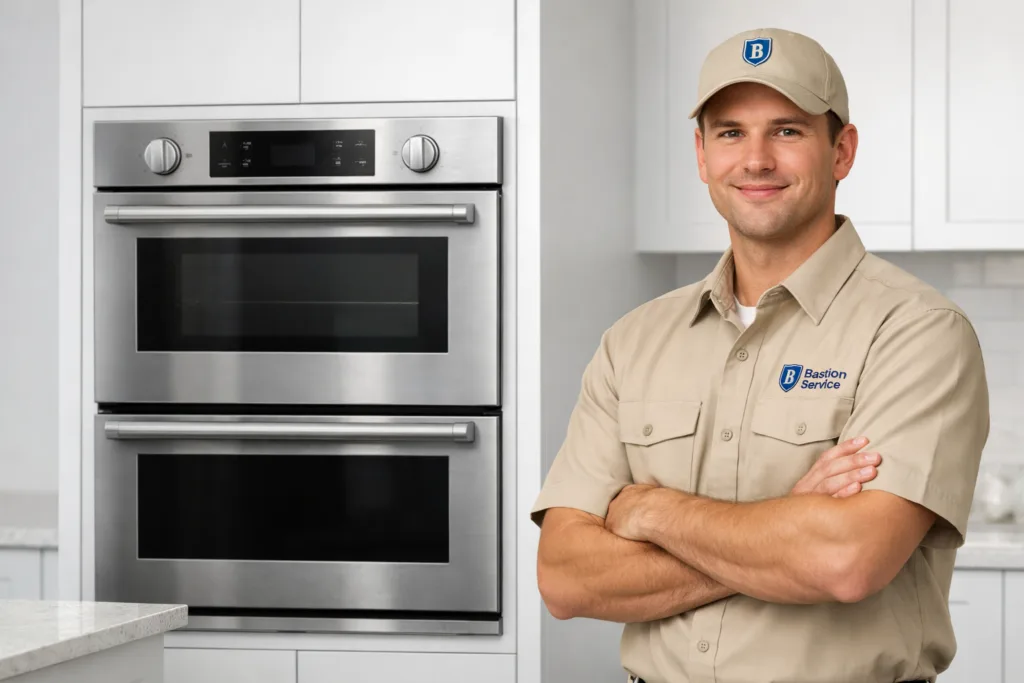
Wall oven problems usually show up first in everyday cooking: cookies browning unevenly, casseroles needing extra time, or a preheat that seems to drag on forever. With a Thermador unit, those symptoms can trace back to heating components, sensors, door-switch feedback, controls, or electrical faults, so the pattern matters as much as the complaint itself.
Common Thermador wall oven symptoms in Inglewood homes
Some issues stop cooking altogether, while others create inconsistent results that become more noticeable over time. Paying attention to how the oven behaves can help narrow the repair path.
Not heating at all
If the oven powers on but never gets hot, the problem may involve a failed bake element, a broil-related heating issue, a sensor fault, a relay on the control board, or a power supply problem. In a built-in wall oven, it is possible for the display and lights to work even when the heating circuit is not operating correctly.
This type of failure is usually obvious because preheat does not complete and food remains undercooked. If the oven is fully unresponsive or repeatedly trips power, it is best to stop using it until the cause is identified.
Slow preheat
A slow preheat often feels like a minor inconvenience at first, but it can point to a weakening component rather than a simple calibration issue. When one part of the heating system is underperforming, the oven may still eventually reach temperature, but it takes much longer than normal and struggles to recover heat after the door is opened.
Homeowners often notice this symptom before a complete heating failure. If preheat times keep getting longer, the oven is usually signaling that something is beginning to fail.
Uneven baking or roasting
When one rack cooks faster than another, baked goods come out browned on one side, or roasting results vary from one use to the next, the issue may involve temperature sensing, convection airflow, heating balance, or control accuracy. This can be frustrating because the oven still works, just not consistently enough to trust for regular meals or baking.
In many cases, uneven performance is more noticeable with delicate foods like pastries, cakes, and casseroles, where small temperature swings affect the final result.
Temperature running too hot or too cool
If the displayed setting does not match actual oven performance, the cause may be a sensor reading problem, a control issue, or a heating circuit that is not cycling correctly. An oven that runs too cool can leave food underdone, while one that overheats may burn dishes long before the timer ends.
Temperature complaints are especially important to address when the issue appears suddenly or worsens over a short period, since that often suggests a part is failing rather than normal variation.
Error codes, beeping, or control panel trouble
Modern Thermador wall ovens depend on electronic controls, touch panels, and sensor feedback. When those systems do not communicate properly, the result may be flashing fault codes, nonstop beeping, a blank display, or buttons that respond only part of the time.
Not every code points to the control panel itself. A sensor fault, latch problem, wiring issue, or intermittent power problem can all create control-related symptoms, which is why testing matters before replacing expensive parts.
Door not closing, locking, or unlocking properly
Door and latch problems can affect both normal cooking and self-clean functions. If the door does not seal correctly, heat can escape and cooking performance can drop. If the latch sticks or the oven stays locked, the problem may involve hinges, the latch motor, switch feedback, or the control system that monitors the lock position.
These issues sometimes show up after a self-clean cycle because high heat can stress already weakened parts.
Shutting off during cooking
An oven that turns off in the middle of a cycle may be dealing with overheating protection, failing controls, unstable electrical connections, or a sensor problem. This is more than a convenience issue, since intermittent shutdowns can make cooking unpredictable and may point to a condition that worsens with continued use.
Why symptom patterns matter
Two ovens can seem to have the same problem while needing very different repairs. For example, “not heating” could mean a failed element, a bad sensor, a relay that is not closing, damaged wiring, or an incoming power issue. “Uneven baking” could be caused by airflow trouble, calibration drift, or a heating circuit that cycles incorrectly.
That is why the most useful service approach starts with the way the problem appears in real use. Whether the issue happens only during preheat, only on bake, after the oven has been running for a while, or only with certain modes can help separate one failure from another.
When to stop using the oven
Some wall oven problems are mainly performance issues, but others should be treated as immediate service concerns. It is wise to stop using the appliance if you notice any of the following:
- The oven will not regulate temperature and begins overheating
- Repeated fault codes interrupt normal cooking
- The unit shuts off mid-cycle
- The door will not lock or unlock correctly
- There is a burning smell, visible scorching, or signs of electrical damage
- The appliance trips the breaker or loses power during operation
Continuing to use a wall oven under these conditions can lead to additional part failures and, in some cases, create avoidable safety concerns in the kitchen.
Repair versus replacement
For many Inglewood homeowners, the decision comes down to the failed component, the oven’s overall condition, and whether the problem appears isolated or part of a larger pattern. A repair often makes sense when the issue is limited to a specific heating, sensing, or control-related part and the rest of the appliance is in solid condition.
Replacement becomes more worth considering when there are recurring electronic faults, multiple systems failing at once, or repair costs that approach the value of keeping the current unit in reliable service. Built-in wall ovens also bring cabinet-fit and installation considerations, so replacement is not always the easier choice.
Helpful details to note before service
A few observations from normal use can make diagnosis more efficient. It helps to note:
- Whether the problem affects bake, broil, convection, or all modes
- Whether the oven fails during preheat or later in the cooking cycle
- If the display shows a code every time or only occasionally
- Whether the issue started suddenly or became worse gradually
- If the oven temperature seems consistently high or consistently low
- Whether the problem appeared after a self-clean cycle or power interruption
Even simple details like longer preheat times, inconsistent browning, or a door that no longer closes firmly can help reveal whether the problem is mechanical, electrical, or control-related.
What makes built-in wall oven repair different
Wall ovens are more complex to evaluate than many freestanding appliances because access is tighter and the appliance is integrated into surrounding cabinetry. That matters when symptoms appear to be electronic or intermittent, since wiring, cooling, and component access can all affect the repair path.
It also means the best next step is not always obvious from the surface symptom alone. A dependable repair plan should consider the full condition of the oven, not just the first problem the household noticed.
Choosing the right next step
If your Thermador wall oven is no longer heating properly, takes too long to preheat, bakes unevenly, or shows recurring control issues, the smartest move is to base the repair decision on the exact symptom pattern and the condition of the appliance as a whole. That helps avoid unnecessary parts replacement and gives you a better sense of whether repair is likely to restore normal cooking performance.
For households in Inglewood, that means looking beyond the display message or single complaint and focusing on how the oven actually behaves from cycle to cycle. Once the fault is identified correctly, the choice between repair and replacement becomes much easier to judge.