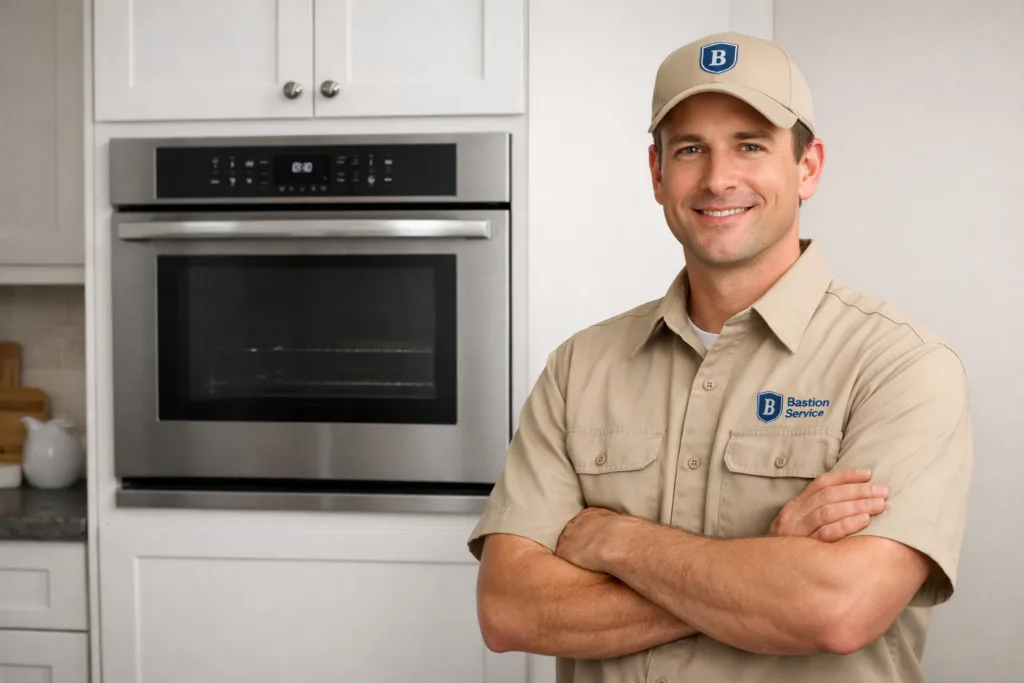
Wall oven problems rarely stay minor for long. A unit that starts with slow preheat, uneven baking, or an intermittent keypad can quickly become unreliable for daily cooking. With Whirlpool wall ovens, the most efficient repair path usually starts by matching the symptom pattern to the parts and systems most likely involved.
Common Whirlpool wall oven problems seen in Inglewood homes
Most service calls fall into a few recognizable categories. The way the oven fails often says more than the fault code alone, especially when the problem comes and goes.
Not heating at all
If the display powers on but the oven does not heat, the issue may involve a bake element, broil element, temperature sensor, thermal protection component, wiring fault, or electronic control problem. In some cases, homeowners assume the oven has power because the clock is lit, but the heating circuit may still be interrupted.
When both bake and broil are affected, that often points away from a single element and toward a broader electrical or control-related fault. If only one cooking mode fails, diagnosis can narrow down the failed component more quickly.
Uneven baking or temperature swings
Food that browns too fast on one side, comes out undercooked in the center, or finishes differently from rack to rack usually indicates a temperature regulation problem rather than a complete heating failure. A drifting sensor, weak element, relay issue, or door seal problem can all affect how consistently the oven cycles.
These complaints often show up first with baked goods, roasted vegetables, and casseroles because they are more sensitive to temperature variation than short broil cycles.
Slow preheat
A Whirlpool wall oven that eventually reaches temperature but takes much longer than normal may have a weak heating element, sensor inaccuracy, or a control issue that prevents proper cycling during preheat. Slow preheat is easy to ignore at first, but it often signals a part that is deteriorating rather than working normally.
Display, keypad, or control problems
If buttons stop responding, the display flickers, settings reset, or the oven starts beeping unexpectedly, the fault may be in the user interface, main control, ribbon connection, or incoming power path. Intermittent control issues matter because they can affect temperature settings, cooking times, and safe operation.
Error codes and shutdowns mid-cycle
Recurring fault codes do not always identify the failed part by themselves. They may indicate sensor readings outside range, latch problems, communication faults, or overheating conditions. An oven that shuts off during use should be checked before continued operation, especially if the pattern is becoming more frequent.
Door, hinge, and latch issues
A wall oven door that does not close fully can lead to heat loss, poor cooking performance, and stress on surrounding components. Worn hinges, a damaged gasket, or latch trouble can all contribute. If the problem appeared after a self-clean cycle, heat exposure may also have affected nearby electrical parts.
How symptom patterns help narrow the cause
Two ovens can show the same general complaint and still need different repairs. “Not heating” might mean a failed element in one unit and a control relay issue in another. “Runs too hot” can come from a bad sensor, damaged wiring, or a control board that is not cycling heat correctly.
That is why accurate Whirlpool wall oven repair in Inglewood depends on what the oven actually does during operation. Useful details include:
- Whether bake, broil, or both are affected
- Whether the oven reaches temperature and then drops off
- Whether the issue is constant or intermittent
- Whether a fault code appears before or after preheat
- Whether the problem started after a power event or self-clean cycle
Those clues can reduce unnecessary parts replacement and help determine whether the repair is straightforward or part of a larger reliability issue.
When the oven should be serviced sooner rather than later
Some wall oven issues are inconvenient. Others raise a safety or reliability concern and should not be pushed off.
It makes sense to stop using the oven and schedule service if you notice:
- A burning smell that does not match normal cooking residue
- The breaker tripping during preheat or cooking
- The oven overheating or failing to regulate temperature
- A door that will not close securely
- A display that cuts out while the oven is running
- Repeated fault codes or mid-cycle shutdowns
Even when the oven still works part of the time, continuing to use it can put added strain on controls, wiring, and heating components.
Issues that often appear after self-clean
Self-clean cycles expose the oven to very high temperatures, and that extra heat can reveal weak components that were already close to failure. After self-clean, some homeowners notice a locked door, blank display, unresponsive controls, or an oven that no longer heats correctly.
Common causes include latch assembly trouble, thermal fuse failure, wiring damage, or heat-stressed electronic controls. If the timing is closely tied to self-clean, that detail is important during diagnosis.
Repair or replace a Whirlpool wall oven?
Built-in wall ovens are often worth repairing because replacement involves more than buying a new appliance. Cabinet fit, trim compatibility, electrical requirements, and installation details can all affect the total project cost.
Repair is often the better option when the problem is limited to one identifiable component such as an element, sensor, latch, interface, or control-related part with a reasonable repair path. Replacement becomes more likely when the oven has repeated major failures, extensive control damage, or several aging issues at the same time.
For many Inglewood homeowners, the real question is not just part cost, but whether the repair restores stable day-to-day cooking performance.
What to note before a service visit
A few observations can make troubleshooting more productive. Before service, it helps to note:
- The full model number if accessible
- Any error code shown on the display
- Whether the problem affects bake, broil, convection, or all modes
- How long preheat is taking compared with normal
- Whether food is undercooking, overbrowning, or cooking unevenly
- Whether the issue began suddenly or worsened over time
If the problem is intermittent, even a short written note about when it happens can help. For example, some ovens fail only after warming up, while others misbehave only during preheat or only after the door has been opened several times.
Why a focused diagnosis matters
Wall ovens combine heating components, temperature sensing, door systems, and electronic controls in a compact built-in design. Because several failures can create similar symptoms, guessing at the cause can lead to extra cost without resolving the complaint.
For homeowners in Inglewood, the best repair decisions come from testing the oven based on the actual symptom pattern, appliance condition, and repair path. That helps determine whether the unit needs a targeted component repair, a broader electrical correction, or a conversation about replacement instead of continued repairs.