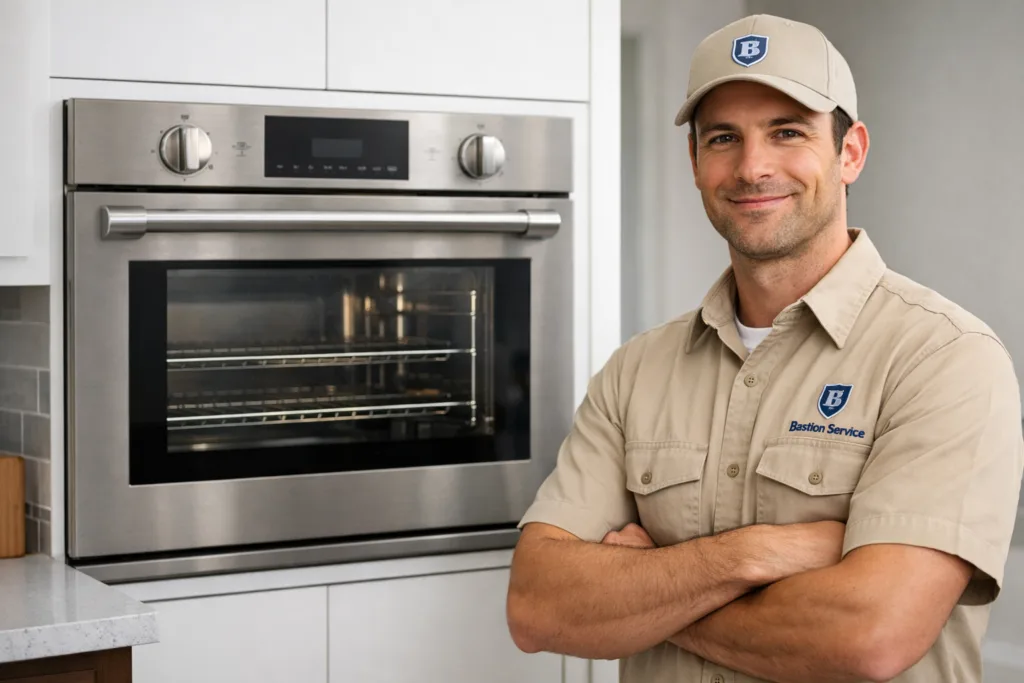
Thermador ovens are designed for steady temperature control, so small performance changes tend to show up quickly in everyday cooking. A roast that needs extra time, cookies that brown unevenly, or a wall oven that suddenly stops mid-cycle usually points to a specific system failure rather than a random glitch. The best next step is to match the symptom to the most likely cause before deciding on a repair.
Common Thermador oven problems in Inglewood homes
Most oven complaints fall into a handful of patterns. Some problems are obvious, like an oven that will not start at all. Others are more subtle, such as slow preheat or temperature swings that make recipes less predictable. Paying attention to how the oven behaves can help narrow down the issue.
Oven not heating or heating very weakly
If the control responds but the cavity stays cool, the fault may involve the bake element, broil element, igniter, sensor, relay, or electronic control system, depending on the model. In some cases, the oven produces some heat but not enough to cook properly. That can make the problem seem less serious than it is, even though the heating circuit is already failing.
Homeowners often notice this first when preheat takes much longer than normal or food comes out undercooked despite a correct temperature setting. A weak heating condition usually gets worse with continued use.
Uneven baking and temperature swings
When one rack cooks faster than another, the back of a dish browns too quickly, or results change from one use to the next, the problem may involve a drifting temperature sensor, inconsistent element performance, convection fan trouble, or a control issue. These symptoms are especially frustrating because the oven still appears to work, just not reliably.
If you have already adjusted cook times, rotated pans more often, or lowered and raised temperatures to compensate, that is usually a sign the oven is no longer regulating heat the way it should.
Slow preheat
Slow preheat is often treated as a minor annoyance, but it can be an early warning sign. On electric models, one heating element may not be doing its share of the work. On gas models, ignition may be delayed or weak. In other cases, the control is sending incorrect signals or the sensor is feeding bad temperature information back to the board.
An oven that still reaches temperature eventually can still be malfunctioning. If preheat times have noticeably changed, that difference is worth taking seriously.
Control panel problems and start failures
If the display is blank, the keypad does not respond, or the oven will not begin a cooking cycle, the cause may be related to incoming power, a failed fuse, wiring damage, a door latch issue, or the control assembly itself. With premium ovens, electronic faults can present as intermittent problems before the unit stops responding altogether.
Repeated resets, random beeping, or controls that work one day and not the next usually suggest more than simple user-setting confusion.
Error codes and mid-cycle shutdowns
Fault codes, unexpected shutoffs, and alarms during cooking often point to overheating protection, sensor faults, communication errors, or board failures. If the oven turns itself off while in use, it should not be dismissed as a one-time event, especially if the same code or shutdown pattern returns.
Intermittent shutdowns can affect more than convenience. They can also signal heat-management or electrical problems that may damage additional components over time.
What these symptoms often mean
Different faults can create similar cooking results. A temperature complaint might be caused by a sensor that reads incorrectly, a heating element that is weakening, a convection issue, or a control problem that cycles heat at the wrong time. That overlap is why symptom-based testing matters.
- Food consistently undercooked: possible heating failure, weak igniter, or sensor inaccuracy.
- Food overcooked despite lower settings: possible sensor drift or control regulation issue.
- Only broil or only bake seems to work: likely a specific heating circuit problem.
- Display works but oven does not: possible relay, latch, fuse, or internal wiring fault.
- Intermittent operation: often linked to electronics, loose connections, or heat-related component failure.
When to stop using the oven
Some issues are inconvenient but manageable for a short time. Others are signs to stop using the appliance until it is checked. If the oven overheats, trips power, shuts off repeatedly, or shows the same error code over and over, continued use can make the repair more complicated.
You should also stop using the oven if you notice burning smells from wiring, visible sparking, or signs that the controls are behaving unpredictably. If the unit is gas and there is a strong gas odor, treat that as a safety issue first and do not continue testing the appliance yourself.
Repair or replace?
In many cases, repairing a Thermador oven makes sense when the problem is limited to one main component and the appliance is otherwise in good condition. That is often true for heating failures, sensor issues, igniter problems, or certain control-related faults. Replacement becomes more likely when there are multiple major problems, recurring electronic failures, or overall wear that makes another repair hard to justify.
Age matters, but condition matters more. A well-kept oven with one defined fault may still be a good candidate for repair, while a heavily worn unit with repeated breakdowns may not be.
What helps before scheduling service
A few observations can make troubleshooting easier. Try to note:
- whether the oven fails every time or only occasionally
- if the problem happens during preheat, during baking, or near the end of a cycle
- whether the display, interior light, and timer still work normally
- any fault code shown on the control
- whether the issue began suddenly or developed gradually
These details can help separate a heating issue from a sensor or control problem and make the repair path easier to evaluate.
What homeowners in Inglewood should expect from oven repair
Good service should focus on the exact behavior of the oven in your kitchen, not a generic assumption about the brand or model line. A proper diagnosis should determine whether the fault is isolated, whether related parts have also been affected, and whether the next step is a targeted repair or a recommendation to retire the unit.
For households in Inglewood, that means looking beyond the surface complaint. “Not heating” may not be the same problem from one Thermador oven to another, and “uneven baking” is not always a calibration issue. When the symptom pattern is understood clearly, the repair decision is usually much easier to make.