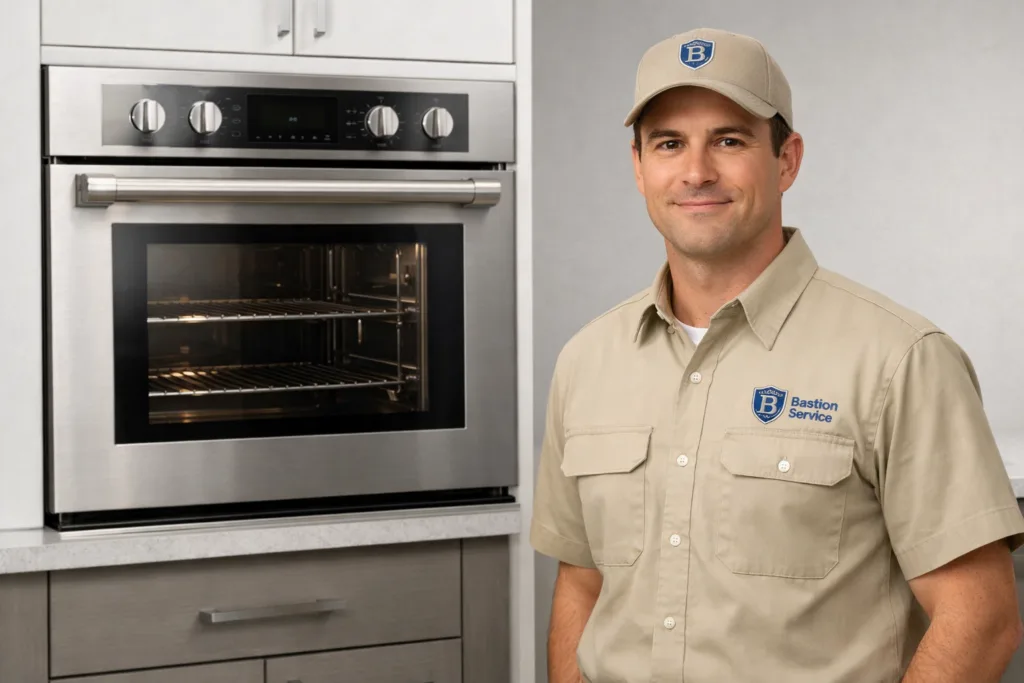
Oven problems rarely stay limited to one meal. A unit that preheats slowly, runs hot on some cycles, or fails without warning can disrupt everyday cooking and make it hard to trust the settings you have used for years. With Thermador ovens, the visible symptom is often only part of the story, so the most useful repair path starts with identifying which heating, sensing, or control component is actually misbehaving.
Common Thermador oven symptoms in Palms homes
Some issues are obvious, such as an oven that will not turn on. Others show up more gradually, like longer preheat times, inconsistent baking results, or temperature swings that only become noticeable after several uses. In Palms homes, these patterns often point to one of a few core problem areas: heat production, temperature feedback, electronic control, door function, or power supply.
Because these systems work together, a single fault can create several symptoms at once. For example, a sensor problem may look like uneven baking, while a relay or control issue may appear to be a weak element. That is why symptom-based testing matters more than assuming the first likely part has failed.
Not heating or barely heating
If the oven stays cold, warms only slightly, or never reaches the set temperature, the cause may involve a bake element, broil element, sensor, relay, wiring fault, or control failure. In some Thermador models, the display and keypad still seem normal even when the oven cavity is not heating correctly. Homeowners may also notice that broil works while bake does not, or that the oven starts heating and then drops off before reaching temperature.
Slow preheat
Slow preheat is often treated as a minor annoyance, but it can signal a larger performance problem. A weak heating circuit, failing temperature sensor, or control issue can lengthen preheat times and reduce cooking consistency afterward. If preheat has become noticeably slower than it used to be, that change is worth checking before the oven stops heating entirely.
Uneven baking and unreliable temperature
Cookies that brown more on one side, casseroles that stay cool in the center, or roasts that finish earlier or later than expected usually indicate that the oven is no longer regulating heat accurately. Thermador ovens rely on coordinated cycling between heating components and temperature monitoring. When that balance is off, the oven may still appear to work while producing poor results across everyday meals.
Temperature swings or overheating
If food burns unexpectedly, the oven seems hotter than the setting, or cooking results vary dramatically from one use to the next, overheating or unstable temperature control may be the issue. This can be caused by sensor drift, stuck relays, control board problems, or wiring faults that interfere with normal heat cycling. Temperature instability is especially frustrating because it often comes and goes before becoming a complete failure.
Error codes, shutdowns, or power-related behavior
An error code is the oven’s way of signaling that it has detected a fault it cannot safely ignore. Repeated shutdowns, a blank display, breaker trips, or an oven that restarts unpredictably can all point to electrical or control-related trouble. These symptoms should be taken seriously, especially if they are getting more frequent or are accompanied by heat loss, unusual noises, or a burning smell.
Door, latch, and self-clean issues
A door that does not close tightly can affect heating performance more than many homeowners expect. Heat escapes, temperature recovery slows down, and cooking results become less consistent. If the latch sticks, the door remains locked, or problems began after a self-clean cycle, the issue may involve the lock assembly, hinges, seal, sensor, or electronic controls affected by high heat exposure.
What different symptom patterns can mean
Looking at how the problem behaves often reveals more than the symptom alone. A Thermador oven that never heats at all typically points in a different direction than one that heats correctly for twenty minutes and then falls behind. Likewise, an oven that is only inaccurate in bake mode may have a different failure path than one showing control errors across every function.
- Cold oven with normal display: often linked to heating, relay, or control issues.
- Very slow preheat: commonly tied to weak heat output, sensor drift, or partial component failure.
- Burning food at normal settings: may indicate overheating, inaccurate sensing, or control problems.
- Inconsistent results from one cycle to the next: often suggests intermittent electrical or control faults.
- Locked door or self-clean trouble: may involve latch, switch, or high-heat related control damage.
This symptom pattern approach helps distinguish a focused repair from a guess. It also helps determine whether the issue is isolated or part of a broader decline in oven performance.
When to stop using the oven until it is checked
Some problems are inconvenient but manageable for a short time. Others can worsen quickly with continued use. It is best to stop using the oven if it is tripping the breaker, producing a burning odor, overheating, shutting off mid-cycle, or displaying repeated fault codes. Continued operation under those conditions can damage additional components and create more expensive repairs.
It is also wise to pause use if the door will not close properly, the latch stays engaged, or the oven temperature has become wildly unpredictable. An oven that cannot retain heat correctly or regulate temperature safely is not just frustrating; it can become unreliable in ways that affect both cooking and appliance condition.
Repair or replacement: what usually makes sense
Many Thermador oven issues are worth repairing when the failure is limited to a sensor, heating component, latch assembly, control-related part, or a defined wiring problem. In those cases, restoring normal operation can be straightforward if the underlying cause is properly identified and addressed.
Replacement becomes a more serious consideration when the oven has multiple major failures, extensive electrical damage, repeated breakdowns, or a repair path that does not meaningfully improve reliability. Age alone is not the deciding factor. The better question is whether the repair solves the core issue and returns the oven to stable day-to-day use.
What homeowners in Palms should expect from oven service
Useful service should do more than replace a suspected part. It should connect the symptom to the failed component, confirm that related systems are functioning, and verify that the oven can heat and regulate temperature as intended. That matters with Thermador cooking appliances because heat production, feedback, and controls are closely linked.
For households in Palms, that means the repair decision should reflect the actual complaint: not heating, uneven baking, slow preheat, temperature swings, door trouble, or control issues. Once the full problem path is understood, it becomes much easier to decide whether repair is practical and what result to expect after the work is completed.
Signs the problem is getting worse
Even if the oven still works part of the time, certain changes suggest the condition is deteriorating. Watch for symptoms that become more frequent, error codes that appear in new combinations, longer recovery times after opening the door, or settings that no longer produce familiar cooking results. These shifts often mean the fault is spreading beyond a single weak component.
If your Thermador oven has become difficult to trust for everyday cooking, addressing the issue early is usually the best way to avoid a larger failure and restore more predictable performance.