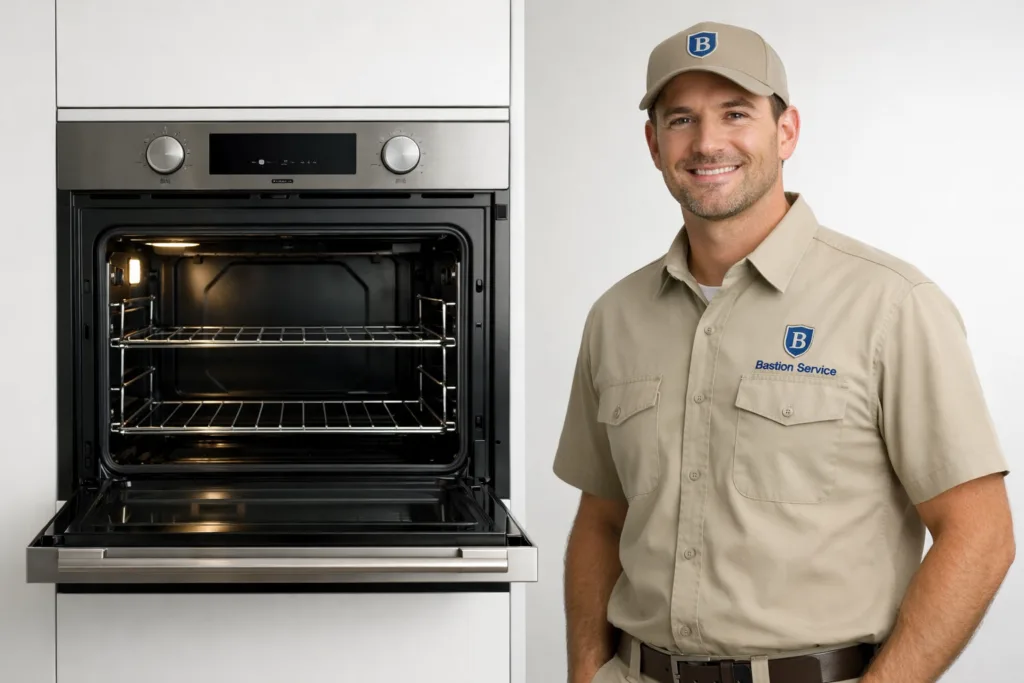
Oven problems usually become obvious at the worst time: dinner cooks unevenly, preheat takes far too long, or the control responds unpredictably just when you need the appliance most. With Asko models, the symptom often points toward a specific group of parts, but the exact cause still needs to be confirmed before any repair decision makes sense.
Common Asko oven symptoms in Palms homes
Most residential service calls begin with one of a few repeat complaints. While the oven may seem to have a single problem, the underlying cause can involve heating components, temperature sensing, airflow, door sealing, or the electronic control system.
Oven not heating
If the oven turns on but never gets warm, the issue may involve a failed bake element, broil circuit problem, wiring fault, temperature sensor issue, or a control that is not sending power correctly. Some ovens fail completely, while others only heat partially and leave food undercooked.
A unit that appears to start normally but stays well below the set temperature should not be judged by one meal alone. Repeated slow cooking, pale baking results, or long preheat times usually indicate a real heating fault rather than normal variation.
Uneven baking or browning
When one side of a pan cooks faster than the other, or the top browns too quickly while the center stays underdone, the oven may not be distributing heat correctly. Causes can include a weak heating circuit, inaccurate temperature feedback, convection fan issues, or a worn door gasket that allows heat to escape.
These problems often develop gradually. Homeowners may start rotating trays more often or adjusting cook times before realizing the oven itself is no longer performing consistently.
Slow preheating
Slow preheat is one of the more overlooked warning signs. An Asko oven that eventually reaches temperature but takes much longer than usual may have a weakening element, a sensor reading problem, or a relay issue on the control side. Because the oven still works to some extent, this symptom can go on for weeks before it becomes disruptive enough to address.
Temperature swings and overheating
If the cavity gets too hot, runs cooler than the display suggests, or cycles in a way that creates inconsistent results, the problem may be calibration-related or tied to a failing sensor or control board. In some cases, homeowners notice burned bottoms, scorched edges, or recipes that suddenly no longer come out as expected.
Persistent overheating should be checked promptly. Excess heat can stress nearby components and may lead to broader electrical or control failures if ignored.
Error codes, shutdowns, or power issues
An oven that shuts off during use, flashes fault codes, trips a breaker, or behaves erratically needs careful evaluation before more testing. Electrical faults can involve high-draw heating parts, damaged wiring, thermal cutoffs, or the control system itself. Repeated resets rarely solve the underlying issue.
Door and latch problems
A door that does not close fully can cause heat loss, longer cook times, and poor baking performance. If the latch sticks, the door feels misaligned, or the oven becomes unreliable after a self-clean cycle, there may be heat-related damage to the latch assembly, switches, hinges, or adjacent controls.
What different symptoms usually suggest
Symptom patterns are useful because they narrow the likely causes. That does not mean parts should be replaced based on guesswork, but it helps homeowners understand why proper testing matters.
- Cold oven with working display: often points to a heating, sensor, wiring, or control-output problem.
- Oven heats, but food cooks unevenly: more likely tied to temperature regulation, airflow, or sealing issues.
- Very slow preheat: commonly linked to a weakened heating circuit or inaccurate sensor feedback.
- Random shutdowns: may involve thermal protection parts, electrical connections, or electronic controls.
- Fault codes after self-clean: can indicate heat-stressed components rather than a simple reset issue.
Why accurate diagnosis matters with Asko ovens
Asko ovens can show similar outward symptoms for very different internal reasons. For example, an oven that will not reach temperature could have a bad element, but it could also have a sensor reporting incorrectly or a control relay failing under load. Replacing the wrong part first adds cost without solving the problem.
The most useful service visit identifies what failed, checks related components, and explains whether the repair path is straightforward or more involved. That is especially important when a household in Palms is deciding whether to invest in repair or start planning for replacement.
When to stop using the oven and schedule service
It is wise to stop using the appliance and arrange service if you notice any of the following:
- The oven trips the breaker
- There is a burning smell that does not clear quickly
- The oven overheats beyond the selected setting
- The control panel behaves unpredictably
- The unit shuts off during preheat or during a bake cycle
- The door will not close or latch properly
Continuing to test an oven under those conditions can increase the chance of added damage to wiring, controls, or adjacent components.
Repair or replace?
For many Palms homeowners, the decision depends on the age of the oven, the confirmed failed parts, previous repair history, and the overall condition of the appliance. A single isolated component failure often makes repair worthwhile. The equation changes when the oven has multiple faults, major electronic failures, or signs of repeated heat-related wear.
Households also tend to weigh how central the oven is to daily cooking. If the appliance has otherwise been reliable and the repair addresses one clear problem, service is often the better value. If several systems are failing at once, replacement may be the more practical long-term choice.
What homeowners should expect from a service evaluation
A helpful visit should do more than confirm that the oven is malfunctioning. It should narrow the issue to the failed system, explain how that failure connects to the symptoms you have been seeing, and outline the reasonable next step. That may be a targeted repair, a recommendation to avoid further use until repaired, or an honest discussion about whether the unit is still a strong candidate for continued service life.
If your Asko oven in Palms is no longer heating evenly, struggles to preheat, swings in temperature, or shows control problems, addressing the issue early usually gives you better repair options than waiting for a complete failure.