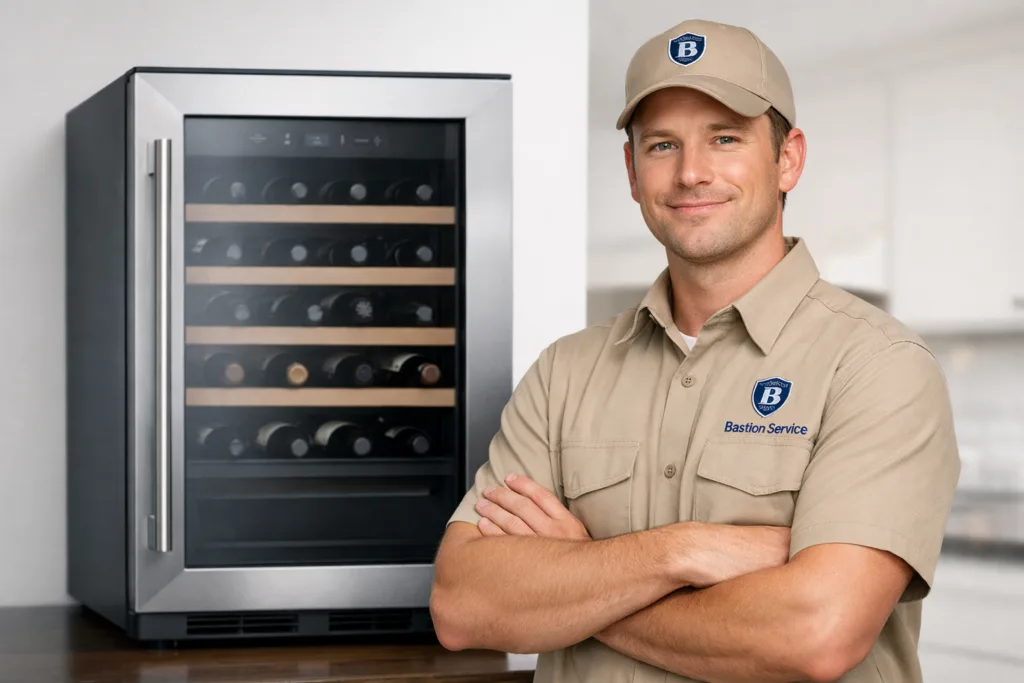
Temperature drift, excess moisture, fan noise, and control glitches in a Summit wine cooler often look similar from the outside, but they do not all come from the same failure. One unit may have a simple airflow or gasket issue, while another may be dealing with a sensor fault, drainage problem, or compressor-related strain. Looking at the full symptom pattern usually tells you much more than the display alone.
How Summit wine cooler issues usually show up
Most homeowners notice a problem in one of a few ways: bottles are warmer than expected, the cabinet runs longer than normal, water shows up under the unit, or the cooler starts making a new noise. In Hermosa Beach homes, those signs are worth checking early because wine coolers are built to hold a narrow range, and even small performance changes can signal a larger problem developing behind the panels.
A Summit wine cooler may also seem to work part of the time and fail the rest of the time. That intermittent pattern is common with control issues, airflow restrictions, worn fans, or door-seal problems. Because the cooler can recover temporarily, it is easy to assume the problem has passed when it has not.
Symptom-based troubleshooting that points in the right direction
Not cooling enough
If the cooler is powered on but struggling to reach or hold the set temperature, likely causes include a faulty thermostat or sensor, dirty condenser coils, poor air circulation, evaporator fan trouble, or a weak door gasket letting warm air in. In some cases, the compressor is running but the cabinet never stabilizes, which may indicate a more serious refrigeration-system problem.
This symptom is especially important when the upper shelves and lower shelves feel noticeably different. Uneven temperatures often suggest airflow or fan-related trouble rather than a complete loss of cooling.
Too cold or freezing bottles
A wine cooler that overcools can have a control board issue, a misreading sensor, or a thermostat problem that keeps the system running too long. Freezing conditions may also create frost, damp shelving, and excess condensation once the ice begins to melt. If that pattern continues, it can put unnecessary stress on internal components.
Water inside or under the cabinet
Leaks are often caused by a blocked drain, heavy condensation, a leveling problem, or frost buildup that later melts. Water does not always mean a major sealed-system failure, but it should not be ignored. Continued moisture can affect flooring, adjacent cabinetry, insulation, and electrical areas inside the cooler.
Buzzing, rattling, clicking, or fan noise
Noise can come from normal vibration, but a change in sound usually points to something worth inspecting. A rattling panel may be minor, while a worn fan motor, compressor strain, or loose mounting point may need repair. Clicking combined with weak cooling is more concerning than noise alone because it can indicate the system is struggling to start or cycle correctly.
Running constantly or short cycling
If a Summit wine cooler in Hermosa Beach seems to run nearly nonstop, it may be compensating for warm air infiltration, dirty coils, control errors, or weak airflow. Short cycling, where the unit turns on and off too quickly, can also point to electrical or control-related problems. Both patterns increase wear and can turn a manageable repair into a larger one if left alone.
Why exact diagnosis matters
Compact refrigeration appliances are sensitive to installation conditions, airflow clearance, gasket condition, and control accuracy. Two wine coolers with the same complaint can need entirely different repairs. One may be restored with cleaning, leveling, or a fan replacement, while another may need sensor testing, electrical repair, or a deeper sealed-system evaluation.
That distinction matters because guesswork often leads to unnecessary parts replacement. It also affects the repair-versus-replace decision. If the cabinet and core components are in good shape, repairs involving controls, fans, sensors, seals, or drainage are often sensible. If there is extensive sealed-system trouble or repeated major failures, replacement may be the better path.
What to check before service
Before scheduling repair, it helps to note a few details:
- Whether the display temperature matches the actual cabinet temperature
- If the problem is constant or comes and goes
- Whether the door is closing fully and sealing evenly
- If moisture appears after heavy use, cleaning, or a power interruption
- What kind of sound the cooler is making and when it happens
These details can make the diagnosis more efficient and help separate a cooling problem from an airflow, control, or installation-related issue.
When to stop using the cooler and call for repair
It is smart to arrange service when the cabinet is warm for extended periods, bottles are freezing, condensation keeps returning, the fan becomes noticeably loud, or water is collecting around the base. If the cooler has stopped cooling entirely, service should be scheduled promptly. Repeatedly restarting the unit or changing settings over and over usually does not solve the underlying issue.
You should also take recurring frost seriously. Frost is not just a cosmetic issue in a wine cooler. It often points to poor sealing, control errors, or airflow trouble, and those problems can keep getting worse as the unit struggles to maintain temperature.
Repair decisions for Summit wine coolers in Hermosa Beach
The most cost-effective repair decisions usually come from matching the symptom to the condition of the appliance as a whole. A well-kept cooler with a fan, control, sensor, or gasket problem is often a good candidate for repair. An older unit with major cooling failure, repeated service history, or visible cabinet deterioration may not be.
For homeowners in Hermosa Beach, the goal is simple: protect the stored collection, avoid avoidable damage, and fix the actual cause rather than the most obvious symptom. When a Summit wine cooler is evaluated that way, the next step becomes much clearer.