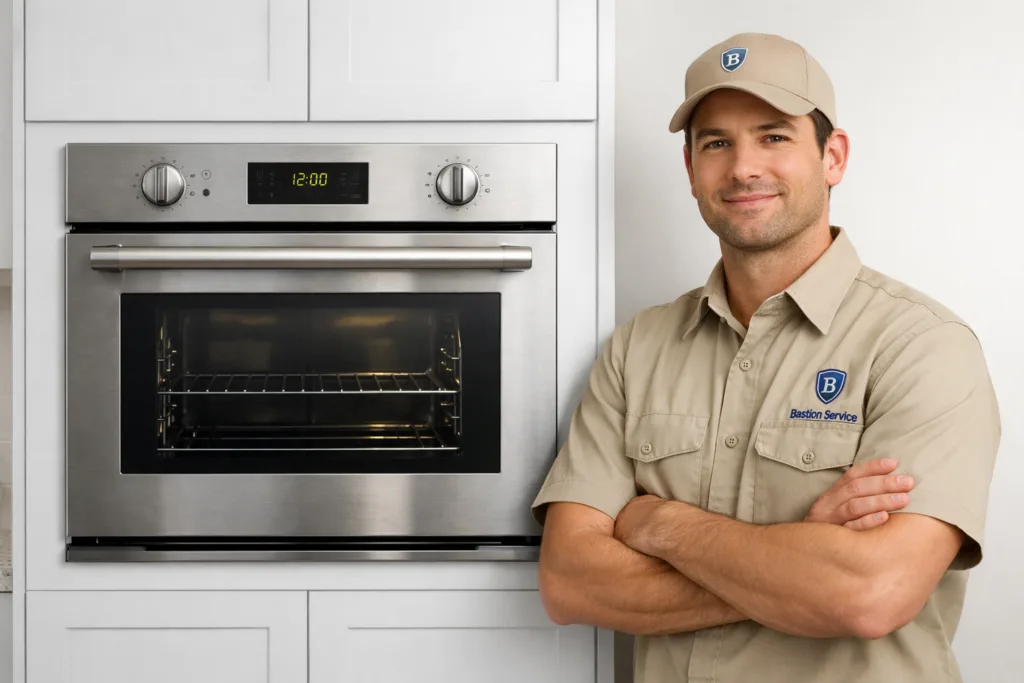
Common Summit wall oven symptoms in Hermosa Beach homes

Wall oven problems often start with a small change in performance before turning into a bigger interruption to daily cooking. A Summit wall oven may still power on, light the display, or appear to start normally while failing to heat correctly, hold temperature, or complete a cycle. The symptom you notice first usually points toward a smaller group of likely causes, which makes testing far more useful than guessing.
Not heating at all
If the oven stays cold, the issue may involve a failed bake element, broil element, temperature sensor, control relay, wiring problem, or incoming power problem. With built-in electric ovens, partial power issues can be especially misleading because lights or controls may still work even though the heating circuit does not.
This symptom is usually most noticeable when preheat never finishes, food remains undercooked, or the cavity feels only slightly warm after several minutes. When a Summit wall oven stops producing heat, the next step should focus on confirming whether the failure is in the heating system itself or in the control side that tells it when to turn on.
Slow preheat
A long preheat often points to a weak element, a sensor reading that is off, or a control issue that is not driving the oven correctly through the heat-up cycle. Some homeowners first notice this when meals start taking longer than expected even though the display says the oven is ready.
Slow preheat should not automatically be dismissed as a minor annoyance. It can be an early sign that a component is weakening and may soon fail completely.
Uneven baking or hot and cold spots
If one rack browns faster than another, cookies burn on the back edge, or casseroles need extra time in certain corners of the oven, temperature distribution may be inconsistent. This can happen when the sensor is inaccurate, an element is weakening, the control is cycling poorly, or heat is escaping because the door is not sealing properly.
In Hermosa Beach households that use the oven regularly, this problem often becomes obvious with baking first, since baked goods reveal temperature differences quickly. What seems like a recipe issue is often an appliance performance issue.
Temperature swings during cooking
All ovens cycle heat on and off, but wide swings can lead to overcooked edges, undercooked centers, and unpredictable results from one meal to the next. When the actual cavity temperature drifts far above or below the set point, attention usually turns to the sensor, control board, or heating response.
If calibration has already been adjusted and results are still inconsistent, the problem may go beyond a simple setting change.
Display, keypad, or control problems
A blank display, unresponsive buttons, flashing codes, or a clock that resets by itself can all indicate a control-related fault. In some cases the oven still heats sporadically. In others, the unit will not start at all.
These problems are worth addressing quickly because control faults can interfere with temperature regulation, cooking time, and safe operation.
Door, latch, and self-clean issues
If the door will not shut fully, the latch stays locked, or the oven begins acting differently after a self-clean cycle, the problem may involve the latch assembly, switch, thermal cutoff, door hinges, gasket, or electronic control. A poor door seal can also make the oven seem weak even when the heating system is working.
How the symptom helps narrow the likely cause
One of the most useful parts of service is matching the complaint to the system most likely involved. A wall oven that does not heat at all is different from one that heats but cooks unevenly, and both are different from an oven that shuts off in the middle of use.
- No heat: often points toward an element, sensor, relay, wiring, or power supply problem.
- Uneven baking: commonly suggests weak heating performance, sensor drift, or sealing issues.
- Slow preheat: can indicate a partially failed heating component or poor control response.
- Error codes or resets: frequently involve controls, communication faults, or electrical interruptions.
- Door not closing or locking: typically relates to latch, hinge, gasket, or switch issues.
This symptom-based approach helps avoid replacing parts that sound plausible but do not solve the real problem.
When to stop using the oven
Some wall oven issues are mainly performance problems, while others raise safety concerns or increase the chance of added damage. It is smart to stop using the oven and arrange service if you notice any of the following:
- The unit trips the breaker.
- The oven shuts off unexpectedly during preheat or cooking.
- There is a burning electrical smell.
- The display flickers, goes dark, or behaves erratically.
- The oven overheats or seems much hotter than the set temperature.
- The door will not close securely or the latch remains stuck.
Continuing to use an oven with electrical or control problems can turn a single failed part into a wider repair.
Why built-in wall oven repairs need a careful approach
Built-in ovens are different from freestanding ranges because access is tighter, installation conditions matter more, and removal may be part of the job. That means the repair decision should take into account not just the failed part, but also the condition of the appliance, how the unit is mounted, and whether the expected fix is likely to hold up well in normal household use.
For homeowners scheduling Summit Wall Oven Repair in Hermosa Beach, the most helpful outcome is a clear explanation of what failed, whether the issue is isolated or part of a larger pattern, and whether repair is a sensible investment for that specific oven.
Repair or replace?
Many Summit wall oven problems are repairable, especially when the failure is limited to a heating element, sensor, latch component, switch, or a defined control-related issue. Repair tends to make more sense when the oven is otherwise in good shape and the fault is not spreading across multiple systems.
Replacement becomes more reasonable when several major problems appear at once, when a critical control issue is paired with poor overall condition, or when the cost of restoring the unit approaches the practical value of the appliance. Age matters, but condition and repair path usually matter more.
A good service visit should help answer questions like:
- What specific part or system failed?
- Is the oven safe to use before repair?
- Is the repair likely to restore normal baking and temperature performance?
- Does the overall condition of the oven support putting money into it?
What homeowners can notice before service
You do not need to disassemble anything to provide useful clues. Before booking service, it helps to note whether the oven fails during preheat or later in the cycle, whether the broil function behaves differently than bake, whether the display shows a code, and whether the problem started suddenly or gradually.
It is also helpful to pay attention to patterns. For example, if the oven only struggles after self-clean, only shuts off at higher temperatures, or only cooks unevenly on one side, that pattern can help narrow the diagnosis more quickly.
Focused help for Summit wall oven problems in Hermosa Beach
When a wall oven becomes unreliable, most homeowners want a straightforward answer rather than trial-and-error part swapping. Whether the problem is no heat, slow preheat, uneven baking, temperature swings, or control trouble, the goal is to identify the actual fault and recommend the next step that makes sense for the appliance in your home.
For households in Hermosa Beach, that means looking closely at the symptom pattern, the oven’s overall condition, and the likelihood of a durable repair before deciding what to do next.