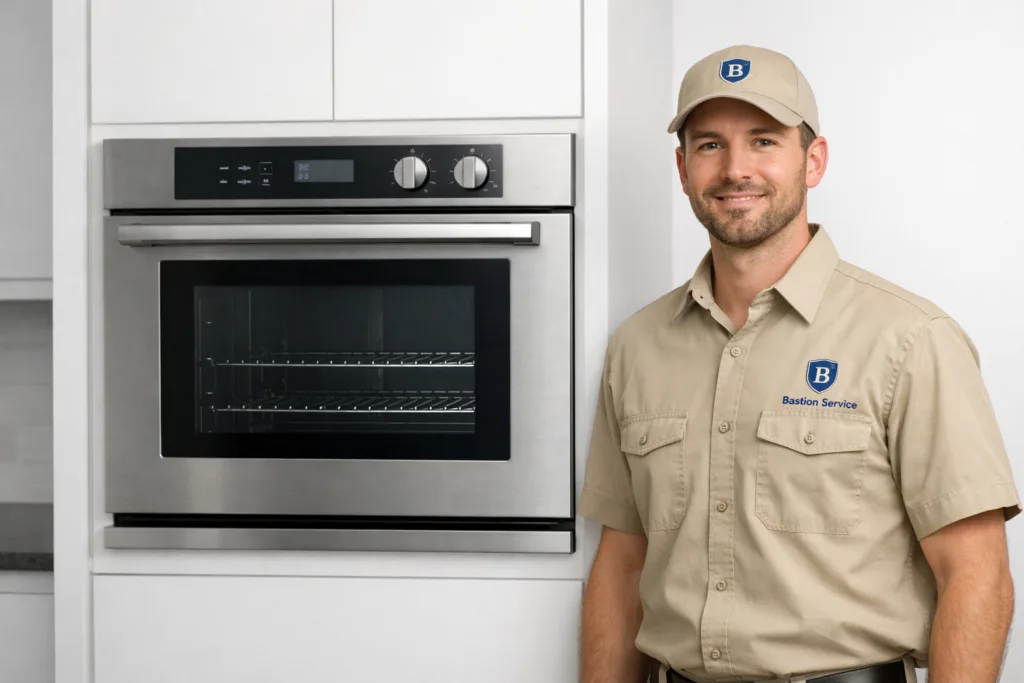
When a built-in oven stops performing the way it should, the most useful place to start is with the pattern of the failure. A Summit wall oven may show the same outward symptom for several different reasons. An oven that will not heat at all can have a different repair path than one that heats slowly, cycles erratically, or shuts off after preheating. Looking closely at what the oven does before, during, and after a cycle helps narrow the cause without relying on guesswork.
Start with the symptom, not the assumption
Wall ovens combine heating circuits, temperature sensing, electronic controls, door safety functions, and power supply components in a compact built-in design. Because of that, a single complaint such as “it is not cooking right” can come from several possible faults. In Pico-Robertson homes, the most common complaints tend to fall into a few practical categories: no heat, slow preheat, uneven baking, temperature swings, control problems, and door-related issues.
What matters is whether the symptom is constant or intermittent. A Summit wall oven that never heats may point toward a failed element, wiring issue, thermal protection problem, or control fault. One that heats sometimes but not others may be dealing with a relay problem, sensor drift, or an electrical connection that fails once the oven gets hot.
Common symptom patterns and what they may suggest
- Oven will not heat at all: Possible causes include bake or broil circuit failure, control problems, wiring damage, or a safety cutoff issue.
- Slow preheat: Often linked to a weak heating element, sensor inaccuracy, or a control that is not managing heat output correctly.
- Uneven baking: Can result from temperature regulation problems, a failing element, poor heat retention, or door seal wear.
- Temperature too high or too low: Frequently associated with sensor faults, calibration problems, or electronic control issues.
- Blank, flashing, or unresponsive display: May involve incoming power, the user interface, or the main control board.
- Door not closing or sealing properly: Hinges, latch components, alignment, or gasket wear can affect both performance and safety.
- Unit shuts off during use: This can point to overheating protection, failing controls, or unstable electrical connections.
Why Summit wall ovens can heat unevenly
Uneven baking is one of the most frustrating oven problems because the appliance still appears to work. One pan may brown too quickly while another stays pale, or recipes that used to be reliable suddenly become inconsistent. In many cases, the issue is not simply “running hot” or “running cold.” It can be a matter of how the oven cycles heat, how accurately it senses temperature, or whether the bake and broil functions are supporting each other properly during operation.
A weak bake element may still glow or warm up, but fail to deliver enough sustained heat. A drifting sensor may report the wrong temperature to the control, which causes long cook times or repeated overshooting. If the door gasket is worn or the door alignment is slightly off, heat loss can also affect consistency, especially during longer baking cycles.
Clues that point to a temperature regulation issue
- Preheat takes much longer than it used to.
- Foods burn on the top while staying underdone in the center.
- The same recipe gives different results from one use to the next.
- The oven appears to reach the set temperature, but cooking remains slow.
- Heat escapes around the door more than normal.
Control and display problems are not always just a bad panel
If the control panel is dead, glitchy, or not accepting commands, the cause is not always limited to the keypad itself. Some Summit wall oven control complaints begin with a power supply problem, a failed interface connection, or a board that is no longer responding correctly once the unit warms up. Error behavior can also show up before a full failure, with intermittent beeping, flashing segments, or settings that do not register reliably.
For homeowners, the important distinction is whether the issue is isolated to the display or affecting cooking performance too. If the oven also loses heat, resets during a cycle, or shuts off unpredictably, the diagnosis usually needs to consider the full electrical and control system rather than only the touch controls.
When continued use is a bad idea
Some oven problems mainly affect convenience, but others can lead to bigger damage or safety concerns if ignored. A Summit wall oven should not keep being used normally if it is tripping breakers, producing a burning smell, overheating, shutting off mid-cycle, or failing to regulate temperature in a major way. Those symptoms can place added stress on wiring, controls, and heating components.
Even less dramatic problems can grow over time. A weak element may increase strain on the rest of the heating system. A failing sensor can push the control to cycle improperly for repeated cooking sessions. If the oven door does not close correctly, heat loss can affect both performance and surrounding components.
Schedule service promptly if you notice any of these
- The oven no longer reaches the selected temperature.
- Preheat has become unusually slow.
- The display goes blank or resets.
- The unit shuts off after it gets hot.
- The breaker trips during preheat or baking.
- There is visible heat escaping from the door area.
- You smell burning insulation or overheated wiring.
Repair or replacement depends on the type of failure
For many Pico-Robertson households, repair is often worthwhile when the issue is tied to a specific component or circuit. Heating elements, temperature sensors, door parts, some control-related faults, and other isolated failures can make sense to repair when the rest of the oven is in solid condition. Built-in appliances are also judged differently than smaller countertop equipment because replacement can involve fit, cabinet compatibility, and installation concerns.
Replacement becomes a more serious consideration when the wall oven has multiple faults at once, recurring electrical problems, or signs of broader age-related decline. The key is understanding whether the current problem is a single repairable failure or part of a larger pattern. That is where a practical repair plan is most helpful, because it frames the choice around condition and repair path rather than frustration alone.
What to note before an appointment
A few details can make diagnosis faster and more accurate. Try to note whether the problem affects bake, broil, convection features if equipped, or every cooking mode. It also helps to know whether the failure started suddenly or developed over time. If the control flashes, resets, or shows unusual behavior only after preheating, that timing matters.
Useful details include:
- Whether the oven fails from a cold start or only once hot
- If broil works while bake does not, or the reverse
- Whether the display stays on when heating stops
- If the door feels loose, misaligned, or hard to close
- Any recent breaker trips or burning odors
- Whether temperature problems are consistent or occasional
Built-in wall ovens need a more focused service approach
A wall oven is not just a heating box with a control panel. Because it is installed into cabinetry and used as a central cooking appliance, service has to account for heating performance, control behavior, electrical integrity, and door operation together. That matters with Summit wall oven repair in Pico-Robertson, especially when symptoms overlap or appear only during certain stages of cooking.
The most effective next step is to match the repair approach to the exact symptom pattern the oven is showing now. Whether the issue is no heat, uneven baking, slow preheat, temperature instability, or an unresponsive control, the goal is to determine what failed, whether related parts have been affected, and whether reliable daily use can be restored.