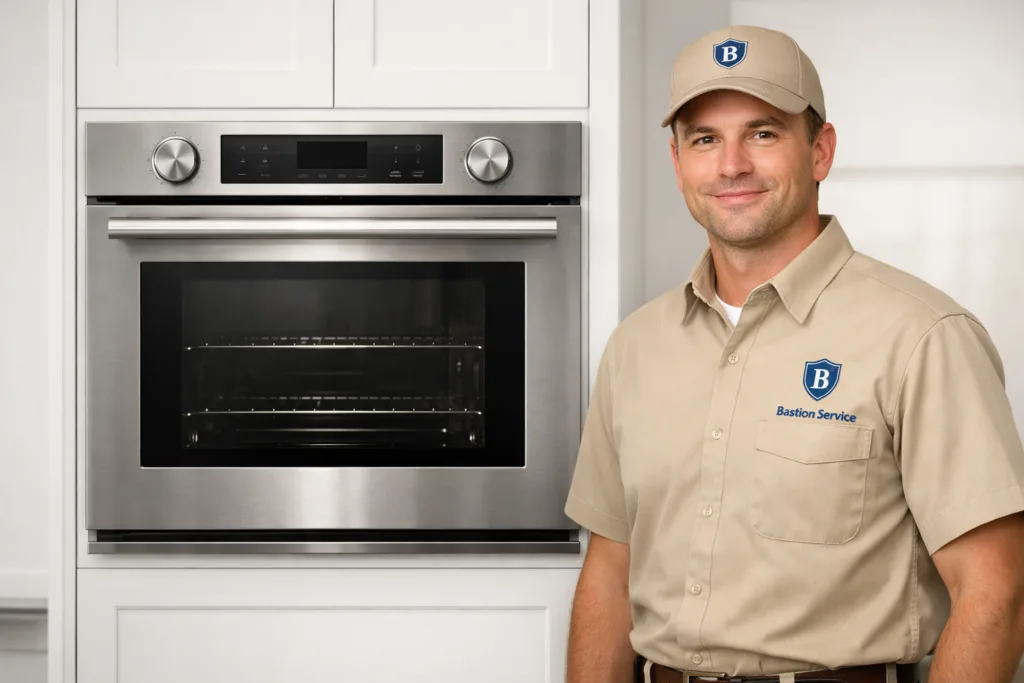
Built-in wall ovens tend to show problems in patterns. One household may notice that preheat stretches longer each week, while another sees cookies browning on one side and staying pale on the other. With a Dacor wall oven, those details matter because the same cooking complaint can come from different parts of the heating and control system.
In Pico-Robertson homes, the most useful approach is to match the symptom to the likely failure path instead of assuming every temperature problem means the same repair. That helps prevent wasted parts replacement and gives a better sense of whether the issue is minor, developing, or serious enough to stop using the oven until it is checked.
Common Dacor wall oven symptoms and what they often mean
Wall ovens usually give warning signs before they fail completely. Some symptoms are obvious, such as no heat at all, while others show up as subtle changes in cooking performance.
Oven will not heat
If the display turns on but the cavity stays cold, the cause may involve a failed bake element, broil element, relay, sensor circuit, wiring issue, or electronic control problem. On some units, the oven may appear to start normally but never actually energize the heating system. That distinction is important because a front panel response does not always mean the oven is producing heat correctly.
Slow preheating
A Dacor wall oven that used to heat quickly but now takes much longer to reach temperature may have a weak heating circuit, a sensor reading problem, or a control issue that is not driving the elements the way it should. Slow preheat is often treated as an inconvenience at first, but it can be an early sign that a component is failing under load.
Uneven baking or roasting
Food that is overdone on the top, pale underneath, or inconsistent from front to back can point to partial heating failure, inaccurate temperature sensing, airflow problems, or a convection-related fault. If one rack cooks very differently from another during the same cycle, that usually suggests more than simple recipe variation.
Temperature swings during cooking
Some cycling is normal in any oven, but sharp swings that affect results are not. If casseroles finish too early one day and remain undercooked the next, the oven may be misreading temperature, overheating, or losing heat at the wrong time in the cycle. Repeated temperature instability deserves attention, especially when the same recipe starts producing different results.
Control panel or display issues
Unresponsive buttons, a blank display, flashing error codes, random resets, or cycles that cancel themselves can all stem from control, interface, or power-related faults. Because a built-in wall oven is hardwired and closely integrated into cabinetry, these issues are not always solved by a reset. When the controls behave unpredictably, the internal fault may be electrical rather than cosmetic.
How specific symptoms help narrow the repair
Homeowners can often make service faster just by noting exactly when the problem appears. A wall oven that fails only in bake mode points in a different direction than one that also struggles in broil or convection. An oven that heats normally at first and then loses temperature mid-cycle may have a different failure path than one that never gets hot in the first place.
Useful details include:
- whether the problem affects bake, broil, convection, or every mode
- whether preheat completes or stalls
- whether the issue started after a self-clean cycle
- whether the display shows an error code
- whether the oven shuts off during longer cooking sessions
- whether the door closes tightly and seals properly
These observations often reveal whether the main concern is heat production, temperature feedback, door sealing, electrical supply, or control response.
Problems that often appear after self-clean
Self-clean cycles expose the oven to extreme heat, and that can sometimes bring out a weakness in an aging component. After self-clean, some homeowners notice a door that stays locked, a control panel that stops responding, or an oven that powers up but no longer heats correctly.
In many cases, the issue is not the cleaning cycle itself but the thermal stress it places on parts that were already vulnerable. If a Dacor wall oven starts acting differently right after self-clean, that timing is worth mentioning because it can help isolate latch, fuse, sensor, or control-related problems more quickly.
When uneven cooking is more than a recipe issue
Not every disappointing meal means the oven is broken, but repeat patterns usually tell the story. If multiple dishes come out uneven despite using familiar cookware and the same rack positions, the appliance may no longer be maintaining heat the way it should.
Watch for signs such as:
- tops browning much faster than centers finish
- one side of a baking sheet cooking faster than the other
- broiling that seems weak or delayed
- convection results that no longer look even
- recipes needing much more or less time than expected
When these issues happen repeatedly in Pico-Robertson households, the cause is often mechanical or electrical rather than user error.
Signs the oven should not keep being used
Some wall oven problems are inconvenient. Others can lead to added damage if the unit keeps running. It is wise to stop using the oven and arrange service if you notice burning electrical smells, repeated breaker trips, overheating around the controls, a door that will not latch properly, or a unit that shuts off unpredictably while hot.
Continued use under those conditions can turn one failed part into several. That is especially true in a built-in appliance where excess heat and electrical stress can affect nearby components inside a confined installation space.
Repair versus replacement considerations
Many Dacor wall oven problems are still repairable, particularly when the issue is limited to a single heating, sensing, latch, or control-related part and the rest of the appliance is in stable condition. Replacement becomes more attractive when there are multiple major failures, repeated electronic issues, heavy heat damage, or a repair path that no longer makes sense for the age and condition of the oven.
Built-in appliances also raise practical questions beyond the repair itself. Cabinet fit, trim appearance, electrical compatibility, and kitchen disruption all matter. For that reason, homeowners often benefit from a clear diagnosis and repair estimate before deciding that replacement is the better move.
What to note before scheduling Dacor wall oven repair in Pico-Robertson
A few simple notes can make the service visit more productive. If possible, write down the model information, any error code on the display, whether the problem happens every time or only sometimes, and whether it began suddenly or gradually. It also helps to mention if the issue appeared after a power interruption or after running self-clean.
For households in Pico-Robertson, symptom-based service is usually the fastest way to sort out whether the problem is a failing heat component, a temperature-reading issue, a control fault, or a door-related problem that is affecting performance. The goal is not just to get the oven running again, but to restore predictable cooking results without guesswork.