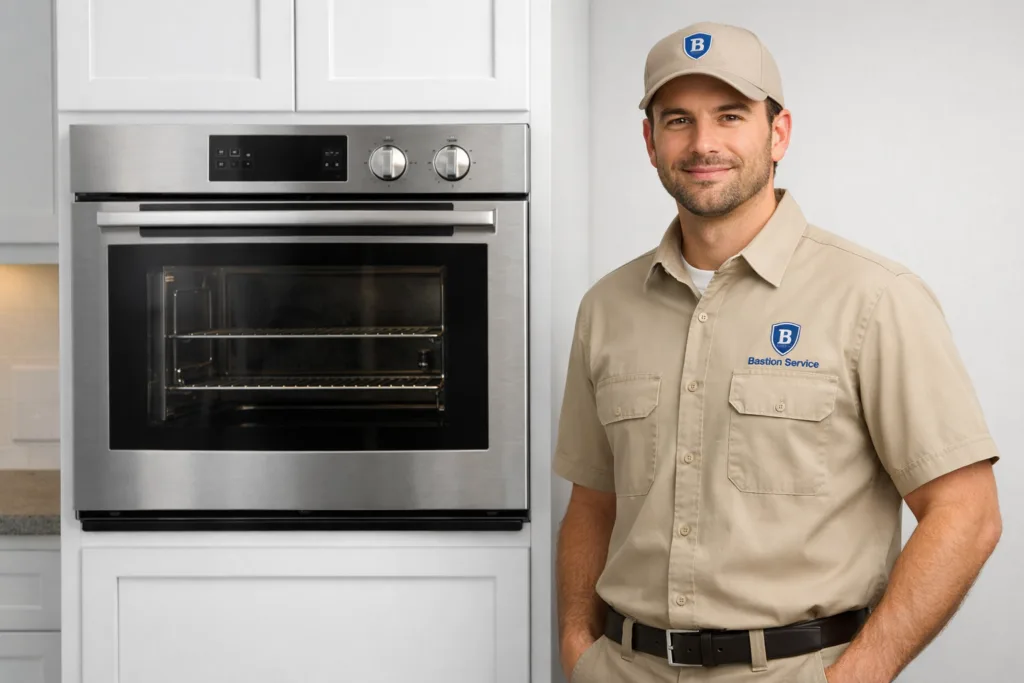
Wall oven problems often show up first in everyday cooking: cookies that brown unevenly, casseroles that need extra time, or a preheat cycle that seems to drag on. With Bosch models, those symptoms can come from heating components, sensors, controls, door hardware, or airflow issues, so the most useful starting point is matching the repair path to the exact behavior you are seeing.
Common Bosch wall oven symptoms in Pico-Robertson homes
Bosch wall ovens rely on several systems working together at the same time. The appliance may power on, light up, and even begin heating, yet still cook poorly if one part is out of range. Looking at the symptom pattern helps separate a simple part failure from a wider control or electrical issue.
Not heating at all
If the display turns on but the oven cavity stays cool, the problem may involve a failed bake element, broil circuit issue, temperature sensor fault, control board problem, or wiring interruption. On some units, the oven appears to start normally but never develops usable heat, which is often a clue that the command to heat is not being completed properly.
Slow preheating
Slow preheat is one of the most common complaints because it can be easy to miss at first. Homeowners may notice that weeknight meals suddenly take longer or that the preheat tone comes much later than expected. A weak heating circuit, inaccurate sensor readings, relay trouble, or convection-related issues can all contribute to this symptom.
Uneven baking or temperature swings
When one rack cooks faster than another, or the back of a dish browns more quickly than the front, temperature regulation is usually the main concern. Causes can include sensor drift, inconsistent element operation, convection fan problems on applicable models, or heat loss at the door seal. These issues often develop gradually, so performance may worsen over time rather than fail all at once.
Oven runs too hot or burns food
An oven that overheats can be just as frustrating as one that does not heat enough. If food is repeatedly overdone at normal settings, the sensor may be reading incorrectly, the control may be keeping an element energized too long, or calibration may be off. Repeated overheating should not be ignored because it can affect both cooking results and component wear.
Error codes, beeping, or control problems
Repeated fault codes, random beeping, frozen touch controls, or shutdowns during operation usually point toward an electronic problem rather than a simple heating issue. Depending on the model, the trouble may be tied to the user interface, main control, sensor feedback, latch system, or incoming power to the oven.
Door not closing, locking, or unlocking correctly
A wall oven door that feels loose, sits unevenly, or does not seal properly can affect cooking performance and safety. Heat can escape around the opening, leading to longer cook times and inconsistent baking. If the door lock does not engage or release as it should, self-clean and normal use may both be affected.
What different symptom patterns can mean
Some Bosch wall oven complaints sound similar but lead to different repairs. For example, an oven that does not reach temperature may have a weak element, while an oven that reaches temperature and then drops far below it may be struggling with sensing or control. An appliance that works fine when cold but fails after it heats up may have an electrical connection or component that becomes unstable under temperature stress.
This is why symptom-based diagnosis matters. It helps avoid swapping parts based only on a broad complaint and focuses attention on what the oven is actually doing before, during, and after a cycle.
Signs the issue may be getting worse
Some oven problems stay mild for a while before becoming obvious. Others escalate quickly. It is smart to stop and reassess if you notice any of the following:
- Preheat times increasing from one week to the next
- Cooking times becoming less predictable
- The display resetting during operation
- The oven only working on certain modes
- Recurring error codes after clearing them
- A door that must be pushed to stay shut
- Burning smells, sparking, or sudden shutoff
Those signs usually suggest more than simple user-setting confusion. They indicate that a component may be failing intermittently or that continued use could lead to a larger repair.
When homeowners in Pico-Robertson usually call for service
Most people schedule service when the oven stops supporting normal meal prep. That could mean it no longer heats reliably, takes too long to preheat, ruins baking results, or becomes difficult to operate through the control panel. In a built-in appliance, even a small issue can be disruptive because the oven is expected to perform consistently and is not easy to replace casually.
For households in Pico-Robertson that rely on a Bosch wall oven for daily cooking, it often makes sense to schedule an inspection once the pattern is repeatable instead of waiting for a complete failure. A problem caught at the stage of unstable temperature control or intermittent operation may be simpler to resolve than one left to worsen.
Repair or replacement: how the decision is usually made
Whether a Bosch wall oven should be repaired usually depends on three things: the failed part, the overall condition of the unit, and whether the fix is likely to restore reliable use. Many problems tied to sensors, heating elements, latch assemblies, fans, wiring faults, or specific electronic components are reasonable to repair when the rest of the oven is in solid shape.
Replacement becomes more worth discussing when there are multiple major failures, extensive control damage, or a repair cost that no longer matches the appliance’s condition. For most homeowners, the real question is not simply whether the oven can be fixed, but whether the result will bring back stable, everyday cooking performance.
What to pay attention to before a service visit
If you are preparing for a wall oven repair appointment, it helps to note exactly how the problem appears. Useful details include whether the oven fails on bake, broil, or convection; whether the issue happens every time or only occasionally; whether the display shows a code; and whether the door, lights, or fan behave differently than usual.
Even small observations can help narrow the likely failure path, such as:
- The oven starts preheating but stalls far below the set temperature
- The broiler works but bake does not
- The control responds, but cooking results are off
- The problem began after a self-clean cycle
- The door remained locked longer than normal
Why built-in wall oven issues deserve careful handling
Wall ovens are built into cabinetry and connected to dedicated power, which makes access and testing different from a freestanding range. Problems involving high heat, door latches, relays, or electrical supply should be approached carefully, especially if there is any sign of overheating, tripped breakers, or burning odor.
For Bosch wall oven repair in Pico-Robertson, homeowners are usually best served by a clear explanation of what failed, whether the oven is safe to use as-is, and what repair path makes the most sense for the symptom pattern they are dealing with.