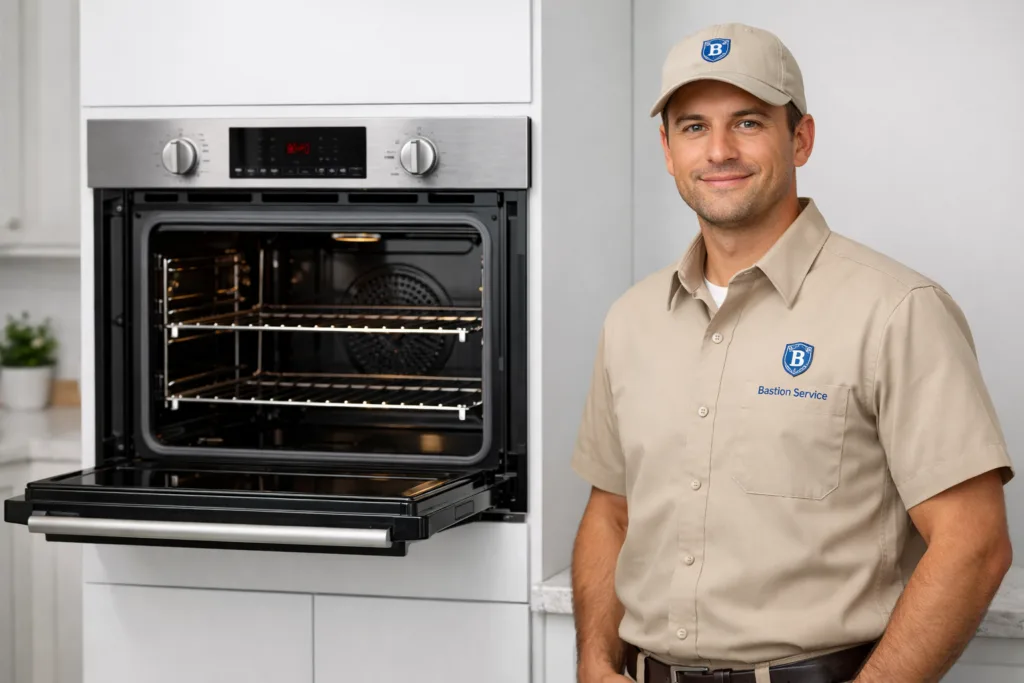
Wall oven problems tend to show up in everyday ways first: cookies browning unevenly, casseroles taking much longer than usual, or a display that suddenly stops responding right before dinner. With Bosch units, those symptoms can come from heating components, sensors, airflow issues, latch systems, or electronic controls, so the most effective repair starts with matching the behavior of the oven to the part of the system that has actually failed.
How Bosch wall oven problems usually show up
Some failures are obvious, such as an oven that will not heat at all. Others are more subtle and easier to dismiss at first. A wall oven may still turn on, light up, and seem normal during preheat, yet never reach the selected temperature or cycle heat incorrectly once cooking begins. That is why symptom patterns matter. When the same issue repeats across different recipes, rack positions, or cooking modes, it often points to a real mechanical or electrical fault rather than simple user settings.
In Hermosa Beach homes, common service calls often involve one of a few broad categories: weak or no heat, inconsistent temperature control, door and latch trouble, convection performance issues, or electronic display and keypad faults. Each category has different likely causes, and each has a different urgency level.
Common symptoms and what they can indicate
Oven not heating
If the oven powers on but stays cold, a failed bake element, broil element, thermal cutoff, control relay, or wiring problem may be interrupting the heating circuit. On some Bosch wall ovens, one heating function may still work while another does not, which can make the appliance appear partially functional even though normal baking results are no longer possible.
If there is no heat at all, it is usually best to stop using the unit until it is inspected. Repeated attempts to run a cycle can stress already-failing components.
Slow preheat
Preheat that keeps getting longer is often one of the earliest signs that something is weakening rather than fully failed. A deteriorating heating element, sensor drift, reduced voltage to a heating circuit, or a control problem can all slow the oven down. Homeowners sometimes notice this first when meals that used to be routine suddenly require extra time before food can even go into the oven.
Slow preheat should not be treated as normal aging without testing. In many cases, the issue is repairable before it develops into complete heating failure.
Uneven baking
When the top browns too quickly, one side cooks faster than the other, or the center stays underdone, the problem may involve temperature sensing, convection airflow, heat cycling, or a door seal that is allowing heat to escape. Uneven baking is especially frustrating because the oven may still seem close to normal until you compare results across multiple meals.
If the issue is consistent from one use to the next, it usually points to a hardware problem rather than cookware or recipe variation.
Temperature swings
An oven that runs too hot, too cool, or shifts unpredictably during a cycle can affect both cooking quality and food safety. Likely causes include a faulty temperature sensor, calibration drift, control board issues, or intermittent relay performance. In some cases, the oven overshoots temperature and then struggles to recover correctly, which creates wide swings that are hard to notice unless recipes begin failing.
Door not closing, locking, or unlocking properly
A wall oven door that does not seal tightly can waste heat and interfere with cooking consistency. Problems with hinges, springs, gaskets, latch assemblies, or door alignment may all contribute. If the lock mechanism fails after a cleaning cycle, the issue may involve a switch, motor, or control problem rather than the door hardware alone.
Door issues are worth addressing promptly because escaped heat can place extra strain on surrounding components and turn a smaller repair into a larger one.
Error codes or unresponsive controls
When the display flashes an error, the touch controls stop responding, or the oven beeps unexpectedly, the fault may involve the interface panel, control board, communication pathway, or incoming power. Electronic symptoms can be expensive to guess at, which is why testing matters. Replacing a board without confirming the true cause can leave the same problem unresolved.
Burning smells, sparking, or breaker trips
These are higher-priority warning signs. A repeated breaker trip, visible sparking, or a persistent electrical smell can point to a shorted element, damaged wiring, terminal failure, or another electrical defect. If any of these symptoms are present, continued use is not advisable until the oven has been checked.
When service is worth scheduling
Scheduling service makes sense when the oven is affecting normal cooking, showing signs of unreliable operation, or creating a possible safety concern. Even intermittent problems deserve attention, because wall ovens rarely correct themselves and often become more disruptive over time.
- Preheat is much slower than it used to be
- Food is baking unevenly on a regular basis
- The oven shuts off during cooking
- The same error appears repeatedly
- The display or controls work only part of the time
- The door will not close, lock, or release properly
- The breaker trips when the oven is used
When to stop using the oven
Some symptoms suggest inconvenience. Others suggest risk. If the oven is overheating, failing to regulate temperature, tripping the breaker, producing a strong electrical odor, or showing signs of arcing, it is best to leave it off until the cause is identified. The same applies to a door that will not stay shut or a unit that behaves unpredictably during operation.
For households in Hermosa Beach, that distinction matters because a built-in appliance can be easy to ignore when it still partly works. But using an unstable oven can damage additional parts and complicate what might have started as a more contained repair.
Repair or replace?
Many Bosch wall oven issues are tied to specific failed components rather than the appliance as a whole. Heating elements, sensors, fans, latch parts, and some control-related components can often be addressed without replacing the entire unit. Repair is often the better route when the oven is otherwise in solid condition and the cabinet fit is worth preserving.
Replacement becomes a more serious consideration when the oven has multiple major faults, extensive interior damage, repeated electronic failures, or repair costs that no longer make sense relative to age and condition. Built-in wall ovens also involve sizing and installation constraints, so the decision is usually best made after the problem has been properly identified instead of assumed.
What a helpful service visit should answer
Most homeowners want straightforward answers: what is causing the symptom, is the oven safe to use, and does the repair make financial sense? A useful appointment should narrow the problem to the failed system, explain whether the issue is urgent or routine, and set realistic expectations about the next step.
For Bosch wall ovens in Hermosa Beach, that symptom-based approach is usually the fastest way to avoid unnecessary parts replacement and get back to predictable cooking performance.