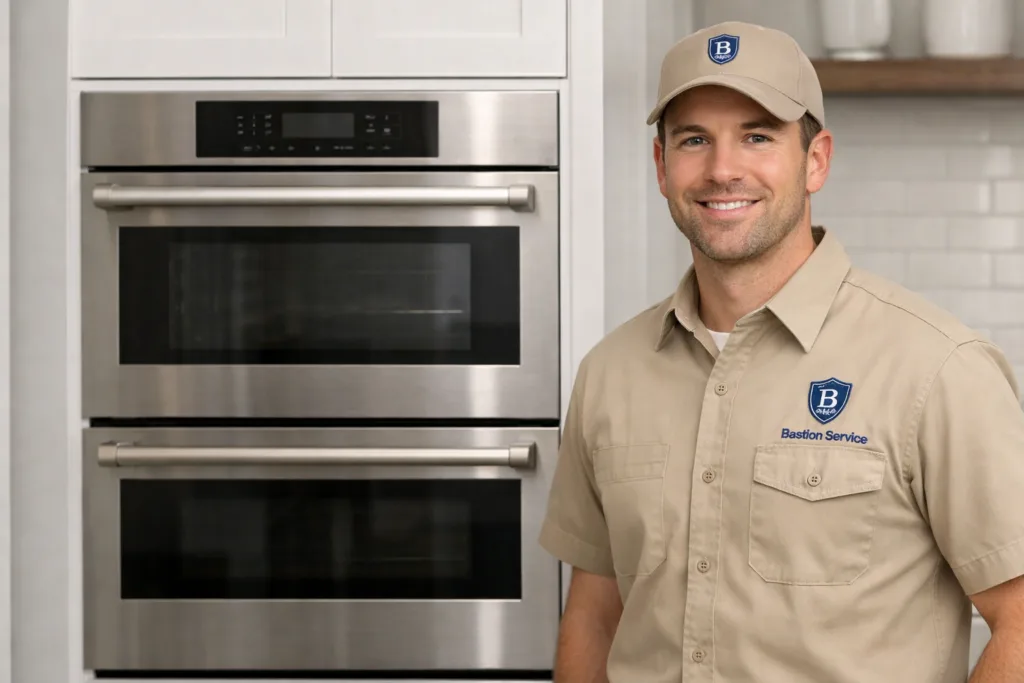
Built-in ovens usually show a pattern before they stop working altogether. One meal may take much longer than expected, another may come out browned on top but pale in the center, or the control may start flashing an error after preheat. With Thermador wall ovens, those symptoms matter because they help separate a heating problem from a sensor, door, wiring, or control issue.
What the symptom pattern usually means
A wall oven can fail in ways that look similar from the outside but come from different parts inside the appliance. An oven that powers on yet does not heat at all points in a different direction than one that heats, but cannot hold a stable temperature. Watching what happens during preheat, how long the cavity takes to warm up, and whether the issue affects bake, broil, or both can narrow the likely cause quickly.
Helpful details include whether the display stays normal, whether the fan behavior changes, whether the oven shuts off mid-cycle, and whether the problem appears every time or only after the oven has been running for a while. On a built-in Thermador unit, that real-world behavior often tells more than the symptom label alone.
Common Thermador wall oven problems in Hermosa Beach homes
Not heating or heating too weakly
If the oven turns on but stays cool, struggles to preheat, or never reaches the selected temperature, the issue may involve a failed element, a weak element, a sensor reading problem, damaged wiring, or a control fault. Sometimes the oven will seem to start normally, then stall well below the set point. That often shows up as food taking far longer to cook than usual.
When both bake performance and broil performance are affected, the diagnosis may point toward shared components such as the sensor circuit, power supply, or electronic control rather than a single heating element alone.
Uneven baking and temperature swings
Uneven baking is one of the most frustrating wall oven complaints because the oven still appears to work. Cookies may brown faster on one side, casseroles may need extra time in the center, or recipes that used to be reliable may suddenly become inconsistent. In many cases, this can be tied to temperature regulation, airflow issues, calibration drift, or an element that is heating but no longer performing at full strength.
For households that use the oven regularly, even moderate temperature instability can become obvious quickly. Repeated undercooking or overbrowning is usually a sign that the oven is not regulating heat the way it should.
Slow preheat
Slow preheat is often treated like a minor annoyance, but it can be an early warning sign. A Thermador wall oven that takes much longer than normal to reach temperature may have a developing heating issue, a sensor problem, or a control that is not cycling heat correctly. If preheat times continue to increase, the fault may be worsening even before the oven stops heating altogether.
Error codes, beeping, or a frozen display
Control problems can appear as flashing codes, random beeping, unresponsive touch controls, or a display that resets during operation. Some faults only appear when the oven is hot, which is why homeowners often notice them partway through cooking rather than at startup. Intermittent electronic issues can be harder to judge without testing because they may involve the control, sensor feedback, wiring connections, or heat-related shutdown behavior.
Door, hinge, and gasket problems
A door that does not close squarely can affect performance more than many people expect. If heat escapes around the seal, the oven may run longer, temperatures may drift, and cooking results can become inconsistent. Worn hinges, latch issues, or a damaged gasket may not look like major failures, but they can directly affect how the oven bakes and how efficiently it holds heat.
Signs the oven should not keep being used normally
Some problems can wait a short time for service, but others call for faster attention. It is wise to stop normal use if the oven trips a breaker, smells like overheating wiring, shuts off unexpectedly, shows repeated fault codes, or gets unusually hot around surrounding cabinetry. Those symptoms can point to electrical or control-related failures that may worsen with continued operation.
If the oven is still running but struggling to maintain temperature, repeated use can also place extra stress on heating and control components. What begins as a slow-preheat complaint can sometimes grow into a broader failure if ignored for too long.
How diagnosis helps separate repairable issues from bigger ones
Many Thermador wall oven problems involve parts that are commonly service-related, such as sensors, elements, hinges, latches, gaskets, and selected control components. That is why a proper evaluation matters before assuming a built-in oven needs to be replaced. In Hermosa Beach homes, replacement can be more disruptive than expected because wall ovens are integrated into the kitchen layout and surrounding cabinetry.
Repair tends to make sense when the problem is isolated, the rest of the appliance is in solid condition, and parts support is still reasonable. Replacement becomes a more serious conversation when there are multiple major failures, recurring electronic problems, or cost factors that no longer support keeping the unit.
What homeowners can note before service
A few observations can make the appointment more productive:
- Whether the problem affects bake, broil, or both
- How long preheat takes compared with normal
- Whether the oven reaches temperature and then drops off
- Any fault code shown on the display
- Whether the issue started after a power interruption or self-clean cycle
- Whether the problem is constant or only happens once the oven is hot
It also helps to have the full model information ready. For Thermador wall oven repair in Hermosa Beach, those details can reduce guesswork and focus testing on the most likely failure path.
What to expect from a practical repair decision
The goal is not just to identify a bad part, but to understand why the oven is behaving the way it is. That matters with symptoms like uneven baking, intermittent shutdowns, and temperature swings, where more than one component can be involved. A useful service visit should explain what failed, whether the repair is straightforward, and whether the condition of the oven supports moving ahead.
For homeowners in Hermosa Beach, the most sensible next step is usually based on symptom severity, appliance condition, and the likely repair path. When the problem is diagnosed accurately, it becomes much easier to decide whether to repair the existing Thermador wall oven now or start planning for replacement later.