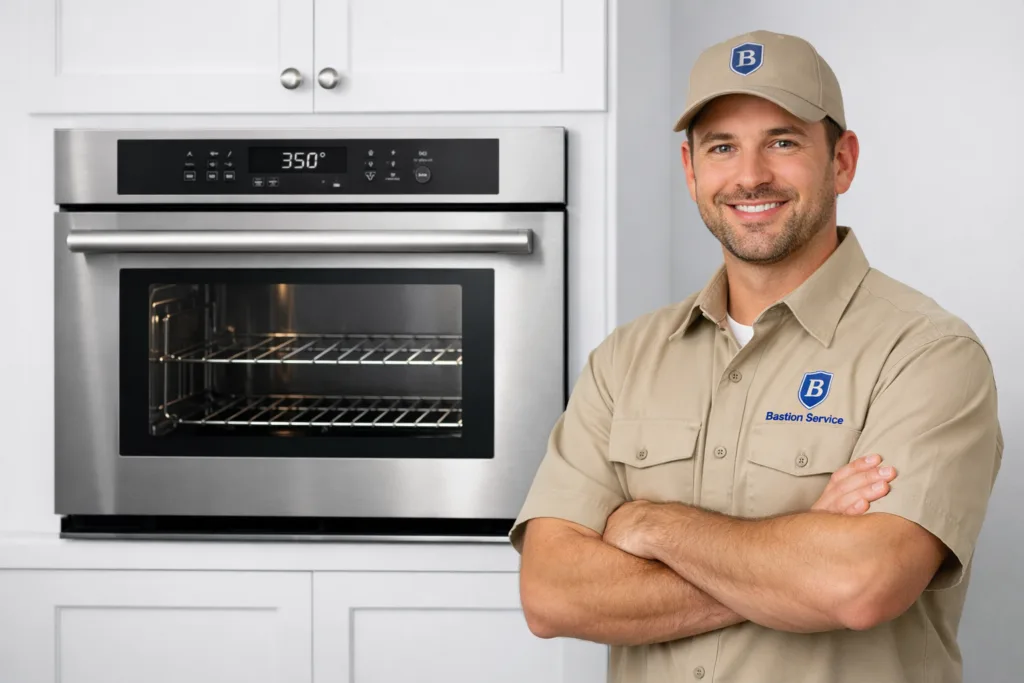
Oven problems rarely stay minor for long. A Summit oven that bakes unevenly, stalls during preheat, or shuts off mid-cycle can affect everyday meals and make simple cooking feel unpredictable. Because several different faults can create the same symptom, the best next step is to identify the failed component before deciding on parts or replacement.
Common Summit oven problems in Inglewood homes
Most homeowners first notice a change in cooking results rather than a complete breakdown. Cookies brown too fast on one side, casseroles take longer than expected, or the oven sounds like it is running but never reaches the set temperature. In other cases, the problem is obvious right away, such as no heat, a dead display, or an oven that stops responding during use.
Oven not heating
If the oven will not heat at all, the cause often depends on whether the Summit unit is electric or gas. Electric models may have a failed bake element, a broken broil element that affects overall heat performance, a damaged wire connection, a bad temperature sensor, or a control problem. Gas models commonly develop igniter issues, especially when the igniter glows but does not draw enough current to open the gas valve properly.
When there is no heat, repeated start attempts usually do not improve the situation. If the oven remains cold after multiple cycles, it is better to stop guessing and have the fault traced to the actual heating circuit, ignition system, or control source.
Slow preheating
A Summit oven that eventually gets hot but takes far too long to preheat is often showing an early failure rather than a temporary quirk. Weak igniters, tired heating elements, inaccurate sensors, and control relay problems can all stretch preheat time. This is one of the most common complaints because the oven still seems usable, yet dinner takes longer and results become inconsistent.
Slow preheating also matters because it can worsen over time. What starts as a 10-minute delay can become an oven that never reaches the selected temperature at all.
Uneven baking and temperature swings
If food burns on top, stays pale underneath, or cooks faster on one side, the issue may involve sensor readings, partial element failure, convection-related components on equipped models, or heat loss from a worn door gasket. Temperature swings can also come from control board issues that cause the oven to overshoot or undershoot the set point.
This kind of problem is frustrating because the oven still operates, just not reliably. Homeowners in Inglewood often notice this symptom first during baking, roasting, or any recipe where timing and stable heat matter.
Control panel problems
When buttons stop responding, the display flickers, error codes appear, or settings will not hold, the problem may be electronic rather than mechanical. A failing control board, keypad issue, loose connection, or power supply problem can prevent normal oven operation even when the heating components themselves are still functional.
Intermittent control problems are worth addressing early. Electronics that fail occasionally often become fully unresponsive later.
Oven shuts off during use
An oven that starts normally and then turns off can point to overheating protection, unstable power, a failing control, or wiring trouble. Some units may restart after cooling, which can make the problem seem random. In practice, that pattern usually means the condition is developing and should be checked before it leads to a complete outage.
Why the same symptom can have different causes
“Not heating” sounds like one problem, but it can come from several different failures. A gas oven may need an igniter, while an electric oven with the same complaint may have a failed element or open circuit. Uneven cooking might be caused by a sensor in one home and a door seal problem in another. That is why symptom-based guessing can lead to the wrong repair.
A proper diagnosis helps answer a few important questions:
- Which component actually failed
- Whether related parts were affected
- If the oven can still be used safely in the short term
- Whether the repair is straightforward or part of a larger issue
Signs you should stop using the oven
Some symptoms are inconvenient, while others raise safety concerns. It is smart to stop using the oven and arrange service if you notice any of the following:
- A strong or persistent gas smell
- Sparking, burning odor, or signs of melted wiring
- Visible damage to a heating element
- The oven trips the breaker repeatedly
- The door will not close properly and heat escapes heavily
- The unit overheats or shuts down unpredictably
Even when the oven still turns on, these warning signs suggest a fault that should not be ignored.
When delayed repair can make the problem worse
Many oven failures begin with reduced performance before turning into a complete breakdown. A weak igniter may continue to deteriorate until the oven no longer lights. A failing element can create inconsistent heat before it burns out entirely. Temperature regulation issues can force longer cycles that put extra stress on controls, wiring, and nearby components.
Delaying service can also make routine cooking harder to manage. If every meal requires longer cook times, constant rotation of pans, or repeated resets, the appliance is already telling you something is wrong.
Repair or replace?
For many Summit ovens, repair makes sense when the problem is isolated to one serviceable part and the rest of the appliance is in good condition. Igniters, elements, sensors, door gaskets, and some control-related components are common examples of repairs that may be reasonable depending on the model and overall condition.
Replacement may be the better path if the oven has multiple failing systems, extensive wiring damage, recurring electronic faults, or a repair cost that comes too close to the value of the appliance. Age matters, but condition matters just as much. An older oven with one clearly defined failure can still be a better repair candidate than a newer one with repeated control issues.
What Inglewood homeowners should pay attention to before service
A few details can make the service process more efficient. Before scheduling, it helps to note:
- Whether the problem affects bake, broil, or both
- If the issue is constant or intermittent
- Whether the display shows an error code
- How long preheating now takes compared with normal
- Whether the oven has unusual smells, sounds, or shutdown behavior
These observations do not replace diagnosis, but they do help narrow the likely fault pattern and speed up the decision on repair.
Focused help for Summit oven issues in Inglewood
When a Summit oven stops performing the way it should, the most useful approach is to match the repair plan to the actual symptom pattern and appliance condition. Whether the issue is no heat, slow preheat, uneven baking, temperature drift, or control trouble, homeowners in Inglewood benefit most from knowing exactly what failed and what the repair path looks like before moving forward.