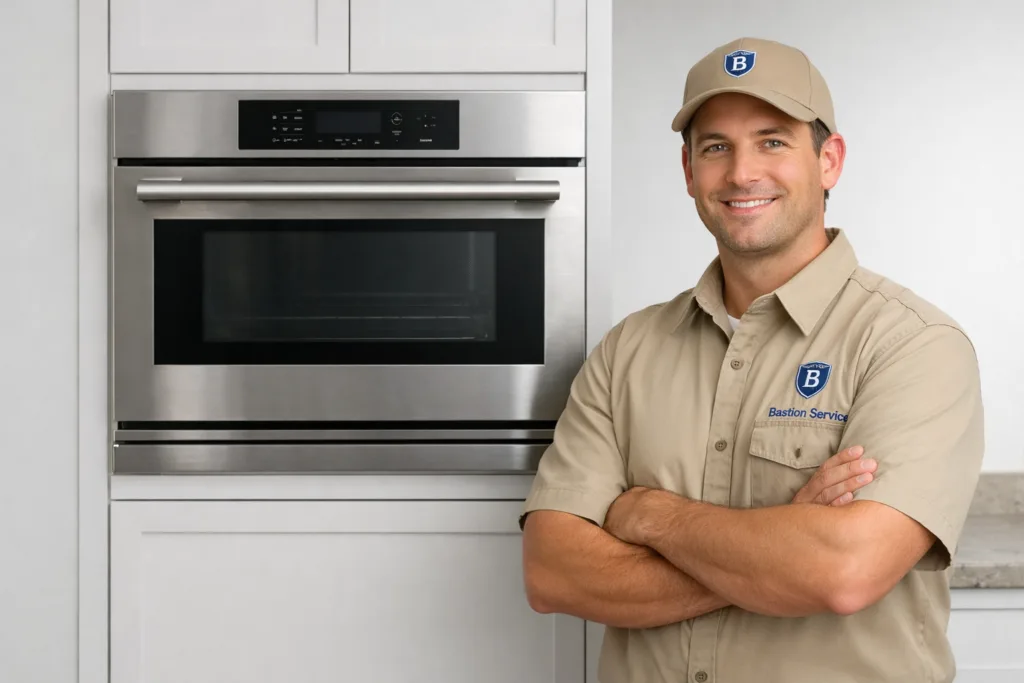
Wall oven problems often look simpler than they are. A Monogram unit may light up normally but fail to hold temperature, or it may show a door or control error even though the underlying cause is elsewhere. For homeowners in Rancho Palos Verdes, the most useful first step is identifying the exact symptom pattern before assuming which part has failed.
Start with how the oven is failing
Monogram wall ovens rely on several systems working together: incoming power, electronic controls, temperature sensing, heating components, fans, and door safety functions. When one of those systems starts to slip, the oven may still appear partly functional. That is why the details matter: whether the problem happens during preheat, only on bake, after self-clean, or at random during use.
Paying attention to the pattern can help separate a minor performance issue from a repair that should be scheduled quickly.
Oven will not heat or heats very slowly
If the display responds but the cavity does not warm properly, the problem may involve a bake element, broil element, temperature sensor, relay, or electronic control. In some cases, the oven reaches a warm state but never gets close to the selected temperature. In others, preheat starts normally and then stalls.
Common signs include:
- Preheat taking much longer than usual
- Food remaining pale or undercooked
- The oven tone indicating preheat is complete when it clearly is not
- Heat dropping off partway through a cooking cycle
When slow preheat keeps getting worse, it is usually best not to ignore it. A partial heating failure can develop into a full no-heat condition.
Uneven baking or temperature swings
If one tray browns too fast while another lags behind, or if familiar recipes suddenly need major timing changes, the oven may not be regulating temperature correctly. That can point to a weak sensor, element performance issue, convection problem, or control fault.
Temperature inconsistency is especially frustrating because the oven may still seem usable. The problem shows up in results instead of a total shutdown. Typical examples include cookies browning unevenly, casseroles cooking around the edges but staying cool in the middle, or roasting times becoming unpredictable.
Display, keypad, and control issues
A Monogram wall oven with a blank screen, beeping panel, intermittent buttons, or recurring error code may have a user interface problem, a control board issue, or an underlying power fault. Sometimes the oven turns on only after repeated attempts. Sometimes it cancels a cycle or resets on its own.
These symptoms are more than a nuisance. Control problems can interrupt cooking, affect temperature regulation, and make the oven unreliable even when the heating system itself is still intact.
Door not closing, locking, or unlocking properly
Door and latch issues can affect both performance and safety. If the door will not seal well, heat may escape and cause long preheat times or uneven baking. If the latch stays engaged after self-clean or will not engage when it should, the problem may involve the latch assembly, switch, hinges, gasket, or related control logic.
Signs to watch for include:
- A door that feels misaligned or pops open slightly
- A locked door after the cycle has ended
- Error messages related to the latch
- Hot air leaking noticeably from the door area
Convection fan or unusual noise problems
If the oven makes a new rattling, buzzing, or grinding sound, the issue may involve the convection fan, fan blade, mounting hardware, or a motor beginning to fail. Some fan noise is normal, but a change in sound often matters, especially if it comes with slow cooking or inconsistent browning.
When convection performance drops, food may cook unevenly even if the oven still reaches the set temperature.
What common symptoms can indicate
While the exact cause depends on the model and test results, these symptom groups often point in useful directions:
- No power at all: possible supply issue, fuse problem, control failure, or wiring fault
- Powers on but does not heat: possible element, sensor, relay, or board issue
- Overheats or burns food: possible sensor drift, calibration problem, or control malfunction
- Error code appears repeatedly: possible communication, latch, sensor, or control issue
- Door stays locked: possible self-clean latch or switch problem
- Long preheat and weak results: possible partial heating failure or temperature regulation issue
Because those symptoms can overlap, guessing at one part based on the most visible sign is not always the cheapest path.
When to stop using the oven
Some faults are mostly inconvenient. Others are a reason to stop using the appliance until it is checked. If the oven trips the breaker, shuts off unexpectedly, overheats, shows persistent electronic errors, or has a door that will not lock or unlock correctly, it should be serviced promptly.
You should also stop using the oven if you notice burning smells that do not fade after normal use, visible sparking, or signs of heat damage around the control area or door.
For gas models, a strong or ongoing gas odor should always be taken seriously. Stop using the appliance and address the gas concern before arranging repair.
Repair versus replacement
In many Rancho Palos Verdes homes, Monogram wall oven repair makes sense when the issue is isolated and the oven is otherwise in solid condition. Problems involving a sensor, heating component, latch assembly, or a specific control-related failure are often reasonable to repair.
Replacement may be worth considering when the oven has a history of repeated electronic failures, multiple major issues at the same time, or overall wear that makes future reliability doubtful. The right decision usually depends on:
- The age of the wall oven
- The condition of the controls and heating system
- Whether the failure is isolated or part of a broader pattern
- How important a matching built-in kitchen setup is to the household
What homeowners should note before service
A few details can make diagnosis faster and more accurate. Before scheduling Monogram wall oven repair in Rancho Palos Verdes, it helps to note:
- Whether the oven fails on bake, broil, convection, or all modes
- If the issue started suddenly or gradually
- Any error code shown on the display
- Whether the problem began after self-clean
- If the control panel stays on, goes blank, or resets
- Whether the oven is consistently too hot, too cool, or fluctuating
Even simple observations can help narrow the cause and avoid unnecessary trial-and-error part replacement.
Why symptom-based service matters
Wall oven issues affect more than one meal. Once temperature control becomes unreliable, everyday cooking gets harder to plan, and entertaining at home becomes more stressful. A service visit should help clarify whether the problem is electrical, mechanical, temperature-related, or tied to the control system, and whether the oven can be used safely until repair is completed.
For Rancho Palos Verdes homeowners, that kind of practical repair guidance makes it easier to decide on the next step with confidence.