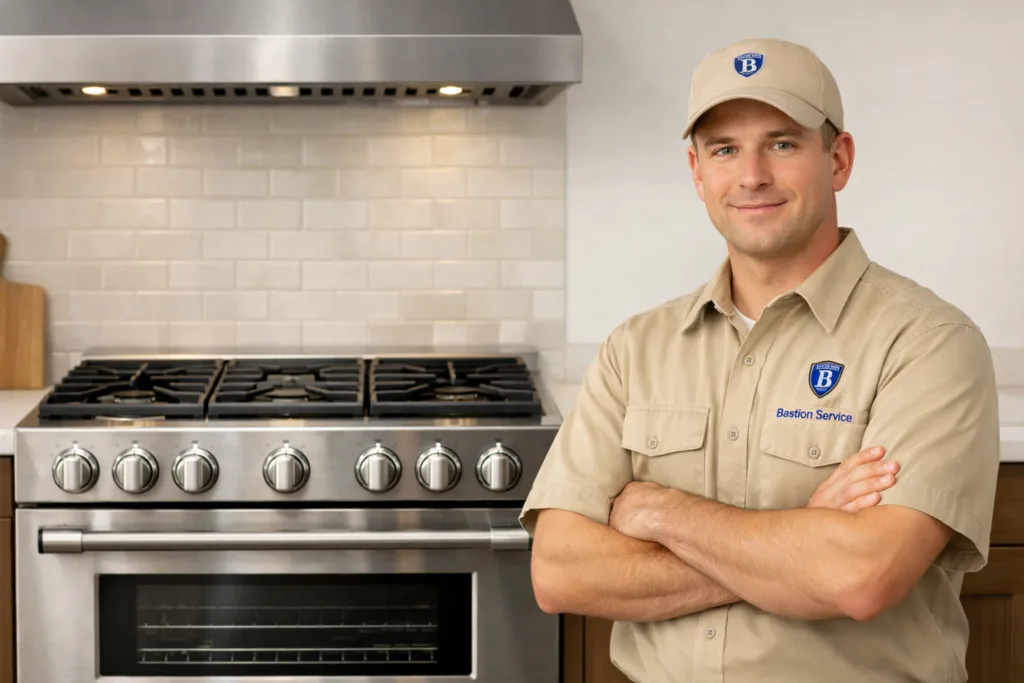
Common Monogram range problems homeowners notice first

Range issues usually show up in the middle of everyday cooking rather than all at once. You may see a burner that clicks but does not light, an oven that preheats slowly, or temperatures that seem off even though the display looks normal. With a Monogram range, those symptoms can point to different failures, so the pattern matters as much as the complaint itself.
A useful service call starts by separating surface symptoms from the actual cause. A heating complaint might involve an igniter, sensor, element, control, wiring issue, or a problem with incoming power. The same is true for burner performance, where ignition parts, burner alignment, moisture, and gas flow can all affect how the appliance behaves.
Burner ignition issues and repeated clicking
When a burner clicks but does not ignite
If you hear steady clicking but the burner does not light, the problem may be as simple as a burner cap that is out of position or as specific as a failing spark component. Food residue and moisture around the burner head can also interfere with normal ignition. In many homes, this starts as an occasional issue and gradually becomes more frequent.
If the burner eventually lights after several tries, that does not mean the problem has resolved. Delayed ignition usually means the system is no longer operating as it should and should be checked before it becomes a no-light condition.
When clicking continues after the flame appears
A burner that lights but keeps clicking can indicate moisture, a switch problem, or trouble in the ignition circuit. This may happen after cleaning, during humid conditions, or because a component is beginning to fail. Repeated clicking is more than a nuisance if it becomes regular, because continued use can put more wear on ignition-related parts.
Gas smell and ignition safety
If there is a strong or persistent gas odor, stop using the range and address safety first. That is different from a clicking complaint without a gas smell, which still needs service but points more directly to an ignition problem. Any gas-related symptom should be taken seriously rather than tested repeatedly at home.
Oven heating problems that affect daily cooking
Oven not reaching temperature
When the oven runs cool, food takes longer to finish and recipes that normally work well start coming out underdone. On a Monogram range, that can be caused by a weak igniter on gas models, a failing heating element on electric configurations, a sensor problem, or an electronic control issue that is not regulating heat correctly.
Homeowners in Rancho Palos Verdes often notice this first through baking results rather than a complete shutdown. Cookies may need extra time, casseroles may stay soft in the center, or preheat may seem unusually slow compared with normal use.
Oven overheating or temperature swings
An oven that runs hotter than the set temperature can be just as frustrating as one that runs cool. Burning on the outside, dry food, or sharp differences between one use and the next often suggest a regulation problem rather than a simple user setting issue. Sensor faults, relay problems, and control failures can all create this kind of uneven temperature behavior.
Uneven baking and hot spots
If one side of the oven browns faster, roasting results change, or pans need to be rotated far more than usual, the appliance may have airflow or temperature-distribution problems. On models with convection features, a failing fan or related component can affect cooking consistency. Worn door seals can also allow heat loss that disrupts stable performance.
Control panel, display, and response problems
Not every range problem starts with heat. Sometimes the first sign is an unresponsive keypad, a display that behaves erratically, or settings that do not register correctly. A range may appear to have power but still refuse to start certain functions, cycle unpredictably, or show errors that come and go.
These symptoms often overlap with heating complaints, which is why guessing can lead to the wrong repair. What seems like a bad oven component may actually trace back to the control system, wiring, or a power-related fault affecting multiple functions at once.
Why accurate testing matters on a Monogram range
Premium cooking appliances often combine multiple systems in one unit, and that means one symptom can travel through several possible causes. A burner issue may not be limited to the burner. An oven complaint may not begin with the oven cavity itself. Electronic faults can mimic mechanical failures, and partial failures can make the range seem inconsistent rather than completely broken.
That is why Monogram Range Repair in Rancho Palos Verdes is most worthwhile when the diagnosis confirms what has failed, what related parts should be checked, and whether the issue looks isolated or part of broader wear. That kind of practical repair guidance helps homeowners avoid replacing parts based only on symptoms.
Signs it is time to schedule service
It is smart to schedule service when a symptom repeats, even if the range still works some of the time. Early attention can help prevent extra strain on ignition components, sensors, controls, and heating parts.
- Burners light only after multiple attempts
- Clicking happens regularly during normal use
- The oven takes much longer to preheat
- Food is suddenly undercooking or overcooking
- The display is inconsistent or certain settings stop responding
- One function fails while others still appear normal
If the appliance has lost a major function entirely, such as an oven that will not heat or a burner that no longer ignites, service should be scheduled promptly rather than waiting for the problem to spread.
When continued use can make the repair bigger
Some problems stay relatively contained for a while, but others tend to worsen with continued use. Repeated ignition attempts can wear components further. Unstable oven temperatures can affect nearby parts over time. Electrical irregularities can move beyond one feature and begin affecting additional functions.
Even if the range is still partly usable, abnormal operation should not be treated as normal household wear. If performance is changing noticeably, there is a reason behind it, and catching that reason early is often the best way to keep the repair more limited.
Repair or replace a Monogram range?
Replacement is not always the right next step when a range develops a major symptom. Many repairs are sensible when the issue is tied to a specific igniter, element, sensor, control component, or other identifiable part. The more important question is whether the current problem stands on its own or reflects a larger pattern of repeated breakdowns and overall decline.
For many Rancho Palos Verdes households, the decision usually comes down to a few practical factors:
- Which component has failed
- The overall condition of the range
- Whether other recent problems have appeared
- How well the appliance is expected to perform after repair
Once the actual fault is known, the repair-versus-replacement decision becomes much easier and far less speculative.
What homeowners should expect from service
Helpful service should do more than repeat the symptom back to you. It should connect the behavior you are seeing to the likely failure, explain whether normal use should stop for now, and outline whether repair is straightforward or likely to involve broader issues. That is especially important when a range still works part of the time, because intermittent problems are often the easiest to misread.
For Monogram range owners in Rancho Palos Verdes, the goal is simple: restore safe, predictable cooking performance without unnecessary trial and error. When the problem is identified correctly, the next step is usually much clearer.