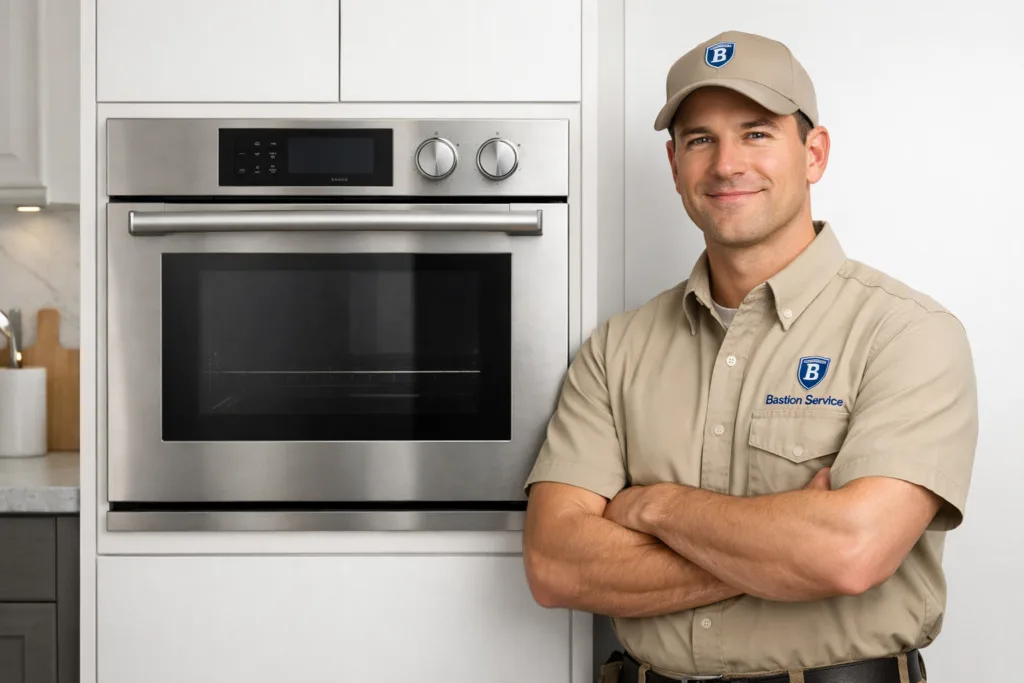
Cooking problems usually become easier to solve once the symptom is narrowed down. A Monogram wall oven that runs too cool, browns unevenly, shuts off during a cycle, or refuses to start can point to very different faults, even when the experience in the kitchen feels similar. In Culver City homes, the most useful repair path is based on what the oven is actually doing in bake, broil, convection, and preheat.
How Monogram wall oven problems usually show up
Wall ovens often give warning signs before they stop working completely. Some start with longer preheat times. Others begin to overcook on one rack, leave the center underdone, or heat normally one day and fail the next. Because Monogram wall ovens rely on several components working together, a single symptom can involve the heating element, temperature sensor, control relay, door seal, latch assembly, or power supply.
That is why it helps to look at the pattern instead of assuming one part is bad. An oven that seems slow may still heat, but not accurately. An oven that appears dead may have partial power. A display problem may be separate from the actual heating complaint, or directly connected to it.
Not heating or taking too long to preheat
If the oven does not heat at all, the cause may be more serious than a simple calibration issue. Common possibilities include a failed bake element, a broil circuit problem, a blown thermal protection component, wiring trouble, or a control failure. When the oven does heat but takes much longer than it used to, the issue may be a weak element, a sensor reading incorrectly, or a door that is letting heat escape.
Preheat complaints are especially noticeable in daily cooking because meals become harder to time and results become less predictable. If preheat time has gradually increased, it is often a sign that one part of the heating system is no longer performing normally.
Uneven baking and temperature swings
When cookies brown more on one side, casseroles need extra time in the center, or dishes come out overcooked on top and undercooked below, the oven may not be maintaining temperature evenly. This can happen when sensor feedback is off, one heating circuit is underperforming, airflow is disrupted, or the control is cycling heat poorly.
Temperature swings are not always obvious from the display. Many homeowners notice them first through results: recipes that suddenly need major adjustments, familiar foods that burn at the edges, or repeated differences between racks. If those changes become consistent, the oven usually needs service rather than trial-and-error setting changes.
Control, display, and power-related issues
Electronic faults can show up as a blank display, unresponsive touch controls, resetting clock, random beeping, or error messages that interrupt cooking. In some cases, the oven still has power but cannot complete commands. In others, it may start a cycle and then shut off unexpectedly.
On a Monogram wall oven, these problems may involve the interface, the main control board, the door lock circuit, or incoming electrical supply. Error codes can help narrow the direction of testing, but they do not automatically confirm which part has failed. Replacing electronics based on a guess can become expensive quickly, especially if the original fault is elsewhere in the circuit.
When the oven trips power or shuts off mid-cycle
If the oven trips a breaker, cuts out during use, or loses power as it heats up, stop using it until the cause is checked. Heat-related electrical faults can worsen with repeated use. The problem may stem from wiring, a shorted component, a failing control, or a damaged heating element.
A shutdown that happens only during higher-temperature cooking can be an important clue. So can a breaker trip that appears only in one mode. Those details help separate a control issue from a heating or supply problem.
Door, hinge, and self-clean complaints
Door problems are more important than they first appear. If the oven door will not close evenly, opens with unusual resistance, will not unlock, or leaves a visible gap, temperature performance can suffer. Lost heat affects preheat speed, baking consistency, and overall efficiency.
Common causes include worn hinges, a damaged gasket, latch trouble, misalignment, or a control problem tied to the lock system. These issues often become more noticeable after self-clean, when high heat puts extra stress on already aging parts.
If a self-clean cycle seems to trigger a new fault, it is usually best not to run it again until the oven is evaluated. Lock errors, nonresponsive controls, sensor failures, and thermal protection problems sometimes appear right after that high-heat cycle.
Symptoms that usually mean service should not wait
Some issues can be monitored briefly, but others deserve prompt attention. Scheduling Monogram wall oven service is usually the right move when the same failure repeats across multiple uses or when the oven shows electrical warning signs.
- The oven will not heat in bake or broil
- Preheat has become much slower than normal
- Food cooks unevenly from side to side or rack to rack
- The display, controls, or timer behave unpredictably
- The oven shuts off during cooking
- Error codes return after being cleared
- The door will not close, lock, or unlock properly
- There is sparking, a burning electrical smell, or visible element damage
For sparking or a strong burning smell, discontinue use immediately. Those are not symptoms to keep testing at home.
Repair or replace: what makes sense for a built-in wall oven
For many Culver City homeowners, repair is worth considering when the problem is isolated and the rest of the oven is in solid condition. Heating elements, sensors, latch components, and some control-related failures can be practical repairs when the appliance is otherwise performing well.
Replacement becomes a stronger option when there are multiple expensive faults, recurring electronic failures, or signs of broader wear that go beyond one component. With a built-in wall oven, the decision is also shaped by cabinet fit, trim compatibility, and installation complexity. That often makes a careful diagnosis more valuable than with a freestanding appliance.
In other words, the right answer is not just about age. It is about the kind of failure, the cost path, and whether the oven is showing one repairable problem or a broader pattern of decline.
What to note before a service visit
A few details can make troubleshooting much more efficient. If possible, write down whether the problem happens in bake, broil, convection, or every mode. Note any error code exactly as shown. It also helps to remember whether the issue started after self-clean, after a power interruption, or after a period of slow performance.
Other useful observations include:
- Whether the oven heats at all or only partially
- Whether it reaches temperature and then falls off
- Whether one cooking mode works while another does not
- Whether the display stays on when heating stops
- Whether the door seems loose, misaligned, or difficult to latch
That kind of symptom history often helps identify the real issue faster and reduces unnecessary parts replacement. For a built-in appliance used every day, that is usually the most sensible route back to reliable cooking.