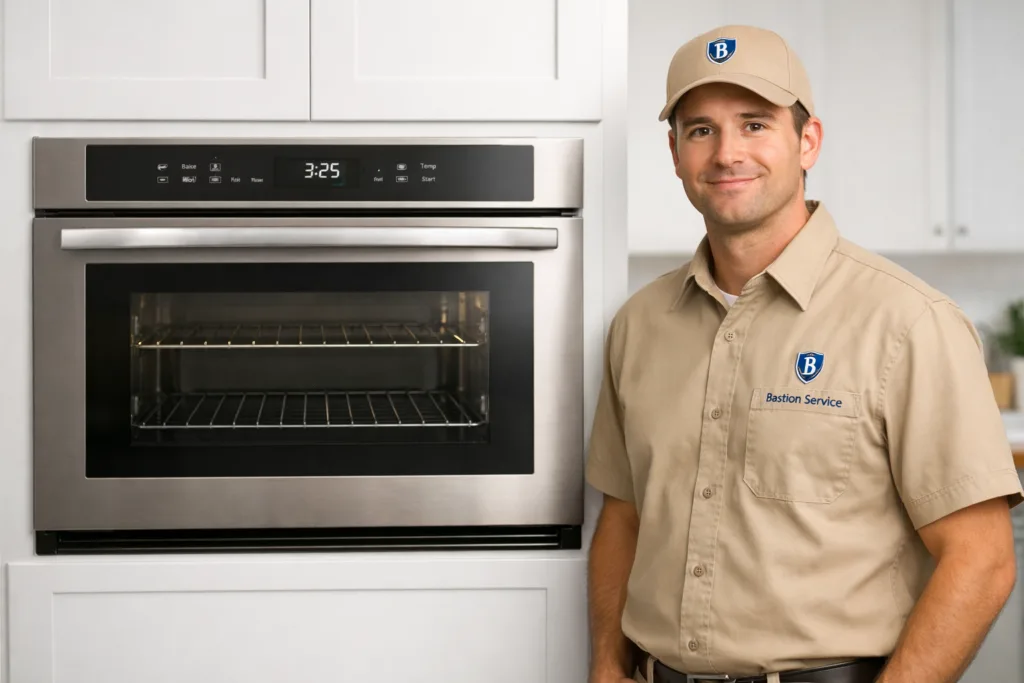
Wall oven problems often start with a small change in performance. Preheat takes longer than usual, one casserole comes out underdone while another browns too fast, or the display begins flashing at random. On a Whirlpool built-in unit, those symptoms can point to different failures, so the most useful first step is to match the repair plan to the way the oven is actually behaving.
Common Whirlpool wall oven symptoms in Culver City homes
Most service calls fall into a few recognizable patterns. Understanding those patterns can help you decide when the issue is minor, when it needs prompt attention, and when continued use may risk a larger repair.
Not heating at all
If the control panel responds but the oven cavity stays cold, the problem may involve the bake element, broil element, sensor circuit, thermal protection component, wiring, or the electronic control. Some Whirlpool wall ovens will appear to start normally even when a key heating part has failed, which is why the display alone does not confirm that the oven is truly working.
Slow preheat
Slow preheat is one of the most common complaints with built-in ovens. In some cases, the oven is heating on only one element. In others, the sensor may be reporting temperature inaccurately, causing the control to cycle heat incorrectly. Homeowners usually notice this first through longer meal prep times, inconsistent roasting results, or recipes that suddenly need extra minutes across the board.
Uneven baking
When cookies brown more on one side, the top rack cooks much faster than the lower rack, or casseroles finish inconsistently, the issue may be tied to element performance, temperature sensing, calibration drift, or airflow problems. Uneven baking does not always mean the oven is completely failing, but it does mean the temperature inside the cavity is not staying as stable as it should.
Temperature swings
All ovens cycle heat to maintain temperature, but wide swings can create obvious cooking problems. If food burns on the outside before the center is done, or if the oven seems much hotter or cooler than the setting, a sensor, relay, or control problem may be affecting regulation. This is especially frustrating in homes where the oven is used regularly for baking rather than just reheating meals.
Display or control issues
A Whirlpool wall oven may beep unexpectedly, stop mid-cycle, fail to accept keypad input, or show an error code that returns after resetting power. Those symptoms can come from a failing interface, control board fault, communication problem, or a separate component that is feeding the control incorrect information. Error codes are helpful clues, but they do not always identify the exact part that needs repair.
Door and latch problems
If the oven door will not close properly, will not unlock, or seems misaligned, the problem may involve hinges, the latch assembly, switches, or heat-related wear after repeated high-temperature use. On self-clean models, latch trouble can leave the oven stuck in a locked state even after the cycle ends.
Completely dead oven
When there is no display, no interior light, and no response from the controls, diagnosis usually starts with incoming power, wiring, thermal cutoffs, and the main control. Because wall ovens are built into cabinetry and connected differently than plug-in appliances, it is important to determine whether the failure is inside the oven or related to the electrical supply reaching it.
What these symptoms usually mean
One symptom can have several possible causes. A wall oven that will not reach temperature may have a weak heating element, but it could also have a bad sensor or a control relay that is not sending power consistently. A door that will not unlock may point to the latch itself, or to a control issue that is failing to recognize latch position.
That overlap is why part-swapping based on guesswork often costs more in the long run. With Whirlpool wall ovens, accurate testing matters because heating complaints, control complaints, and self-clean complaints can all cross into one another.
Signs the oven should not keep being used
Some issues are more than an inconvenience. It is best to stop using the oven and schedule service if you notice:
- Burning smells that do not seem related to food residue
- Visible sparking or signs of arcing
- Breaker trips when the oven heats
- Smoke that appears electrical rather than cooking-related
- The oven shutting off unpredictably during use
- Extreme overheating or temperatures far above the selected setting
These symptoms can indicate electrical or control-related faults that may worsen if the oven is repeatedly reset and used again.
When a service visit makes sense
Scheduling Whirlpool wall oven service is usually worthwhile when the problem is recurring rather than one-time. A single odd preheat cycle may not mean immediate failure, but repeated slow heating, repeated fault codes, or repeated temperature inconsistency usually points to a real component problem.
Service is also a smart next step if you have already ruled out basic user settings. Control lock, delayed start, timer confusion, and cooking mode selection can sometimes look like a malfunction. If those have been checked and the oven still performs poorly, the issue is more likely mechanical or electrical.
How diagnosis helps with repair decisions
Built-in ovens are different from freestanding appliances because replacement is not always simple. Cabinet fit, trim compatibility, electrical setup, and installation labor can all affect the decision. For that reason, many homeowners in Culver City prefer to know exactly what failed before deciding whether to repair or replace.
Repair is often the better path when the issue is isolated to a sensor, element, latch component, switch, or a repairable control-related part and the oven is otherwise in good condition. Replacement becomes more reasonable when the unit has multiple major failures, a long history of repeat problems, or repair costs that approach the value of the appliance.
Symptom-based examples homeowners often notice
“The oven says it is preheated, but food is still undercooked”
This often points to inaccurate temperature sensing or a heating system that is not cycling correctly. The control may believe the oven has reached the target temperature when the actual cavity is still too cool.
“It bakes fine sometimes, then badly the next time”
Intermittent performance can suggest a sensor drifting in and out of range, a control relay failing under heat, or wiring that becomes unreliable as the oven warms up. Intermittent issues are worth addressing early because they usually become more frequent.
“The broiler works, but baking does not”
That symptom often narrows attention to the bake side of the heating circuit, though the final cause may still be the element itself, wiring, or the board that controls it.
“The oven stopped working after self-clean”
Self-clean cycles put heavy thermal stress on components. After that kind of high-heat operation, some ovens develop latch faults, sensor issues, thermal cutoff failures, or board damage. If the problem started immediately after self-clean, that timing is an important diagnostic clue.
What homeowners in Culver City should expect from a repair evaluation
A useful repair visit should identify the failed system, explain how that failure matches the symptom pattern, and clarify whether the recommended repair is likely to restore normal operation. That is especially important with a Whirlpool wall oven, where similar complaints can come from very different parts.
For households in Culver City that rely on the oven for daily cooking, the goal is not just to get heat back temporarily. It is to resolve the underlying cause of the poor performance, whether that means correcting a temperature problem, restoring consistent heating, fixing a latch issue, or addressing a control fault that keeps interrupting use.
Practical next steps when your Whirlpool wall oven acts up
If the unit still powers on, note the specific pattern before service: whether preheat is slow every time or only sometimes, whether one cooking mode works better than another, whether an error code appears during heating or only at startup, and whether the problem began after a power interruption or self-clean cycle. Those details often make diagnosis faster and more accurate.
If the oven is dead, tripping power, overheating, or showing signs of electrical trouble, avoid continued operation until it has been checked. Early attention can prevent a smaller repair from turning into a more expensive control or wiring problem.