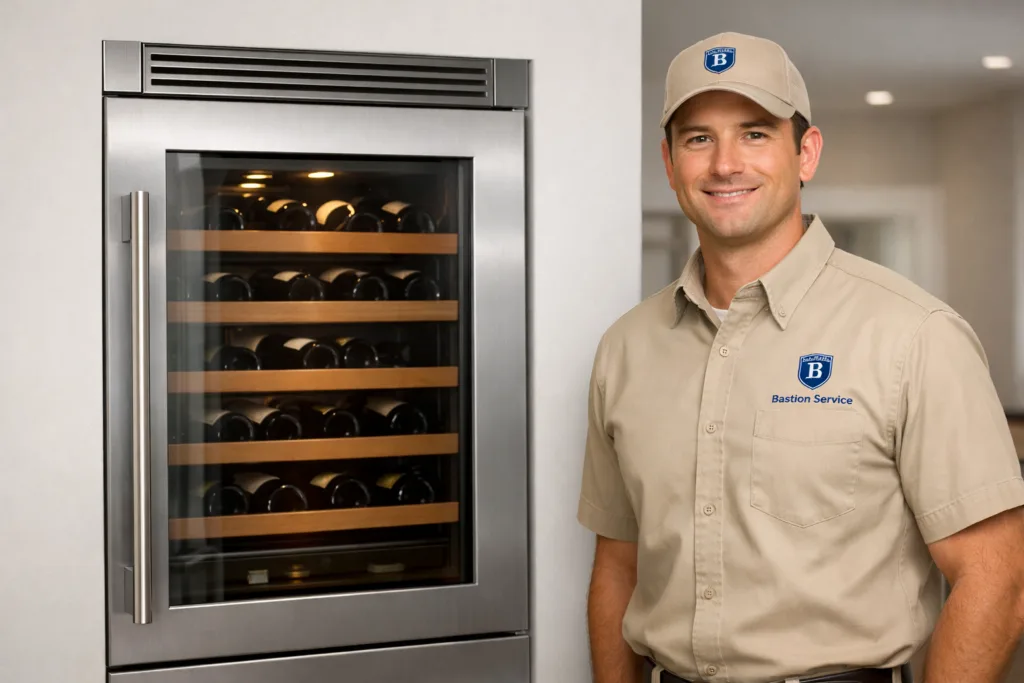
Stable temperature matters in a wine cooler because small swings can change how the cabinet performs long before the unit stops cooling altogether. If your Monogram wine cooler is warming up, overcooling, running loudly, or building moisture, the symptom pattern usually tells you where the problem is starting—airflow, controls, fan operation, door sealing, or the refrigeration system itself.
Signs your wine cooler needs attention
Many households first notice a problem when bottles feel less consistently chilled or the display no longer seems to match the actual cabinet temperature. In other cases, the warning sign is sound: a fan that suddenly gets louder, a repeated clicking noise, or a unit that seems to run all day without settling into a normal cycle.
It is smart to pay attention to changes such as:
- Cabinet temperature drifting above the set point
- Interior getting too cold or freezing items near one section
- Uneven cooling from top to bottom or side to side
- Condensation on the glass or moisture inside the cabinet
- Frost buildup on interior surfaces
- Fan noise, buzzing, rattling, or repeated clicking
- Display errors or controls that do not respond normally
- Compressor running constantly or cycling too often
These symptoms do not all point to the same repair. Two coolers can both seem “not cold enough” while one has a circulation issue and the other has a more serious sealed-system problem.
Temperature swings and weak cooling performance
If the cooler is no longer holding a steady temperature, there are several likely causes. Restricted ventilation, a dirty condenser area, a weak evaporator fan, a faulty sensor, or a control problem can all interfere with normal cooling. On built-in and under-counter units, heat management is especially important because limited airflow around the cabinet can make the system work harder than it should.
A common complaint is that the cooler still runs but takes too long to recover after the door is opened. That can happen from normal use, but when recovery becomes noticeably slower, it often suggests that the unit is losing efficiency. If the issue is left alone, the system may start running longer and longer until the cabinet never fully reaches the set temperature.
When the cabinet is too warm
A warmer-than-normal cabinet can be tied to poor airflow, fan failure, a sensor giving inaccurate readings, a control board issue, or declining refrigeration performance. If interior lights and the display appear normal but the bottles are not staying cool, that is a sign the appliance needs more than a settings check.
When the cabinet is too cold
Overcooling can be just as important as warming. If one section is freezing or the whole unit is dropping below the selected temperature, the fault may involve sensor feedback, thermostat regulation, or an electronic control issue. This kind of problem can make the cooler seem functional at first, even though it is not maintaining proper storage conditions.
Uneven temperatures inside the cabinet
Monogram wine coolers are designed to maintain consistent storage conditions, so hot spots or cold spots usually indicate a problem worth checking. Uneven cooling may show up as bottles near the top staying warmer than those below, or one area becoming noticeably colder than the rest.
Possible causes include:
- Evaporator fan running weakly or intermittently
- Air passages blocked by frost or debris
- Door gasket allowing warm air intrusion
- Sensor or control irregularities
- Partial cooling-system performance loss
If the issue appears only occasionally, it can be tempting to wait. But intermittent temperature imbalance often becomes easier to identify before the appliance reaches a full no-cool condition.
Condensation, moisture, and frost buildup
Water droplets on the glass, damp shelving, or frost collecting where it normally does not belong can all signal trouble. Some moisture can occur during heavy use, but recurring condensation usually means warm air is entering the cabinet or temperature regulation is off.
In Culver City homes, it helps to notice whether the moisture appears after frequent door openings or whether it forms even with normal use. That distinction can help separate a usage-related pattern from a mechanical issue.
What moisture problems may indicate
- Door gasket not sealing tightly
- Cabinet door slightly misaligned
- Drainage issue causing water to collect inside
- Cooling cycle irregularities leading to excess humidity
- Frost buildup interfering with airflow
When frost starts to return after being cleared, that is usually a sign the underlying cause remains. Continued operation in that condition can strain fans and reduce overall cooling consistency.
Noise changes that should not be ignored
Wine coolers are not silent, but the sound profile should be fairly predictable. A sudden change is often meaningful. Buzzing may come from vibration or compressor stress. Rattling can point to mounting or panel issues. Clicking can be a sign of a start problem, a relay issue, or an electrical fault. A louder fan sound can indicate obstruction, wear, or frost interference.
If the unit sounds different and cooling performance has changed at the same time, those two symptoms together usually narrow the diagnosis more quickly than either one alone.
Constant running or short cycling
A Monogram wine cooler that rarely shuts off may be trying to overcome heat, air leakage, dirty condenser surfaces, or weakened system performance. On the other hand, a cooler that starts and stops too frequently may have a control issue, a sensor problem, or an electrical component beginning to fail.
Watch for patterns such as:
- Unit running nearly nonstop but still not cold enough
- Compressor attempting to start, then clicking off
- Cooling for short bursts without reaching the target temperature
- Display operating normally while cabinet performance falls behind
These are the kinds of issues that tend to worsen with delay, especially when the appliance is repeatedly trying to restart.
Control and display problems
Sometimes the first symptom appears on the interface rather than in the temperature itself. Buttons may stop responding, the display may flash or behave erratically, or the shown temperature may not match what the cabinet is actually doing. In those cases, the issue may be in the user interface, control board, sensor circuit, or power-related components.
Because control faults can imitate other failures, replacing parts based only on the visible symptom is not always the best approach. Testing how the controls respond alongside actual cabinet performance is what separates a simple fix from guesswork.
When repair makes sense
Repair is often a reasonable option when the cabinet is in good overall condition and the failure is limited to a serviceable part such as a fan motor, control component, sensor, gasket, or drainage-related part. Many wine cooler problems start small and are worth correcting before they place extra wear on the compressor and other cooling components.
Replacement may deserve stronger consideration when the unit has repeated cooling failures, multiple aging parts at once, or a major sealed-system issue that changes the long-term value of the repair. The right decision depends on condition, symptom history, and how extensive the actual fault turns out to be.
What homeowners should note before service
A few observations can make diagnosis faster and more accurate. Before your appointment, it helps to note:
- Whether the cabinet is too warm, too cold, or fluctuating
- How long the problem has been happening
- Whether noise, moisture, and temperature changes started together
- If the issue affects the entire cabinet or one section
- Whether the display is showing normal settings or unusual behavior
- If the unit runs constantly, clicks repeatedly, or struggles to restart
Even simple details can help identify whether the problem is primarily airflow-related, electrical, control-based, or tied to the refrigeration system.
Service for Monogram wine coolers in Culver City homes
For homeowners in Culver City, the most helpful repair visit is one that explains why the unit is no longer maintaining proper storage conditions and what the realistic next step is. Whether the problem involves temperature swings, fan noise, condensation, frost, or a display issue, the goal is to restore reliable operation without unnecessary parts replacement.
If your Monogram wine cooler is no longer cooling the way it should, acting inconsistently, or showing signs of strain, early service can prevent a narrower issue from turning into a larger refrigeration repair.