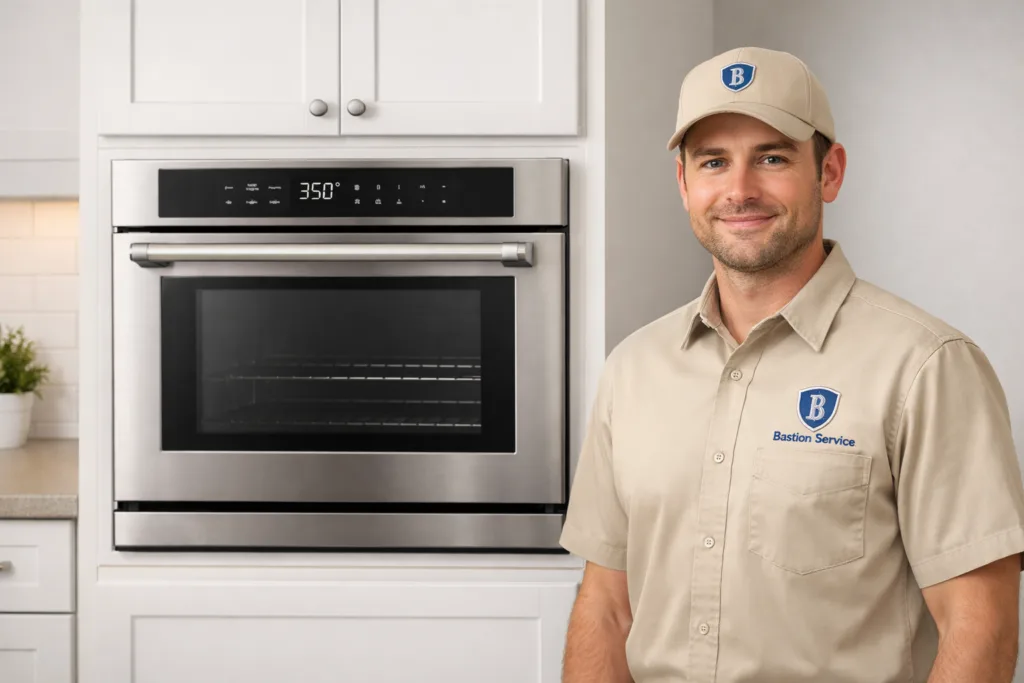
Wall oven problems rarely stay minor for long. A unit that runs a little cool today may become a no-heat call next week, and an oven that occasionally shuts off can turn into a control or wiring repair if it keeps being used under load. For homeowners in Culver City, the most useful starting point is to match the symptom pattern to the likely failed system instead of assuming every heating problem has the same cause.
How KitchenAid wall oven issues usually show up
Most problems fall into a few recognizable categories. The oven may not heat at all, may heat unevenly, may take far too long to preheat, or may show display and control issues that interrupt cooking. Those symptoms can seem similar from the outside, but the repair path changes depending on whether the fault is in a heating element, sensor circuit, control, door latch system, fan, or power-related component.
That difference matters because replacing the wrong part wastes time and does not solve the underlying issue. A wall oven needs testing based on what it is actually doing during bake, broil, convection, and preheat.
Not heating at all
If the oven turns on but never gets hot, the problem may involve a failed bake or broil element, a bad temperature sensor, a thermal safety component, damaged wiring, or an electronic control fault. In some cases, homeowners notice the broil still works while bake does not, or the oven light and display appear normal even though there is no heat. Those details help narrow the likely cause.
Uneven baking and temperature swings
When food cooks differently from one rack to another, or comes out underdone despite the correct setting, the oven may be struggling to regulate temperature. A drifting sensor, weak element, airflow issue, fan problem, or calibration-related fault can all create inconsistent results. This is one of the most frustrating wall oven issues because the appliance still seems usable, but cooking becomes unpredictable.
Slow preheat or endless preheat
A KitchenAid wall oven that takes much longer than normal to preheat often has a heating component that is no longer performing at full strength. Sometimes the oven eventually reaches temperature, but only after excessive cycling. Other times, it appears stuck in preheat and never stabilizes. Continued use in this condition can put extra stress on controls and connectors.
Display errors and intermittent shutoffs
Flashing codes, random beeping, a blank display, or a unit that stops mid-cycle usually point toward an electrical or control-side issue. Intermittent faults are especially important to evaluate carefully because the oven may behave normally during one use and fail during the next. If the clock resets, the keypad misses inputs, or the oven cancels itself during baking, that pattern should not be ignored.
Symptoms that suggest you should stop using the oven
Some wall oven problems are inconvenient. Others can signal risk of further damage. It is wise to pause use and schedule service if you notice:
- Burning or overheated electrical smells
- Breaker trips when the oven starts heating
- Recurring error codes that return after resetting power
- The door locks or unlocks at the wrong time
- The oven overheats far beyond the set temperature
- The unit shuts off during normal cooking cycles
These symptoms can indicate failing wiring connections, control problems, latch faults, or overheating conditions that may worsen if the oven continues to run.
What certain symptoms often point to
- No bake heat: bake element, sensor, control, thermal protection, or wiring issue
- Broil works but bake does not: often a bake-side component failure
- Food browns unevenly: sensor drift, weak heating performance, or airflow problem
- Very slow preheat: weak element, sensor fault, or control-related cycling issue
- Error code on the display: sensor circuit, latch assembly, keypad, or control problem
- Door lock problems: latch motor, switch, alignment, or control fault
- Shuts off while cooking: overheating protection, loose connection, or failing electronics
Built-in wall ovens need a more careful repair approach
Unlike a freestanding range, a wall oven is installed into cabinetry, so access and removal matter. Service often involves more than checking whether the unit powers on. Trim, mounting, electrical feed, and component access can all affect how the repair is handled. For that reason, the most accurate service calls usually begin with a symptom description that includes what cycle was used, whether the issue happens every time, and whether the problem started suddenly or gradually.
In Culver City homes, built-in oven repairs are often more practical than replacement when the fault is limited to a specific component and the rest of the appliance is in solid condition. That is especially true when cabinet fit and installation constraints make a full replacement more involved than it first appears.
When repair makes sense and when it may not
Many KitchenAid wall oven problems are repairable when the failure is isolated. Heating elements, sensors, latch assemblies, fans, switches, and some electrical parts can often be addressed without replacing the entire appliance. A repair decision becomes less favorable when the oven has repeated major electrical failures, extensive internal heat damage, or a high-cost control issue on an older unit already showing broader wear.
The right decision depends on the exact failure, the age and condition of the oven, and whether the problem appears isolated or part of a larger decline. A good diagnosis helps separate a focused repair from a situation where replacement deserves consideration.
What to note before scheduling service
If your wall oven is acting up, a few observations can make the problem easier to identify:
- Whether bake, broil, convection, or all functions are affected
- If the issue happens on every cycle or only occasionally
- Any error code shown on the display
- Whether the oven heats too little, too much, or not at all
- If the problem began suddenly after a normal use or worsened over time
- Whether the door lock or controls behave abnormally
Those details often help determine whether the likely issue is mechanical, electrical, or control-related.
Repair help for KitchenAid wall ovens in Culver City
When a built-in oven becomes unreliable, waiting usually does not improve the outcome. If your KitchenAid wall oven is cooking unevenly, taking too long to preheat, failing to regulate temperature, or showing control problems, the next step is to have the fault narrowed down and the repair options weighed against the oven’s condition. That makes it easier to decide whether a targeted repair is the right move for your kitchen and your household routine.