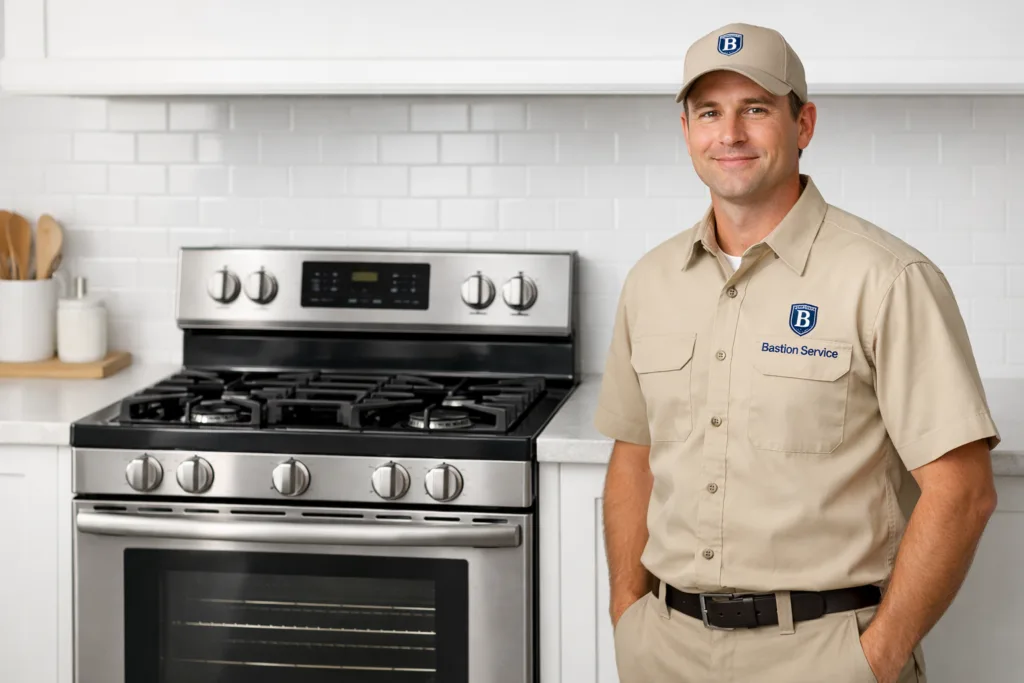
Range problems tend to show up in the middle of normal routines: breakfast on a burner that will not spark, an oven that needs far too long to preheat, or dinner that comes out uneven even though the recipe has not changed. With Kenmore ranges, those symptoms can point to different faults depending on whether the issue starts at ignition, heating components, temperature sensing, control electronics, or the incoming power supply.
For homeowners in Palms, the most useful approach is to match the repair path to the exact behavior of the appliance. That usually means looking beyond the obvious symptom and checking what the range does at each step, from startup to temperature recovery to shutoff.
Symptoms that usually mean the range needs attention
Some range issues are easy to spot right away, while others build slowly over time. If your Kenmore unit is doing any of the following on a regular basis, it is worth having the problem evaluated:
- Oven will not heat, or heats only partway
- Preheat takes much longer than it used to
- Surface burner clicks repeatedly without lighting
- Burner ignites but flame looks weak or uneven
- Temperature swings cause inconsistent baking or roasting
- Touchpad, knobs, or display do not respond normally
- Range works intermittently or shuts off unexpectedly
These issues can overlap. A control fault may look like a heating problem, and a weak igniter can appear to be a gas-flow issue when the real problem is that the valve is not being opened properly.
Oven not heating, slow preheat, or uneven baking
What this can indicate on a Kenmore range
If the oven is not reaching the set temperature, several components may be involved. On electric models, a failed bake element or broil element can reduce heat output enough to cause long preheat times and uneven results. On gas models, the igniter is one of the most common causes. It may glow and still be too weak to ignite gas correctly or consistently.
Other possibilities include a temperature sensor that is reading inaccurately, a relay or control board problem, or damaged wiring between the control and the heating circuit. In some cases, the oven does heat, but not in a stable way, which leads to food browning too fast on top, staying pale underneath, or finishing at inconsistent times.
Signs the issue is more than calibration
Many homeowners first assume the oven simply needs an adjustment. Sometimes that is true, but recurring underheating or overheating often points to a part failure rather than a simple setting change. A few common clues are:
- Preheat completes but the oven never seems fully hot
- Temperature drops sharply when food is placed inside and does not recover well
- The broiler works but bake does not, or the reverse
- Results vary widely from one use to the next
When those patterns show up, component testing is usually more helpful than guessing at a temperature offset.
Burners that click, fail to light, or heat poorly
Repeated clicking without ignition
One of the most common complaints with a Kenmore range is a burner that clicks over and over but does not light. Sometimes the cause is simple, such as moisture after cleaning, food residue around the igniter area, or a burner cap that is not seated correctly. In other cases, the problem comes from a worn ignition switch, a spark module issue, or a fault in the wiring to the burner circuit.
If the clicking continues after the burner is dry and properly aligned, it usually needs closer inspection. Repeated attempts to light the burner without resolving the cause can make the problem more frustrating and can mask whether the issue is isolated to one burner or affecting the ignition system more broadly.
Weak flame or uneven burner performance
When a burner lights but does not heat evenly, the cause may be blocked burner ports, a damaged burner head, restricted gas flow, or a valve-related issue. This kind of problem often shows up as a flame that is patchy, lopsided, or slower to spread around the burner ring. In everyday cooking, that can lead to hot spots, slow boiling, and unreliable pan heating.
Control and display problems
If the display is blank, error-like behavior appears, settings change on their own, or the touch controls stop responding, the problem may be electronic rather than mechanical. Kenmore ranges can develop faults in the user interface, main control board, wiring harness, or power supply path. Sometimes the unit still powers on but does not send the proper commands to heating or ignition components.
Control complaints matter because they can affect more than convenience. A range that starts inconsistently, resets during use, or does not regulate temperature correctly can also create secondary heating symptoms that make the original fault harder to identify.
When continued use can make things worse
It is common to keep using the one burner that still works or to rely on the oven even though preheat has clearly changed. The problem is that partial function can hide a failing component that is getting worse under repeated use. A weak igniter may fail completely, a worn switch can stop operating without warning, and an electrical connection that is already unstable may begin overheating.
Scheduling service sooner is usually wise when:
- The oven takes much longer than normal to preheat
- A burner needs repeated attempts before it lights
- The range trips power or cuts out during use
- Controls behave unpredictably or intermittently
- Cooking results are becoming unreliable week after week
For gas models, ignition trouble should not be ignored. If there is a persistent gas odor, stop using the appliance and address that as a safety concern first.
Repair or replacement for a household range
Many Kenmore range problems are still sensible to repair, especially when the issue is limited to a specific component such as an igniter, surface burner part, heating element, sensor, switch, or control-related part. If the appliance is otherwise in good condition and the problem is isolated, repair is often the simpler path.
Replacement becomes a more serious consideration when the range has multiple active problems at once, major control failures with signs of broader wear, or a history of recurring breakdowns across different systems. Age alone does not decide the question. What matters more is whether the current problem is contained or part of a wider decline in reliability.
What a symptom-based service visit should answer
For most homes in Palms, the goal is not just to get a part replaced. It is to understand why the range is failing and whether the fix is likely to restore normal daily use. A useful visit should help answer questions like these:
- Is the complaint caused by one failed part or several related issues?
- Is the fault in the heating system, ignition system, controls, or power path?
- Is the repair likely to be stable, or is it part of a broader pattern of wear?
- Does the appliance still make sense to keep in service?
That kind of practical repair guidance is what helps homeowners make a confident decision instead of guessing based on symptoms alone.
Why symptom details matter before service
If you are arranging Kenmore range repair in Palms, it helps to note exactly what the appliance is doing. Whether the problem happens only during preheat, only on one burner, after the oven has been running for a while, or only when certain settings are selected can all narrow the diagnosis. Small details often make the difference between a straightforward repair and unnecessary part swapping.
A range is one of the most used appliances in the kitchen, so even minor failures can become daily disruptions quickly. When a Kenmore unit starts missing ignition, heating unevenly, or losing control response, resolving the underlying cause early is usually the best way to restore normal cooking and avoid a larger repair later.