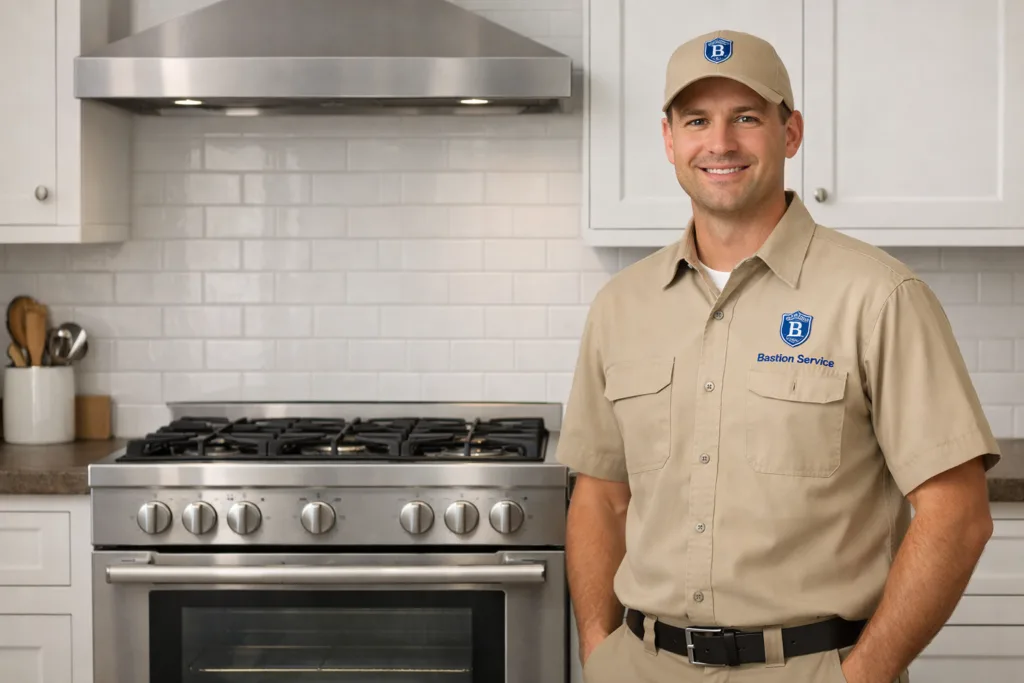
Range problems tend to show up in everyday cooking first: a burner that clicks but does not light, an oven that takes too long to preheat, or temperatures that suddenly stop matching the setting on the display. With Bosch models, those symptoms can come from ignition parts, sensors, heating components, wiring, or control issues, so the most useful approach is to match the repair path to the exact behavior of the appliance.
Common Bosch range symptoms and what they may mean
Many homeowners notice one clear symptom and assume there is one obvious failed part. In practice, a range can produce the same complaint for several different reasons. Looking at how often the problem happens, whether it affects the cooktop, the oven, or both, and whether the issue is getting worse helps narrow down the cause.
Burners that click, spark, or fail to ignite
If a gas burner clicks continuously or lights only after several tries, the problem may be as simple as burner cap alignment after cleaning, or as involved as a worn ignition component or a faulty switch. Moisture from wiping the cooktop or a recent boil-over can also interfere with normal ignition.
Typical signs include:
- One burner not lighting while the others work normally
- Clicking that continues after the flame is lit
- A burner that lights only with repeated attempts
- Weak flame, uneven flame, or delayed ignition
When ignition problems are ignored, the clicking often becomes more frequent and daily cooking gets less predictable.
Electric surface elements that do not heat correctly
On electric Bosch ranges, a surface element may stop heating fully, cycle irregularly, or remain cooler than expected. In some cases the fault is limited to the element itself. In others, the issue involves the switch, receptacle, or control circuit. If one element behaves differently from the rest, that pattern is often helpful during diagnosis.
Oven not heating, overheating, or baking unevenly
Oven complaints usually show up as undercooked centers, overbrowned edges, or long preheat times. A Bosch oven that runs too cool may have a weak igniter on gas models, a failing bake element on electric models, or a sensor that is no longer reading temperature accurately. If the oven overheats or swings widely above and below the set point, the sensor or electronic control may be involved.
Watch for patterns such as:
- Food taking much longer than usual to cook
- Preheat completing on the display before the oven is truly ready
- One rack baking faster than another in a new or unusual way
- Broil working while bake does not, or the reverse
Control panel and display problems
When the clock resets, buttons stop responding, or an error code appears, the range may have a power supply issue, a keypad fault, or a problem with the main control. These issues can affect temperature regulation and cooktop operation depending on the model. Intermittent control behavior is especially frustrating because the range may seem normal one day and fail the next.
Signs the problem is getting more serious
Some range issues remain minor annoyances for a while. Others point to a fault that should be addressed sooner rather than later. Scheduling service makes sense when you notice the appliance becoming less consistent, not just less convenient.
- Burners light slower over time
- The oven takes longer to preheat than it used to
- Temperature results are inconsistent from meal to meal
- The display flickers, resets, or loses settings
- The range trips power or stops mid-cycle
- Multiple functions begin acting up at once
When separate symptoms start appearing together, the issue may no longer be limited to one small component.
When to stop using the range
Certain symptoms are more than a cooking inconvenience. If a gas model gives off a strong or persistent gas odor, stop using it immediately and follow gas-safety steps before arranging appliance service. If there is no gas smell but ignition is delayed, repeated clicking is still a sign the burner system needs attention before regular use continues.
On electric models, stop using the range if an element overheats, the controls respond unpredictably, or the appliance trips the breaker. Those symptoms can indicate an electrical fault that should not be tested by repeated use.
What a symptom-based repair visit should clarify
A worthwhile service call should answer a few practical questions clearly: which system failed, whether the issue is isolated or affecting multiple functions, whether continued use is safe, and whether the expected repair is reasonable for the condition of the appliance. That matters with Bosch ranges because a burner complaint can sometimes be separate from an oven problem, while in other cases both trace back to one shared control issue.
For homeowners in Palms, the goal is usually simple: get back to reliable cooking without replacing parts based on guesswork.
Repair or replace: how to think it through
Repair is often the better option when the range is otherwise in good condition and the failure is tied to a specific part such as an igniter, sensor, switch, heating element, or control component. Replacement becomes more likely when the appliance has a history of repeated breakdowns, major problems across multiple systems, or costs that keep adding up from one repair to the next.
A few questions help frame the decision:
- Is the problem limited to one function or affecting the whole range?
- Has the appliance been reliable until now?
- Are parts and repair steps straightforward for the exact model?
- Would a completed repair restore normal daily use with confidence?
If the answer points to a contained repair with a good chance of restoring performance, fixing the range often makes practical sense.
Helpful steps before service
Before scheduling repair, it helps to note exactly what the range is doing. Write down whether the issue affects one burner or all burners, whether the oven reaches temperature eventually, and whether any error code appears on the display. If the problem started after cleaning, a power interruption, or a spill, that timing can also be relevant.
You do not need to disassemble anything to make the service visit more productive. A short symptom history is often enough to speed up diagnosis and keep the conversation focused on the most likely repair path.
Focused Bosch range service for homes in Palms
In a household kitchen, range reliability matters every day. When burners stop lighting properly or oven temperatures drift, the effect is immediate: slower meals, uneven results, and less confidence in the appliance. A symptom-based evaluation helps determine whether the issue is a routine repair, a broader control problem, or a sign that replacement should at least be considered.
For Bosch range repair in Palms, the most useful next step is understanding the exact fault and whether fixing it will restore safe, consistent cooking in a way that makes sense for the appliance.