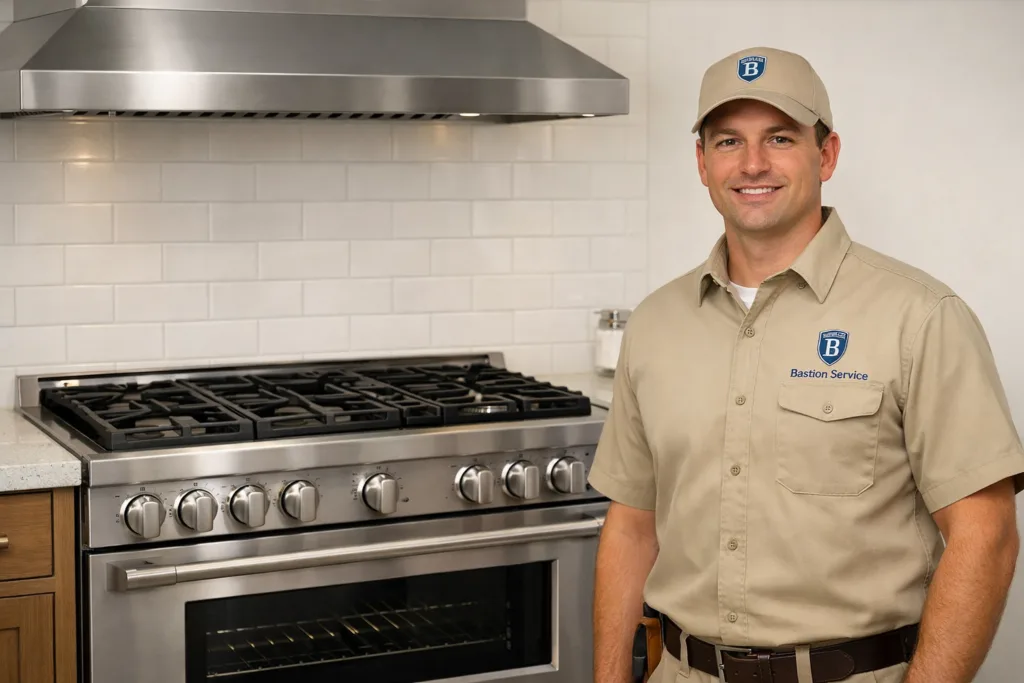
Range problems tend to show up at the worst time: a burner that will not light when dinner is already started, an oven that preheats forever, or temperature swings that make baking unpredictable. With a Monogram range, those symptoms can come from ignition parts, heating components, sensors, controls, wiring, or airflow issues, so the best repair decisions start with testing the exact failure instead of assuming the cause.
What Palms homeowners usually notice first
Most range service calls begin with a small change in performance that becomes harder to ignore. A front burner may click several times before lighting. The oven may seem hot enough for roasting but still leave baked dishes pale in the center. Sometimes the display works normally while cooking results clearly do not.
In Palms homes, these problems often affect everyday cooking more than dramatic breakdowns do. A range that still turns on but cooks unevenly, shuts off mid-cycle, or responds inconsistently can be just as disruptive as one that stops working entirely.
Common Monogram range symptoms and what they can mean
Burner clicking that will not stop
Continuous clicking usually points to an ignition-related problem rather than a gas supply issue alone. Moisture around the switch area, a misaligned burner cap, residue near the igniter, or a failing ignition switch can all keep the sparking system active longer than it should be.
If the burner does light but keeps clicking, the appliance may still need service even though it appears usable. Repeated sparking can be a sign that one part of the ignition system is not sensing normal operation correctly.
Burners that will not ignite or ignite slowly
When a surface burner takes multiple tries to light, the cause may be a weak spark, clogged burner ports, poor cap seating, or an issue affecting ignition consistency. If only one burner is affected, the fault is often localized. If several burners behave the same way, the diagnosis may need to include shared ignition components.
Delayed ignition should not be ignored. Even when the burner eventually lights, the pattern suggests that something in the ignition sequence is no longer working normally.
Oven not heating properly
An oven that stays cold, heats slowly, or never reaches the selected temperature can have several different causes depending on the model configuration. Problems may involve a bake element, igniter, temperature sensor, relay, electronic control, or related wiring.
This is one reason symptom-based diagnosis matters. Two ovens can both seem “not hot enough” while needing completely different repairs.
Uneven baking or roasting
If the top rack browns too quickly while the lower rack lags behind, the issue may not be calibration alone. Uneven results can be linked to poor heat circulation, convection fan trouble, inaccurate temperature sensing, or a heating component that works only part of the time.
Homeowners often notice this first with cookies, casseroles, or sheet-pan meals that used to cook evenly. When a familiar recipe suddenly becomes unreliable, the range may be drifting away from normal temperature control.
Display or control problems
A blank display, unresponsive buttons, changing settings, or cooking modes that do not start correctly can indicate control board trouble, interface failure, power-related issues, or loose internal connections. In some cases, what looks like a heating problem actually starts in the control system.
If multiple functions act strangely at once, such as delayed ignition and unstable oven behavior, it is often a sign that the issue is broader than a single burner or single heating part.
When continued use is not a good idea
Some range problems are inconvenient but manageable for a short time. Others should be addressed quickly. It is wise to stop normal use and arrange service if:
- burners click repeatedly without lighting properly
- the oven shuts off during cooking
- temperature swings are large enough to ruin food
- the unit trips power or loses power intermittently
- controls behave unpredictably
If there is a strong or persistent gas smell, stop using the appliance right away. Leave the area if needed and contact the gas utility or emergency services before arranging appliance repair.
Why intermittent problems deserve attention
Intermittent symptoms are easy to postpone because the range still works some of the time. But a burner that lights on the third try today may fail completely next week. An oven that is only ten to fifteen degrees off now may drift much farther as a sensor or control component worsens.
For many households in Palms, early service prevents larger disruptions later. Catching a weak igniter, unstable sensor response, or failing control before total breakdown can reduce both downtime and the chance of extra parts being affected.
Repair or replace?
Many Monogram range problems are repairable when the issue is isolated to a specific system, such as ignition, temperature sensing, oven heating, or controls, and the appliance is otherwise in good condition. Because Monogram units are premium cooking appliances, repairing a targeted fault often makes sense when the rest of the range remains structurally sound and performs well.
Replacement becomes more likely when there are multiple major failures, recurring electronic problems, or overall wear that makes future reliability doubtful. The better question is not simply how old the range is, but how extensive the current problem is and whether the repair restores normal daily cooking with confidence.
What a thorough service visit should clarify
A worthwhile diagnosis should identify the failed part or system, rule out look-alike causes, and explain whether the problem affects safety, cooking accuracy, or both. That helps homeowners make an informed decision instead of guessing between cleaning, calibration, repair, or replacement.
For Monogram range repair in Palms, the goal is simple: understand why the appliance is misbehaving, what the repair path looks like, and whether that fix is likely to return the range to stable everyday use.