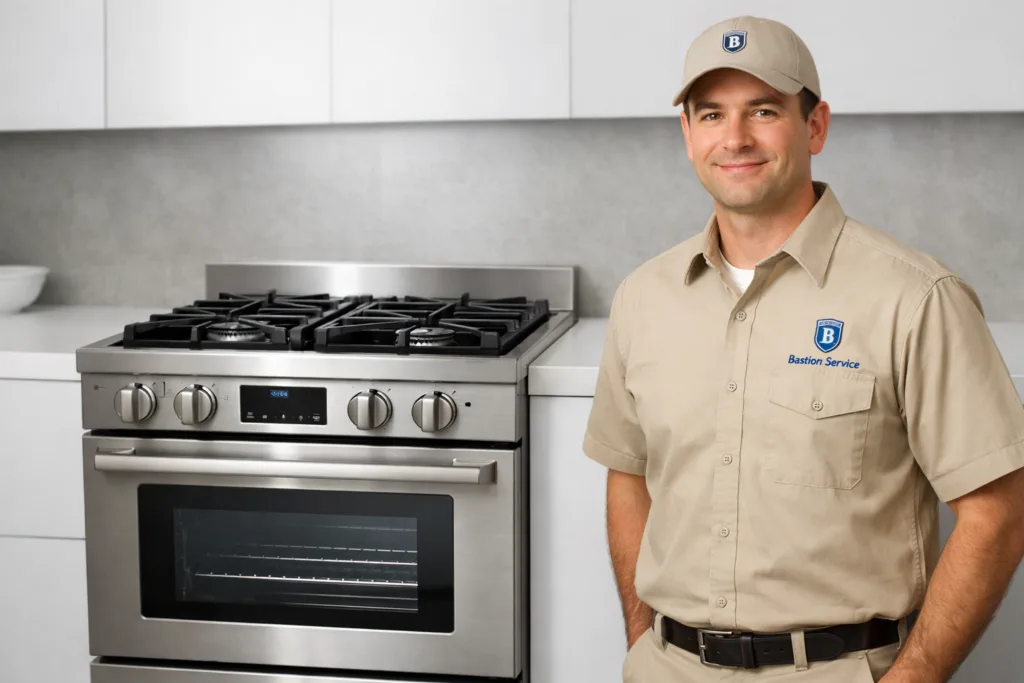
How Summit range problems usually show up in everyday use

Range problems often start as small changes that are easy to work around at first. A front burner may need a second try to light, the oven may seem slower to preheat, or baked food may come out less evenly than before. With Summit ranges, these patterns matter because they help narrow down whether the issue is related to ignition, heat production, temperature sensing, controls, or power.
In Palms homes, the most useful approach is to pay attention to what the appliance is doing consistently. Does the problem affect one burner or all of them? Does the oven fail completely, or does it heat but not hold temperature well? Does the clicking stop after ignition, or keep going? Those details can point toward a much different repair path than the symptom name alone.
Common Summit range symptoms and what they can mean
Burner clicks but does not light
On gas models, repeated clicking without ignition can come from a wet or dirty ignition area, burner cap misalignment, clogged burner ports, a worn igniter, or a spark module issue. If the burner lights only after several tries, the problem may still be minor, but it should not be ignored. Inconsistent ignition tends to become more frustrating and less predictable over time.
If clicking continues after the flame is on, the switch area or ignition system may need attention. This is especially worth checking when the sound continues after cleaning and drying the cooktop surface.
Oven will not heat or takes too long to preheat
An oven that stays cold, warms very slowly, or never reaches the selected temperature may have a weak igniter on a gas range, a failed bake or broil element on an electric range, a sensor problem, or an electronic control fault. Sometimes the oven appears to be functioning because the display responds normally, but the heating system is not producing enough heat for real cooking.
Slow preheat is one of the most commonly overlooked warning signs. Many homeowners adjust by waiting longer, but that delay often points to a part that is already failing.
Uneven baking or temperature swings
If casseroles are underdone in the center, cookies brown unevenly, or recipes that used to work now need constant adjustment, the range may not be regulating oven temperature correctly. A drifting sensor, weak igniter, failing element, damaged door gasket, or control issue can all affect cooking consistency.
Because uneven baking has several possible causes, replacing a part based only on guesswork often does not solve it. Symptom patterns matter here: whether the oven overshoots heat, falls short, or cycles too widely helps identify the real fault.
Surface burner too weak, too hot, or not heating at all
On electric Summit ranges, a burner that stays cold may have a failed element, damaged receptacle, or bad switch. A burner that overheats and does not respond properly to setting changes can also point to a control switch problem. On gas models, weak flame, uneven flame, or delayed ignition may come from clogged ports, burner assembly issues, or valve-related faults.
When only one burner is affected, that usually helps narrow the problem to a specific component rather than a whole-appliance issue.
Display, controls, or power problems
If the range does not respond, the display is blank, buttons behave unpredictably, or the unit loses power during use, the problem may involve incoming power, wiring, the control board, or the interface itself. A breaker issue can be part of the story, but repeated tripping or intermittent operation should be checked instead of reset and dismissed.
Signs the range should be serviced sooner rather than later
Some problems are inconvenient but manageable for a short time. Others can lead to cooking safety concerns, more expensive damage, or a full loss of function. It is smart to stop putting off service when you notice any of the following:
- Burners that do not ignite reliably
- Clicking that continues after ignition
- An oven that will not maintain temperature
- Preheat times that have become much longer than normal
- A burner that overheats or will not regulate properly
- Controls that fail intermittently
- Power loss, tripping, or shutoffs during use
Using a range with unstable heat can make everyday cooking frustrating, but it can also put extra strain on ignition parts, heating components, and controls. A problem that begins as one weak burner or a slow oven can turn into several overlapping issues if it is left unresolved.
What homeowners can check before scheduling repair
There are a few basic observations that can help make the symptom clearer. On gas burners, check whether the burner cap is seated correctly and whether food debris is blocking the ports. If the cooktop was recently cleaned, moisture around the igniter may explain temporary misfiring. On electric models, note whether the issue follows a particular burner position and whether the problem is no heat, partial heat, or runaway heat.
For oven concerns, compare whether the problem is no heat at all, slow preheat, or poor temperature consistency after preheating. If the display works but the oven still struggles to cook properly, that is useful information. If the appliance trips power, smells hot, or behaves unpredictably, it is better to stop using it until it has been evaluated.
Repair or replace: making the practical choice
Repair is often worthwhile when the problem is limited to one system and the rest of the range is in solid condition. A single failed igniter, burner component, switch, sensor, or element can often be a reasonable fix if the unit has otherwise been reliable.
Replacement becomes more worth considering when the range has multiple unrelated problems, ongoing control issues, visible wear across several components, or a history of repeated service needs close together. Age alone does not decide the answer, but age combined with parts condition, reliability, and repair cost usually gives a clearer picture.
For many households in Palms, the most helpful decision point is whether the repair restores normal daily cooking without setting up another likely repair in the near future. If yes, repair can make sense. If not, replacement may be the better long-term move.
What a good service visit should clarify
A worthwhile diagnosis should identify the primary failure, explain why the symptom is happening, and make clear whether the issue is isolated or part of broader wear in the appliance. Homeowners should come away understanding whether continued use is advisable, what repair path fits the symptom, and whether the condition of the range supports fixing it.
That kind of practical repair guidance is especially important with Summit ranges because similar cooking complaints can come from very different causes. A burner problem may be ignition-related on one model and control-related on another. An oven temperature complaint may involve heat production, sensing, or calibration rather than a single obvious part.
Keeping a Summit range reliable for daily cooking
Routine care will not prevent every failure, but it can reduce some common problems. Keeping burner areas clean, avoiding heavy buildup around ignition points, checking that burner caps sit properly, and paying attention to changes in preheat time or temperature performance can help catch trouble earlier. Small changes in how the range behaves are often the first sign that service is needed.
When a Summit range in Palms begins acting differently, the fastest way to a sensible decision is to match the exact symptom to the most likely cause instead of guessing from the surface. That helps protect the appliance, reduces wasted time, and makes it easier to decide whether repair is the right next step for the household.