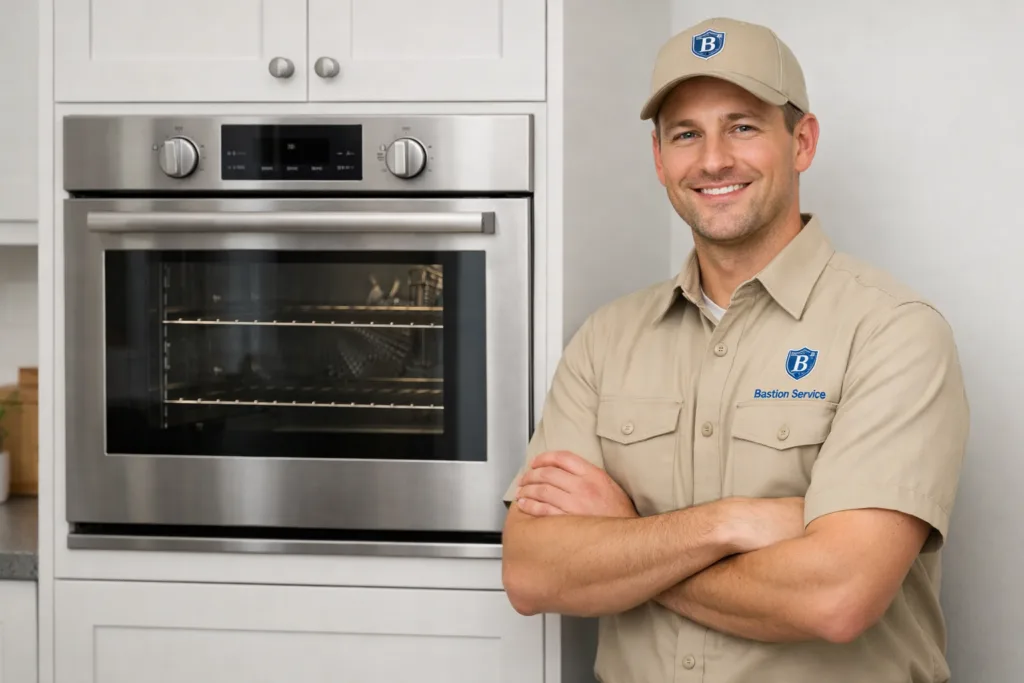
Signs your Bosch wall oven needs attention

Many oven problems start as small performance changes rather than a total failure. You may notice longer preheat times, food browning unevenly, a temperature that seems too high or too low, or a control panel that does not respond the same way every time. In a busy household, those issues quickly turn routine cooking into trial and error.
With Bosch wall ovens, the same symptom can come from different underlying faults. A unit that is not heating properly may have a failed element, a sensor problem, a relay issue, a wiring fault, or a door seal problem that lets heat escape. That is why symptom pattern matters more than assumptions.
Common Bosch wall oven problems in Fairfax homes
Not heating at all
If the oven powers on but never gets hot, the problem may involve the bake element, broil element, temperature sensor, thermal protection components, or the electronic control system. Sometimes the display appears normal while the cooking cavity stays cold. In other cases, the oven starts a cycle and then stops before real heat builds.
This kind of failure usually points to a functional problem rather than a minor calibration issue. If the oven is built into cabinetry and hardwired, it is best not to keep cycling it on and off in hopes that it resets itself.
Slow preheat
Slow preheat is one of the most common complaints because it affects nearly every meal. When a Bosch wall oven takes much longer than usual to reach temperature, possible causes include a weak heating element, inaccurate sensor readings, control trouble, or heat loss from a door that is not sealing correctly.
Some homeowners work around this by simply waiting longer, but that can hide a part that is getting weaker over time. A sluggish preheat often becomes uneven baking or incomplete cooking later.
Uneven baking or roasting
If cookies finish differently on the same tray, casseroles cook unevenly, or one rack consistently browns faster than another, the oven may not be maintaining stable heat. A drifting temperature sensor, element that is not cycling correctly, airflow issue, or control problem can all produce inconsistent results.
These symptoms are frustrating because the oven still seems usable. However, when cooking performance becomes unreliable, the appliance is no longer doing its basic job well.
Temperature swings
Some temperature fluctuation is normal during operation, but wide swings are not. If the oven seems to overshoot, drop too low, or behave unpredictably from one cycle to the next, the issue may involve sensor readings, relay operation, or an electronic control fault.
Temperature instability is especially noticeable with baking. Recipes that used to be repeatable suddenly need extra time, burn on top, or come out underdone in the center.
Control panel or display issues
A Bosch wall oven may also develop electronic symptoms such as a blank display, flashing error code, random beeping, keypad buttons that do not register, or cycles that stop unexpectedly. Sometimes this points to a failing interface. In other cases, the main control board, wiring connections, or incoming power to the unit may be involved.
When the controls are inconsistent, it is hard to trust timer settings, cooking modes, or actual temperature selection. That becomes more than an inconvenience when you rely on the oven daily.
Door and latch problems
If the door will not close fully, feels misaligned, will not unlock, or started acting up after a self-clean cycle, the problem may involve hinges, latch components, switches, or heat-related wear. A bad door seal can also create symptoms that look like a heating failure because hot air escapes during operation.
Even a small door issue can affect preheat speed, temperature stability, and cooking consistency.
What certain symptom patterns often mean
Looking at the full pattern helps narrow the likely cause:
- Oven is on but food stays pale: heating performance may be reduced or intermittent.
- Preheat takes forever and baking is uneven: one heating component may be weak, or heat may be escaping.
- Display works but oven will not start a cycle: a control, latch, or safety-related fault may be preventing operation.
- Error code appears after self-clean: heat stress may have affected electronic or latch-related components.
- Oven shuts off during cooking: overheating protection, control failure, or electrical issues may be involved.
These are not exact diagnoses on their own, but they help explain why two ovens with similar complaints may need different repairs.
When to stop using the oven
It is smart to stop using the appliance and arrange service if you notice any of the following:
- the oven trips the breaker
- there is a burning smell that does not clear quickly
- the oven overheats or will not shut off properly
- the door will not lock or unlock correctly
- error codes keep returning
- the control panel behaves erratically
Because a wall oven is installed into cabinetry, access is more involved than with a freestanding unit. Repeated testing without knowing the cause can sometimes worsen part damage or make the final repair more expensive.
Repair or replace?
For many Fairfax homeowners, the better choice depends on the age of the oven, its overall condition, the exact failed part, and whether the problem appears isolated or part of broader wear. A single failed sensor, element, latch component, or targeted electrical problem often makes repair a sensible option.
Replacement may be worth considering if the oven has recurring control issues, multiple failing components, or signs of heavier age-related decline. The key is understanding whether the current symptom points to one repairable fault or to several systems wearing down at once.
That is where a clear diagnosis and a practical repair plan are most useful. Instead of guessing from the front panel behavior alone, you can make the decision based on what is actually failing.
Why built-in Bosch wall ovens need model-specific repair evaluation
Wall ovens are more complex to assess than small kitchen appliances because installation, ventilation space, control layout, and heat exposure all affect the repair process. Bosch units can also show similar symptoms across different models while requiring different parts or testing steps.
For that reason, the best service approach is not just to match a symptom to a common part. It is to evaluate how the oven is failing, confirm which system is responsible, and avoid replacing components that are not the true cause.
What Fairfax homeowners usually want from service
Most households are not looking for technical jargon. They want to know why the oven is acting up, whether continued use is safe, and whether repair is practical. If your Bosch wall oven is not heating, baking unevenly, preheating too slowly, showing temperature swings, or having control issues, the next step should make those answers clearer rather than more confusing.
For homes in Fairfax, that means focusing on the actual symptom, the condition of the appliance, and the repair path that makes the most sense for everyday cooking reliability.