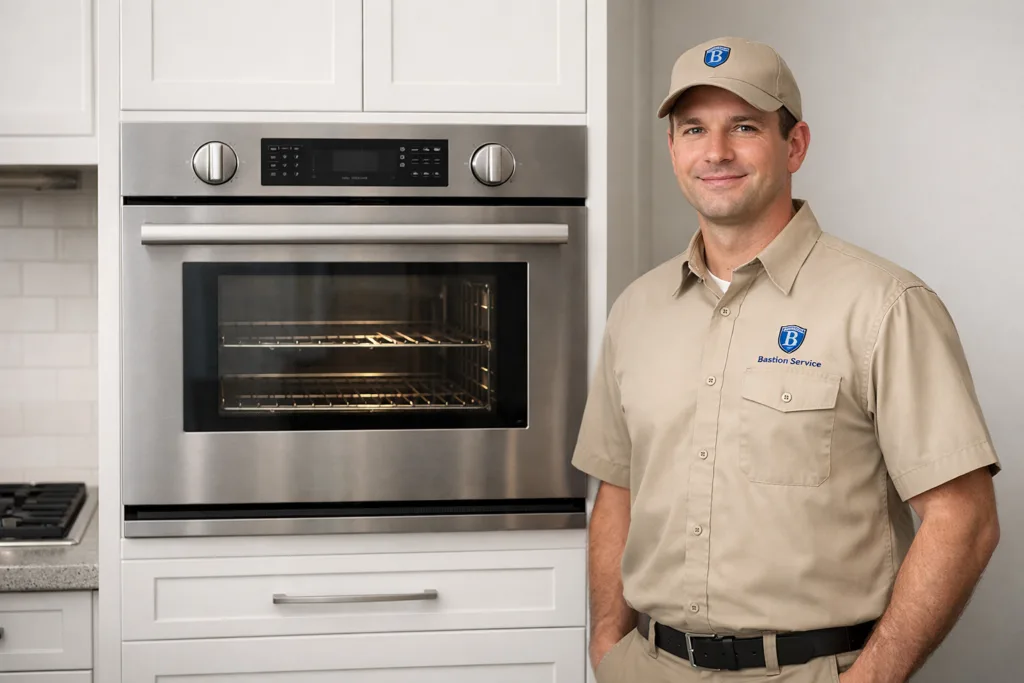
Cooking problems with a built-in oven usually show up before the appliance stops working completely. A Thermador wall oven may still turn on, light the display, and appear normal while preheat drags on, temperatures drift, or the cycle ends before food is done. Looking closely at how the problem appears during bake, broil, convection, or self-clean is often the fastest way to narrow down what failed.
Start with the symptom, not the part
Many wall oven complaints sound similar from the outside, but the repair path can be very different. Slow preheat might come from a weak heating circuit, a sensor reading problem, or a control issue. Uneven baking may point to airflow trouble, calibration drift, or one heating function dropping out during the cycle. That is why symptom-based diagnosis matters more than guessing based on a single sign.
In Fairfax homes, this is especially important with built-in appliances because access takes more time and unnecessary part replacement can quickly add cost without fixing the root issue.
Oven will not heat at all
If the oven powers on but never gets hot, the problem may involve the heating system, temperature sensing, power supply, safety components, or the main control. Some ovens fail completely in both bake and broil. Others lose only one mode, which can make the unit seem partially functional even though cooking performance is no longer reliable.
Homeowners often notice this after setting a normal temperature and finding the cavity still cool much later than expected. If that happens more than once, it usually points to more than a simple setting error.
Slow preheat and weak cooking performance
A wall oven that eventually reaches temperature but takes much longer than normal can be frustrating because it feels inconsistent rather than fully broken. This symptom often shows up as:
- Preheat taking far longer than it used to
- Food needing extra cook time every night
- Roasting that seems sluggish or pale
- Heat recovery that is slow after opening the door
In many cases, the oven is not generating or regulating heat the way it should. The display may suggest everything is normal while actual cavity temperature lags behind.
Uneven baking and temperature swings
If one rack browns too fast while another stays underdone, or if familiar recipes stop turning out consistently, the oven may be cycling heat incorrectly. Thermador wall ovens depend on stable sensing and controlled heat delivery. When either side of that process slips, results become unpredictable.
Common signs include cookies darker on one side, casseroles taking longer in the center, or baked goods that look done outside but remain undercooked inside. Convection models may also show these symptoms when airflow is reduced or inconsistent.
Error codes, beeping, and control problems
Electronic faults can be obvious or intermittent. Sometimes the display flashes an error code right away. Other times the oven resets, beeps randomly, ignores button presses, or shuts off during use. These issues can come from the interface, control board, wiring, or heat stress affecting electronic components.
Intermittent control issues are worth addressing early. They often start as occasional disruptions and become complete operating failure later.
Issues that should not be ignored
Some symptoms go beyond inconvenience and suggest that continued use could make the repair more involved. It is wise to stop using the oven if you notice:
- A burning or sharp electrical odor
- Breaker trips when the oven starts or heats up
- The oven overheats or scorches food unusually fast
- The door does not close securely
- The unit loses power in the middle of a cycle
- The door remains locked unexpectedly after self-clean
Problems like these can affect surrounding components, not just the original failed part. Heat-related stress, repeated resets, and unstable electrical behavior can spread damage through the control and wiring system if the oven keeps being used.
Self-clean and door lock problems
Self-clean cycles place heavy stress on wall oven components because internal temperatures rise far above normal cooking levels. After a self-clean cycle, some homeowners notice that the oven no longer heats properly, the display starts showing faults, or the door lock does not return to normal. That can involve the latch assembly, control logic, sensor response, or components affected by high heat.
A stuck lock or failed clean cycle can leave the appliance unusable even when the heating system itself is still capable of working. If the door will not unlock, forcing it is usually a bad idea because it can create additional mechanical damage.
Convection fan and airflow complaints
On convection-equipped models, airflow plays a big role in even cooking. When the fan becomes noisy, stops turning correctly, or runs inconsistently, cooking times and browning can change noticeably. Homeowners may first notice this as uneven roasting, louder operation than usual, or hot spots that were not there before.
Not every fan sound means failure, but rattling, grinding, or major changes in performance usually deserve inspection. A convection issue can also be mistaken for a temperature issue when the real problem is poor circulation inside the cavity.
When repair usually makes sense
Thermador wall ovens are premium built-in appliances, so repair is often worth considering when the failure is limited to a specific system. That commonly includes sensor faults, latch problems, fan issues, certain heating failures, and isolated electrical problems. If the oven cabinet, interior, and overall condition are still good, restoring normal operation can be more practical than replacing the entire unit.
Replacement becomes more likely when multiple major systems are failing at the same time, the unit has a history of repeated electronic problems, or age and condition make the next repair hard to justify. The key is understanding whether the issue is isolated or part of broader deterioration.
What to check before scheduling service
Before assuming the oven is finished, it helps to note exactly what it is doing. Useful details include:
- Whether the problem happens in bake, broil, convection, or all modes
- If preheat completes too soon or never completes
- Whether the display shows a fault code
- If the breaker has tripped recently
- Whether the problem started after self-clean or a power outage
- If the oven shuts off only after it gets hot
Those observations can make the inspection more efficient and help distinguish between a heating problem, a control problem, and a door or latch issue.
Common service-triggering symptoms in Fairfax homes
Most homeowners call for help when everyday cooking stops being predictable. The most common situations include:
- The oven does not heat in bake or broil
- Preheat takes too long
- Temperature seems inaccurate from one meal to the next
- Food cooks unevenly or burns unexpectedly
- The control panel is unresponsive or keeps beeping
- The oven turns off before the cycle is done
- The fan is unusually loud or does not seem to operate correctly
- The door will not lock, unlock, open, or close as it should
When these problems start affecting regular meals, the next step is usually to find out whether the fault is contained to one repairable system or is part of a larger failure. That gives Fairfax homeowners a realistic basis for deciding what to do next with the oven already built into the kitchen.