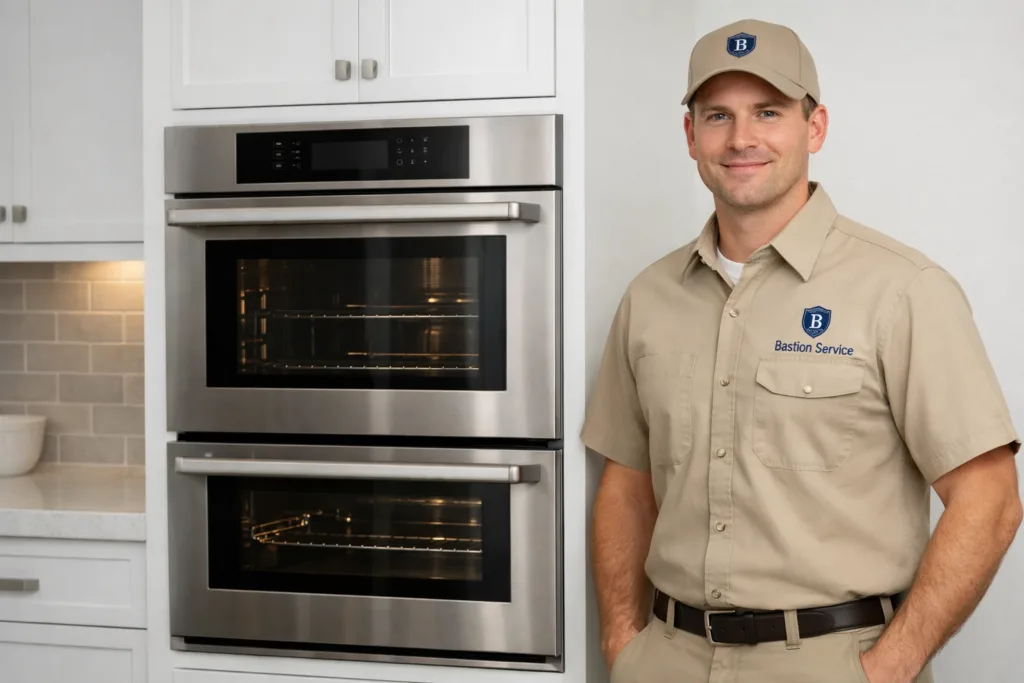
Common JennAir wall oven problems in Fairfax homes

Wall oven failures do not always start with a complete shutdown. In many kitchens, the first sign is a change in cooking results: cookies browning too fast on one side, casseroles taking longer than usual, or a unit that seems to preheat forever before dinner can even begin. With JennAir models, those symptoms can point to several different systems, including the heating circuit, sensor, control board, door seal, or incoming power.
Problems that often lead to service include:
- Oven not heating at all
- Weak heat or long preheat times
- Uneven baking between racks
- Temperature running hotter or cooler than the setting
- Control panel errors, beeping, or frozen display
- Door not closing correctly or latch issues
- Unit shutting off during a cycle
- Self-clean problems that affect normal operation
What specific symptoms may mean
Oven turns on but does not heat
If the display lights up and the controls respond, it is easy to assume the appliance has full power. In reality, a wall oven can appear alive while still failing to send proper power to the bake or broil circuit. Possible causes include a failed element, a relay issue on the control, a thermal cutoff problem, damaged wiring, or an electrical supply fault. The exact cause matters because the repair path is very different depending on where power stops.
Slow preheat
A JennAir wall oven that eventually reaches temperature but takes much longer than normal may have an element that is weakening, a sensor giving inaccurate feedback, or a control that is not cycling heat correctly. Slow preheat often starts as an annoyance and gradually becomes a bigger performance problem. If the appliance is repeatedly struggling to reach the selected temperature, cooking times become less predictable and daily use gets more frustrating.
Uneven baking and roasting
When food cooks differently from front to back or top to bottom, the issue is not always calibration alone. Uneven results can come from partial element failure, poor heat circulation, inaccurate temperature sensing, or a door seal that is allowing heat to escape. This symptom is especially common when the oven still gets hot enough to seem functional but no longer holds a stable cooking environment.
Temperature swings
If one meal burns at 350 degrees and the next seems undercooked at the same setting, the oven may be cycling too widely around the target temperature. A drifting sensor, failing control board, or intermittent connection can all cause this kind of inconsistency. Temperature swings are worth addressing early because they affect both cooking quality and confidence in the appliance.
Error codes or unresponsive controls
Electronic control problems can show up as flashing codes, random beeping, touchpad failures, or a display that freezes and then resets. In some cases the control is the problem. In others, the code is reacting to a sensor, latch, or wiring issue elsewhere in the oven. That is why symptom-based testing is more useful than assuming the displayed code automatically identifies the failed part.
Door, gasket, or latch trouble
A door that does not close evenly can lead to heat loss, poor baking results, and repeated cycling as the oven tries to maintain temperature. Latch problems may also interfere with normal operation after a self-clean cycle. If the gasket looks worn, the hinges feel off, or the latch does not engage and release properly, performance issues may follow even when the heating system itself is still working.
Why these issues should not be ignored
Wall ovens are built into cabinetry, operate at high temperatures, and rely on stable electrical performance. Continued use after the oven starts overheating, shutting off, or responding unpredictably can lead to a more involved repair. A weak component can sometimes damage related parts over time, especially when the unit keeps trying to complete a cycle with inaccurate feedback or poor heat retention.
It makes sense to stop using the oven and schedule service if you notice:
- Repeated tripping of a breaker
- Burning smells beyond normal cooking residue
- Food scorching unexpectedly
- Controls cutting in and out during operation
- Frequent error messages that keep returning
- The oven stopping mid-cycle without explanation
Repair or replace?
For many households in Fairfax, repair is often the practical option when the problem is limited to a sensor, heating element, latch assembly, wiring issue, or a defined control failure. Those are the kinds of faults that can often be evaluated in a straightforward way and compared against the overall condition of the appliance.
Replacement may be worth considering when the oven has multiple major problems at once, when reliability has been declining across several functions, or when the repair needed is unusually extensive relative to the unit’s age and condition. The goal is not simply to get the oven running for the moment, but to decide whether the expected result is stable day-to-day use.
What to note before service
A few details from normal use can help narrow the issue faster. Before the appointment, it helps to write down what the oven is doing and whether the symptom is constant or intermittent. Even simple observations can point testing in the right direction.
- Whether the problem happens in bake, broil, convection, or self-clean
- If the oven reaches any heat at all
- How long preheat takes compared with normal
- Whether one rack cooks faster than another
- Any error code shown on the display
- Whether the problem started suddenly or gradually
- If the door feels loose, misaligned, or hard to latch
What homeowners in Fairfax can expect from a diagnostic visit
The most useful service call starts with the real-world symptom rather than a guess about parts. Testing may involve checking heating performance, sensor readings, control response, door condition, and electrical supply to determine why the oven is not operating normally. That process helps separate a single failed component from a broader reliability issue.
For households dealing with inconsistent cooking, no-heat conditions, or control problems, JennAir wall oven repair in Fairfax is most effective when the problem is confirmed at the system level and the next step is based on safety, appliance condition, and expected long-term performance.