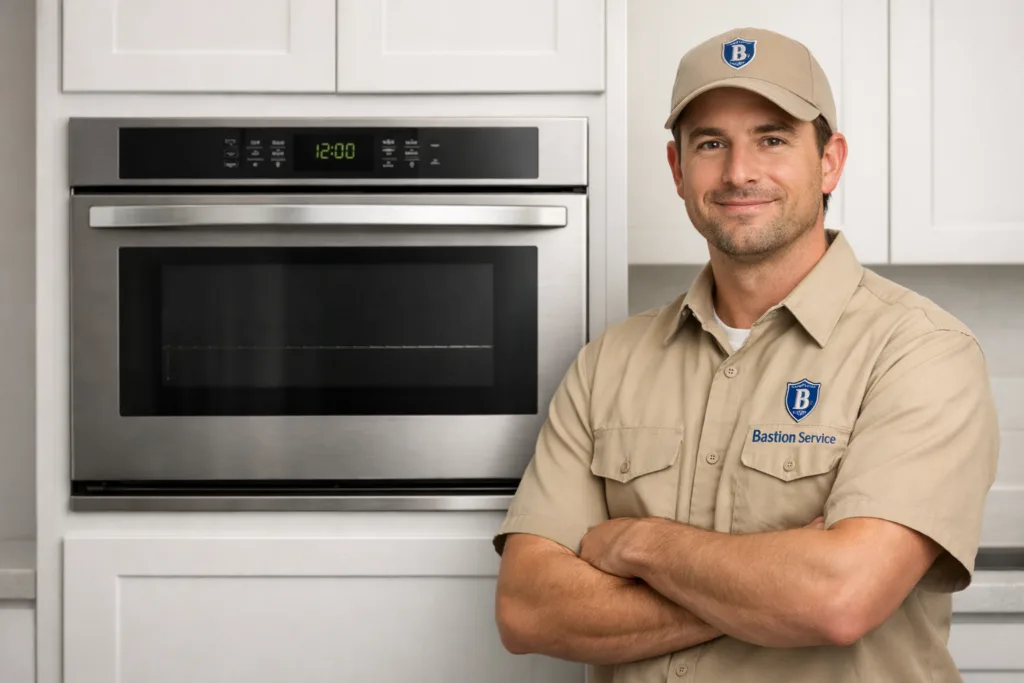
Wall ovens tend to show trouble gradually before they stop working completely. A longer preheat, a hot spot near the back, or a control panel that responds only some of the time can all point to a developing part failure. With Whirlpool units, those symptoms often trace back to heating components, sensors, door-related parts, or the electronic controls that manage temperature cycling.
Start with the symptom pattern
The most useful way to approach a Whirlpool wall oven problem is to look at exactly how it is failing. Two ovens can both seem to be “not heating right” but need very different repairs. One may have a weakened bake element, while another may be reading temperature incorrectly and cycling off too soon. Watching for when the issue happens, how often it happens, and whether it affects baking, broiling, or preheating helps narrow down the likely cause.
In Fairfax homes, built-in ovens are often used for routine family meals, batch cooking, and holiday baking, so performance changes usually show up in real cooking results before a full breakdown occurs. If recipes that used to work now need extra time, burn on top, or stay pale in the center, the appliance may not be regulating heat the way it should.
Common Whirlpool wall oven problems and what they may mean
Oven will not heat
If the display lights up and the controls appear normal but the cavity stays cold, the problem may involve a failed bake element, broil element, thermal limiter, wiring issue, igniter on gas configurations, or an electronic control fault. In some cases, the oven starts a cycle but never reaches a usable temperature. In others, it appears to run without producing any real heat.
This is one of the clearest signs that continued use is not worth forcing. If the oven cannot begin heating normally, the failure is usually beyond a simple reset.
Uneven baking or roasting
Uneven results are often blamed on pans or recipes, but the appliance is frequently the real reason. If one side cooks faster, cookies brown inconsistently, or casseroles need to be rotated constantly, the oven may have a sensor problem, an element that is weakening, or a door seal that is letting heat escape. Temperature swings can also come from a control issue that causes the oven to overshoot and then cool too far before cycling back on.
For households that use the oven several times a week, this kind of inconsistency becomes frustrating quickly because there is no reliable setting or timing to trust.
Slow preheating
A Whirlpool wall oven that still gets hot but takes much longer than usual often has a partial heating problem. One stage of the heating process may be underperforming, so the oven eventually reaches temperature but not on a normal timeline. This is common when an element is failing gradually rather than stopping all at once.
Slow preheat can also create a misleading impression that the oven is working fine, even though cooking performance is already slipping. Meals may start late, and items that depend on a fully stabilized temperature can come out uneven.
Temperature is off by a wide margin
If the oven says 350 degrees but food behaves more like it is being cooked at 300 or 400, the sensor, control calibration, relay behavior, or heat distribution may be off. A small difference can sometimes be corrected through settings, but large or unpredictable temperature errors usually point to a component issue rather than user adjustment.
Signs include:
- Food repeatedly undercooking at normal bake times
- Top surfaces browning too fast while centers remain raw
- Broiling that seems weak or delayed
- Burning at temperatures that used to be reliable
Error codes, beeping, or control panel problems
Whirlpool wall ovens rely on electronic controls for timing, temperature management, locking functions, and cycle selection. When those systems begin to fail, the oven may flash codes, beep unexpectedly, freeze mid-cycle, or ignore button presses. Some faults are steady and repeatable, while others appear only after the oven has been hot for a while.
Intermittent control issues are easy to put off, but they rarely improve on their own. If commands do not register consistently or the display behaves erratically, the problem may spread from inconvenience to complete loss of operation.
Door will not close, lock, or unlock correctly
A wall oven door does more than keep heat in. It affects temperature stability, safety, and self-clean performance. Worn hinges, a damaged gasket, latch trouble, or switch failure can lead to heat loss, lock errors, or a door that feels misaligned. If the door is not sealing tightly, the oven may run longer than normal and still struggle to cook evenly.
Door-related issues often become more noticeable after heavy use or a self-clean cycle, when heat stress exposes parts that are already wearing out.
Signs the problem is getting worse
Some oven issues stay mildly annoying for a while. Others tend to escalate quickly. It is smart to stop and reassess if you notice any of the following:
- Preheat times increasing week by week
- New burning smells not tied to spilled food
- Recurring error codes after resets
- Cooking times changing dramatically for familiar dishes
- The oven shutting off during a cycle
- Buttons working only after multiple presses
- The door staying locked or failing to lock when it should
These patterns usually mean the issue is no longer isolated to normal wear in one area of use. The oven is telling you that a key system is no longer operating the way it should.
When to stop using the oven and schedule service
Homeowners can sometimes work around a minor inconvenience for a short time, but there are situations where continued use is not a good idea. Service should move up the priority list if the oven is tripping breakers, overheating food suddenly, failing to regulate temperature, or showing repeated electrical or control problems.
In Fairfax, households often rely on a wall oven as a daily appliance rather than an occasional extra, so a malfunction can interrupt routines quickly. If the unit is no longer predictable, using it less does not necessarily protect it from further damage. A struggling heating circuit or failing control can continue to deteriorate every time the oven cycles on.
Repair or replace: what usually matters most
Whether repair makes sense depends on the age of the oven, the condition of the appliance overall, and the specific part failure involved. Many Whirlpool wall oven problems are still reasonable to repair when the issue is limited to a sensor, element, igniter, latch assembly, switch, or a single clearly identified control-related fault.
Replacement becomes a stronger option when multiple major components are failing, the oven has a history of repeat breakdowns, or the cost of restoring reliable operation is too close to the value of the unit. Built-in appliances also raise practical questions about fit and installation, so many homeowners prefer repair when the oven is otherwise in solid shape.
A proper diagnosis makes that decision easier because it separates a repairable fault from a broader decline in the appliance.
What a helpful service visit should answer
Most people do not need a long technical explanation. They want to know what is causing the symptom, whether the repair is practical, and what to expect next. For Whirlpool wall ovens, that typically means confirming whether the failure is tied to heat production, temperature sensing, door function, or control behavior.
A good evaluation should help answer questions like:
- Is the oven safe to keep using right now?
- Is the problem likely limited to one part or system?
- Will the repair restore normal baking and preheating?
- Does the age and condition of the oven still support repair?
Residential wall oven issues in Fairfax often come down to reliability
For most households, the biggest concern is not just whether the oven turns on. It is whether dinner can be cooked on time, whether baking results are consistent, and whether the controls can be trusted. When a Whirlpool wall oven starts missing temperatures, heating unevenly, or acting unpredictably, the goal is to restore reliable daily use rather than chase symptoms one at a time.
If your oven has become slow to preheat, inconsistent with temperature, or difficult to operate, the next step is to have the exact fault identified so you can decide on the repair path with confidence.