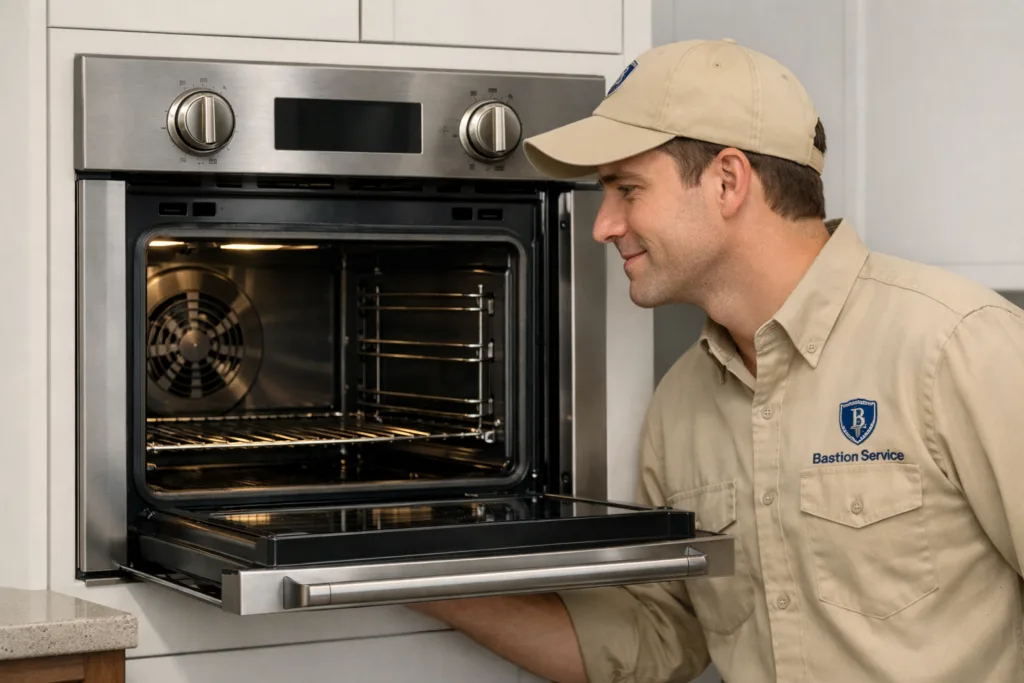
Wall ovens tend to show problems in the middle of everyday cooking, not at a convenient time. A pan that used to finish evenly may come out pale on one side, dinner may stall during preheat, or the display may start beeping without a clear explanation. On a Wolf wall oven, those symptoms usually trace back to heating, sensing, airflow, controls, or door-related issues, and the repair path depends on which system is actually failing.
Common Wolf wall oven symptoms in Palms homes
Most homeowners notice a change in performance before the oven quits completely. Paying attention to the pattern helps narrow down the cause and can make service more efficient.
Not heating at all
If the oven powers on but produces no heat, the issue may involve the bake circuit, broil circuit, temperature sensor, relay, wiring, or electronic control. In some cases, the display appears normal while the oven never receives proper heating output. A unit that is completely dead may point to a separate power or control problem rather than a failed heating component alone.
Slow preheat
Slow preheating often means the oven is heating, but not correctly. One heating circuit may be weak, the sensor may be reading inaccurately, or the control may not be cycling the elements the way it should. This kind of problem can seem minor at first, but it usually gets more noticeable over time as cooking times become harder to predict.
Uneven baking
When one rack browns faster than another or food cooks unevenly from front to back, the cause may be poor temperature regulation, weak heat output, convection fan trouble, or heat loss around the door. With built-in ovens, even a small change in airflow or temperature sensing can affect baking results long before the appliance stops working completely.
Temperature swings
Some cycling is normal in any oven, but wide swings that affect results are not. If the cavity overshoots, drops too far, or struggles to hold a stable range, likely causes include a drifting temperature sensor, a relay or board problem, or a calibration issue that needs to be confirmed rather than guessed at.
Error codes or control problems
A flashing code, random beeping, frozen display, or buttons that only respond sometimes usually points toward the control system. Depending on the code and the oven’s behavior, the fault could involve the user interface, main control, latch monitoring, wiring, or an overheating condition. If the code returns after a reset, the oven usually needs testing instead of repeated power cycling.
What specific symptoms often mean
Two ovens can show the same complaint for different reasons, but certain symptom patterns are still useful.
- Food undercooks even though preheat completed: the sensor may be misreading, or one heating circuit may be underperforming.
- The broiler works but baking does not: the bake side of the heating system, control relay, or related wiring may be the fault.
- The oven shuts off mid-cycle: overheating, control failure, connection issues, or a protective shutdown condition may be involved.
- The door will not close firmly: heat can escape, causing long cook times and poor temperature stability.
- Self-clean created new problems: high heat can expose weakness in latch parts, sensors, controls, or wiring connections.
Why Wolf wall oven problems should be tested, not assumed
Wall ovens often present overlapping symptoms. A homeowner may suspect a heating element because the oven is not reaching temperature, but the real cause could be a sensor reading issue or a control that is not sending proper voltage at the right time. Likewise, an error code may look like a board failure when the root problem is elsewhere in the circuit.
That is why a useful service visit should verify the failure instead of replacing parts based on the most obvious symptom. With premium cooking equipment, accurate testing matters because it helps avoid unnecessary parts costs and gives a better picture of whether the oven is a good candidate for repair.
Door, latch, and self-clean problems
Door-related issues are easy to overlook, but they can affect both performance and safety. A worn hinge, damaged gasket, or latch problem may let heat escape, interfere with proper temperature control, or keep the oven from completing certain cycles. If the door will not unlock after self-clean, or the oven starts acting differently after a high-heat cycle, the latch assembly and control logic often need attention.
In many cases, homeowners first notice these issues as longer cook times, excess heat around the cabinet, or an oven that seems to run more than usual. Even when the oven still heats, poor sealing can create inconsistent baking and added strain on other components.
When to stop using the oven and schedule service
Some issues can wait a short time for evaluation, while others should not be ignored. It is wise to stop regular use if you notice:
- a burning smell coming from the appliance itself
- visible sparking
- repeated shutdowns during cooking
- an oven that overheats or scorches food unexpectedly
- a door that will not latch, unlock, or close properly
- recurring electrical faults or tripped breakers tied to oven use
These symptoms can point to problems that may worsen with continued operation. Even when the oven still turns on, using it in that condition can increase the chance of added damage.
Repair versus replacement for a Wolf wall oven
Many Wolf wall oven problems are worth repairing when the failure is limited to one main area, such as a sensor, fan motor, latch component, heating circuit, or a specific control-related issue. In those cases, repair can restore normal cooking performance without turning into a larger project.
Replacement becomes more reasonable when several major systems are failing at once, when damage has spread beyond the original problem, or when the total repair path no longer makes sense for the oven’s age and condition. For homeowners in Palms, the important question is not simply whether a repair is possible, but whether it is likely to restore reliable everyday use.
What homeowners can note before a service visit
A few details can make the problem easier to identify. If possible, note:
- whether the oven fails during preheat or later in the cycle
- if the issue happens on bake, broil, convection, or all settings
- any error code shown on the display
- whether the problem is constant or intermittent
- if the oven recently completed a self-clean cycle before symptoms began
That information can help connect the complaint to a likely system and reduce guesswork during diagnosis.
What a good repair decision should clarify
Before moving forward with Wolf wall oven repair in Palms, homeowners should come away with a few clear answers: what failed, what testing supports that conclusion, whether continued use risks further damage, and whether the proposed repair is sensible for the oven’s current condition. Once those points are clear, the choice between repair and replacement is usually much easier to make.
If your wall oven is preheating slowly, baking unevenly, drifting off temperature, or showing control issues, the next step is to identify the exact fault pattern and address the problem before normal cooking becomes less predictable.