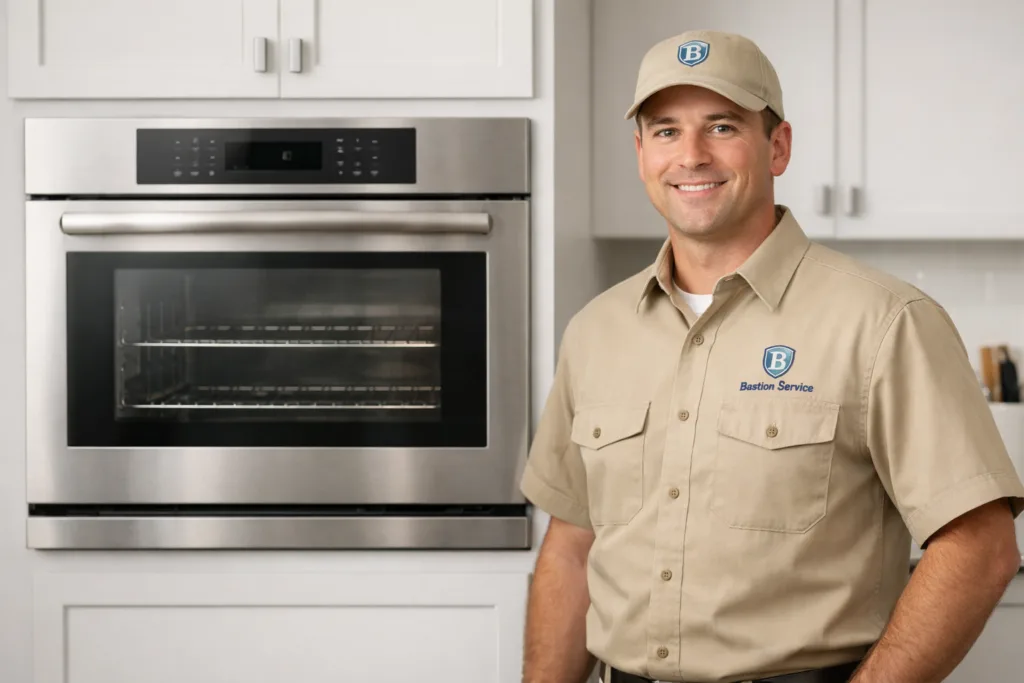
Whirlpool ovens can fail in ways that look similar on the surface but come from very different causes. A unit that runs cold, overheats, or bakes unevenly may have an element, igniter, sensor, fan, relay, wiring, or control issue behind it. For Los Angeles homeowners, the most helpful service starts by matching the symptom pattern to the likely system involved instead of guessing based on one visible problem.
Common Whirlpool oven symptoms in homes
Most service calls begin with a few recurring complaints. The oven may power on but never reach the set temperature. It may preheat slowly, then struggle to hold heat through the rest of the cycle. Some ovens cook the top rack much faster than the lower rack, while others shut off during use or flash an error code on the display.
These symptoms matter because they point in different directions:
- No heat at all may involve a bake element, broil element, igniter, thermal protection part, relay, or power supply problem.
- Slow preheat often suggests a weak igniter on gas models, a partially failed element on electric models, or a control issue affecting heat output.
- Uneven baking can come from a drifting sensor, poor convection airflow, door seal wear, or inconsistent heat cycling.
- Display problems or error codes may indicate a sensor circuit fault, control board issue, keypad failure, or wiring interruption.
- Shutoffs during cooking can point to overheating protection, intermittent electrical faults, or unstable controls.
What different symptom patterns can mean
Oven turns on but stays cold
If lights and the display work but the cavity never heats, the problem is usually in the heating or ignition system rather than the user interface alone. On electric Whirlpool ovens, a failed bake element is a common cause, though relay or wiring faults can create the same symptom. On gas models, a weak igniter may glow without drawing enough current to open the gas valve properly.
This is one of the clearest examples of why diagnosis matters. Replacing the first part that seems likely does not always solve the issue if the real fault is elsewhere in the circuit.
Preheat takes much longer than normal
When preheat stretches well beyond its usual timing, the oven may still be producing some heat but not enough to reach temperature efficiently. That partial-performance pattern is common with weakening igniters, failing elements, or controls that are not cycling heat correctly. Homeowners often work around this by starting dinner earlier or increasing the set temperature, but that tends to hide the underlying issue rather than fix it.
Food bakes unevenly or burns in spots
If one side of a pan browns faster, cookies need constant rotation, or casseroles come out overcooked on top and underdone in the center, the oven may not be regulating heat correctly. A sensor that reads inaccurately can make the control board end the heat cycle too early or too late. On convection models, a weak or nonworking fan can reduce heat circulation and create uneven results. A worn door gasket may also let heat escape and interfere with stable temperature control.
Temperature swings from one use to the next
An oven that seems fine one day and far too hot or too cool the next may have an intermittent component problem. Sensors, electronic controls, and wiring connections can all behave inconsistently before failing completely. This pattern is frustrating because it can look like recipe inconsistency when the real issue is unstable oven performance.
Oven shuts off mid-cycle
Mid-cycle shutdowns should not be ignored. The cause may be a control fault, overheating condition, latch issue, or a power interruption within the appliance. If the problem becomes more frequent, the oven can eventually stop completing any bake cycle at all.
Error codes and display issues
Error codes can be useful clues, but they are not complete answers by themselves. In many Whirlpool ovens, the code points to a system rather than a single failed part. A sensor-related code, for example, can still trace back to the sensor itself, the wire harness, the connector, or the control board reading that circuit incorrectly.
Likewise, a blank display or unresponsive keypad does not always mean the board has failed. Power delivery, ribbon connections, and related components may also need to be checked. Good testing helps avoid replacing expensive electronic parts when the root cause is elsewhere.
When the problem may be getting worse
Some oven issues stay relatively stable for a while, but many grow more expensive if ignored. Watch for these signs that service should be scheduled soon:
- Preheat times that keep getting longer
- Burning or undercooking despite familiar settings
- Recurring error codes after reset attempts
- The oven only works intermittently
- The control panel responds inconsistently
- The door no longer closes firmly or seals well
Continuing to use the oven in this condition can put more stress on related parts and make the final repair less straightforward.
When to stop using the oven right away
Stop using the oven and arrange service if you notice sparking, repeated breaker trips, burning electrical smells, visible element damage, or shutdowns that happen during normal cooking. Those symptoms can indicate conditions that should be checked before the appliance is used again.
For gas Whirlpool ovens, a strong or persistent gas smell should be treated as a safety concern first. Do not continue testing the oven to see whether the smell goes away. Follow appropriate gas safety steps and address the odor before scheduling appliance repair.
Repair or replace?
Many Whirlpool oven problems are worth repairing when the issue is limited to a single failed component and the rest of the appliance is in solid condition. Elements, igniters, sensors, fans, some door parts, and many temperature-control faults are often practical repairs. In those cases, restoring normal operation can be much more sensible than replacing the appliance.
Replacement becomes more likely when there are multiple major faults, recurring electronic problems, heavy wear, or structural issues that affect long-term reliability. Age alone does not decide the answer. The better question is whether the current failure is isolated or part of a broader pattern of decline.
What homeowners should have ready before service
A few details can make the visit more efficient:
- The full model number if it is available
- A note about whether the oven is gas or electric
- The exact symptom, such as no heat, slow preheat, uneven baking, or shutoff during use
- Any error code shown on the display
- Whether the problem is constant or intermittent
- Whether the broil function, convection fan, or light still works normally
These details help narrow down the probable systems involved before testing begins.
What a useful oven service visit should accomplish
A worthwhile appointment should do more than confirm that the oven is not working. It should identify which system failed, explain how that failure connects to the symptoms you have been seeing, and make clear whether the repair is likely to restore dependable household use. That is especially important with temperature complaints, since several different components can create nearly identical cooking results.
For homeowners in Los Angeles, the goal is straightforward: understand what failed, what needs to be repaired now, and whether the oven remains a sensible appliance to keep in service. When that answer is based on the actual symptom pattern and appliance condition, it is much easier to decide on the next step with confidence.