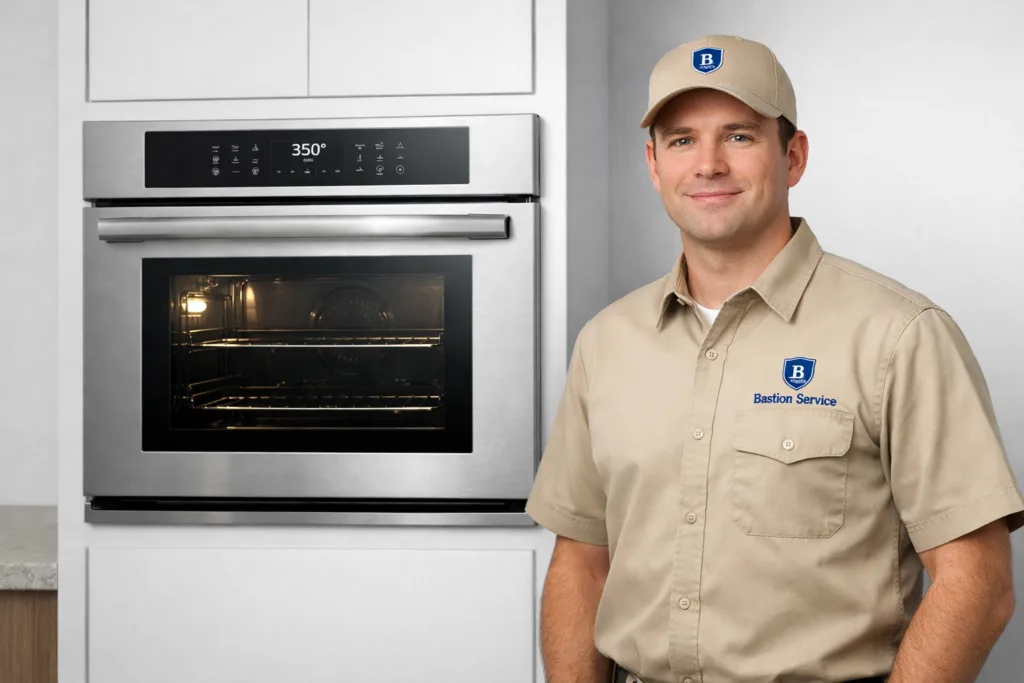
Cooking problems often start subtly with a wall oven. A Summit unit may still turn on, light up, and appear to run, but symptoms like slow preheat, uneven baking, or random shutdowns usually point to a component that is no longer performing correctly. In a built-in appliance, that can involve the heating system, sensor circuit, control board, door switch, or wiring behind the unit.
For Mid-City homeowners, it helps to look at the exact pattern rather than assuming every heating issue means the same repair. An oven that never heats, one that heats weakly, and one that overshoots the set temperature can each require a very different fix.
Common Summit wall oven symptoms and what they may mean
Oven will not heat at all
If the cavity stays cold during bake or broil, the problem may involve a failed element, a blown thermal safety component, a bad igniter on gas-equipped models, or a control that is not sending power where it should. Sometimes the display works normally even while the actual heating circuit does not.
This is also a symptom where homeowners can misread the issue. A wall oven that seems completely dead to heat may still have only one failed part, but the correct part depends on whether the unit is trying to start, whether broil works while bake does not, and whether any fault codes appear.
Slow preheating
When preheat takes much longer than it used to, the oven may be operating on partial heat. One weak element, a temperature sensor drifting out of range, or an ignition problem can all cause delayed warmup. Meals take longer, baking becomes less predictable, and the appliance may continue running harder than normal just to reach the selected temperature.
Slow preheat is worth addressing early because it can be the warning stage before a complete no-heat failure.
Uneven baking or inconsistent browning
Food that comes out overdone on one side and underdone on the other often signals a temperature regulation problem rather than a simple recipe issue. A Summit wall oven may cycle incorrectly if the sensor is inaccurate, if the control is misreading temperature, or if one heating function is not contributing enough heat during the cook cycle.
- Cookies browning more on the back than the front
- Casseroles finishing on top while staying cool in the center
- Roasting times becoming inconsistent from one use to the next
- Recipes that suddenly need major time adjustments
Oven runs too hot or temperature swings are obvious
If the oven burns food even at familiar settings, the sensor or control may be reading cavity temperature incorrectly. In some cases, calibration is off. In others, the oven is actually overheating because the control system is not cycling the elements properly. This can affect both baking results and long-term component life.
Large temperature swings can also show up as an oven that seems normal for part of the cycle and then becomes too hot later in use.
Oven shuts off during cooking
A unit that stops mid-cycle may be overheating internally, losing electrical continuity, or encountering a control fault that interrupts operation. If the shutdown repeats, the appliance should not be treated as a minor inconvenience. Intermittent electrical problems can worsen over time and may eventually affect other components.
Error codes or unresponsive controls
When the control panel flashes an error, stops responding, or resets unexpectedly, the issue may be tied to the touch interface, electronic control board, sensor feedback, or power supply to the oven. Because electronic symptoms can overlap with heating problems, this is one area where symptom-based testing matters more than guesswork.
Door or latch problems
A wall oven door that does not seal properly can let heat escape and create poor baking performance. A faulty latch or switch can also prevent the oven from starting or interfere with certain cycles. On built-in models, small alignment issues sometimes create larger performance complaints because the oven cannot regulate heat the way it should when the door system is compromised.
Why built-in wall ovens need careful troubleshooting
Summit wall ovens are installed inside cabinetry, so service is not exactly the same as with a freestanding range. Access to power connections, mounting points, and internal components can take more time, and the repair path often depends on how the unit is installed as well as which symptom is happening.
That is why a symptom like “not heating” is only the starting point. The real issue could be:
- A failed bake or broil element
- An igniter that is too weak to light gas reliably
- A faulty oven temperature sensor
- A relay or electronic control failure
- A blown fuse or safety cutoff
- A door switch, latch, or wiring problem
Replacing the wrong part wastes time and money, especially when the actual fault is somewhere else in the heating circuit.
When to stop using the oven
Some wall oven problems are inconvenient but manageable until service. Others should be treated as a stop-use situation. If your Summit wall oven in Mid-City is tripping the breaker, showing repeated fault codes, overheating badly, or shutting off unpredictably, it is safer to leave it off until it is checked.
You should also stop using the appliance if you notice:
- A burning or electrical smell during operation
- The oven continuing to heat after the cycle should end
- The control panel acting erratically
- The door failing to close or latch securely
- Visible sparking, arcing, or signs of heat damage
For gas-equipped models, a strong or persistent gas odor should be treated as a safety issue first rather than a routine appliance problem.
Repair versus replacement
Many Summit wall oven issues are worth repairing when the failure is limited to one major part or system, such as an element, igniter, sensor, fuse, latch assembly, or selected control component. In those cases, the repair can often restore normal cooking performance without replacing the entire appliance.
Replacement becomes a more realistic option when there are multiple faults at once, repeated breakdowns over a short period, heavy control damage, or part availability problems. Age matters, but condition matters too. A well-kept oven with one specific failure is a different decision than an older unit with heating issues, control problems, and door wear happening together.
The most useful question is not simply whether the oven can be repaired, but whether the repair is likely to restore reliable everyday use.
What homeowners should expect from a service visit
A productive service visit should identify the failed part or system, explain why the symptom is happening, and clarify whether continued use could cause more damage. That is especially important with wall ovens because temperature complaints, control complaints, and shutdown complaints often overlap.
For a Summit wall oven repair in Mid-City, homeowners usually want a few practical answers:
- Is the problem electrical, mechanical, or control-related?
- Is the oven safe to use before repair is completed?
- Is this likely a targeted repair or a larger parts decision?
- Does the symptom suggest additional wear beyond the main failure?
Once those points are clear, it becomes much easier to decide on the next step based on safety, cost, and how important the oven is to daily cooking at home.
Symptom patterns that should not be ignored
Some problems look minor at first but tend to progress. An oven that takes slightly too long to preheat today may stop heating altogether later. A temperature issue that only affects baking can spread into broil performance or control errors. A door that does not close quite right can slowly turn into heat loss, longer cook times, and strain on the heating system.
If your Summit wall oven has changed in performance, consistency, or responsiveness, the change itself is useful information. Catching the issue while it is still limited can help prevent a smaller repair from turning into a more expensive one.