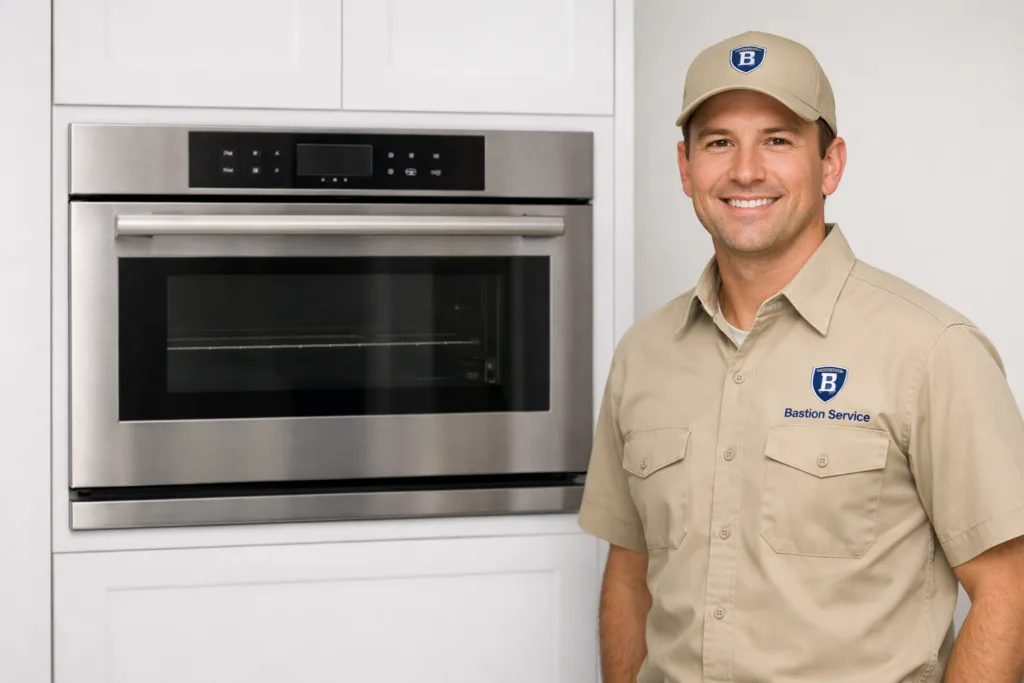
Built-in wall ovens can fail in ways that look simple at first but come from very different components. A Dacor unit that seems slow to preheat may have an element problem, a drifting temperature sensor, a relay issue on the control, or an airflow problem affecting heat balance. Sorting that out early helps homeowners in Mid-City avoid repeat breakdowns and unnecessary part replacement.
What symptom patterns usually mean
The fastest way to narrow down a wall oven problem is to look at how the symptom shows up during everyday use. Whether the oven is completely cold, heats unevenly, flashes errors, or shuts down during cooking, the pattern often points to a smaller group of likely causes.
Oven turns on but does not heat well
If the display works and the oven appears to start but food still comes out undercooked, the issue is often in the heating circuit rather than the incoming power alone. On many Dacor wall ovens, weak bake performance can come from a failing bake element, while slow recovery or poor browning may also involve the broil side, sensor readings, or the electronic control that cycles heat.
Homeowners often notice this as long preheat times, pale baked goods, or dishes that need much more time than normal. If this happens repeatedly, it usually means the oven needs tested repair work rather than another round of temperature adjustment guesses.
Uneven baking from rack to rack
When one tray browns too fast while another lags behind, the problem may be tied to heat distribution rather than total heat output. Convection fan trouble, sensor inaccuracy, partial element failure, or door seal issues can all create uneven results.
This kind of symptom is easy to dismiss at first because the oven still “works,” but inconsistent heat usually gets worse over time. If rotating pans no longer solves it, the unit likely needs service.
Temperature swings during normal cooking
Some cycling is normal, but large temperature swings are not. If the oven overshoots, drops too low, or seems to alternate between scorching and underheating, a bad sensor, control fault, or relay problem may be behind it. In a wall oven, those issues can affect everything from weeknight baking to longer roasting cycles.
- Food cooks faster than the set temperature suggests
- Preheat completes, but the cavity never seems truly ready
- Recipes that used to be reliable suddenly fail
- The oven appears hotter or cooler than the display indicates
Error codes, beeping, or a blank display
Dacor wall ovens can show faults through beeping, flashing displays, locked controls, or full loss of response. In some cases, a breaker reset may briefly restore operation, but repeat errors usually point to a deeper issue involving the interface, control board, sensor circuit, or latch system.
If the oven powers on intermittently or the keypad works only part of the time, continued use can be frustrating and may lead to incomplete cycles, failed preheat, or shutdown during cooking.
Door problems and lock issues
A door that will not close squarely, seal tightly, lock, or unlock can affect both performance and safety. Heat loss around the door changes cooking results, while latch and lock problems can interfere with normal operation and self-clean functions.
Watch for these signs:
- The door feels loose, misaligned, or drops differently than before
- The oven stays locked after a cycle ends
- The latch motor keeps trying to engage
- Heat escapes around the gasket during baking
Fan noise, overheating, or shutdowns mid-cycle
Cooling and convection fans play a bigger role in built-in wall ovens than many homeowners realize. If a fan becomes noisy, runs too long, fails to run when needed, or causes the oven to stop during cooking, the surrounding controls and internal components can overheat.
This is especially important in a built-in installation where ventilation and cabinet fit affect how the appliance manages heat. A shutdown during cooking is rarely something to ignore.
Why Dacor wall ovens need symptom-based testing
Dacor wall ovens often combine electronic controls, multiple cooking modes, and model-specific built-in layouts. That means two ovens with the same symptom may still need different repairs. “Not heating” can mean a failed element on one unit and a control output problem on another. “Runs hot” can point to calibration drift in one case and a sensor or relay fault in another.
That is why a practical repair plan starts with confirming power, checking control response, verifying actual temperature behavior, and narrowing the failure to the heating system, sensor circuit, fan operation, door components, or control electronics.
When repair makes sense
Repair is often worthwhile when the problem is limited to a serviceable part and the oven is otherwise in solid condition. Many wall oven issues come down to one failed component or one fault path that can be corrected without replacing the full appliance.
Common examples include:
- Failed or weakened heating elements
- Temperature sensor problems
- Door latch or hinge failures
- Cooling or convection fan issues
- Select control or interface faults
For many households in Mid-City, repair is the better option when it restores reliable day-to-day cooking without opening the door to repeated follow-up issues.
When replacement may be the better option
Sometimes replacement becomes the more practical choice, especially if the wall oven has several major problems at once, has a history of recurring electronic failures, or needs a repair that approaches the value of the appliance. Age alone does not decide it, but age combined with multiple symptoms usually matters.
Replacement may deserve serious consideration when:
- The oven has both heating and control problems
- Critical parts are difficult to source in a reasonable timeframe
- The cavity, door, and electronics all show wear at the same time
- Recent repairs have not restored stable performance
Signs you should stop using the oven until it is checked
Some symptoms are more than an inconvenience. If the oven trips breakers, sparks, smells like burning insulation, overheats the surrounding area, or shuts off unpredictably during use, it is best to stop using it until the fault is identified. The same is true for a damaged door seal, a stuck lock, or repeated control failure that affects normal operation.
Built-in appliances place heat and electrical components in a tighter installation, so problems that seem minor can put extra stress on wiring, controls, and nearby parts if ignored.
What homeowners in Mid-City can do before scheduling service
Before arranging a repair visit, it helps to note exactly how the oven is failing. Specific details can make diagnosis faster and more accurate.
- Does the oven fail during preheat or later in the cycle?
- Is the issue constant or intermittent?
- Are both bake and broil affected?
- Does the display show a code, flash, or go blank?
- Is the door closing and sealing normally?
- Do you hear unusual fan or relay sounds?
If the problem changed after a power outage or breaker trip, that is also useful to mention. Small details often help separate a control issue from a heating or sensor problem.
Choosing the right repair path for a built-in wall oven
The best repair decisions come from matching the symptom to the actual failed component, not from replacing parts based on the most obvious guess. With Dacor wall oven repair in Mid-City, that matters because built-in access, control configuration, and heat management all affect how the oven behaves when something starts to fail.
If your oven is no longer dependable for everyday meals, baking, or holiday cooking, the next step is to have the symptom properly narrowed down so you can decide on repair versus replacement with real information instead of trial and error.