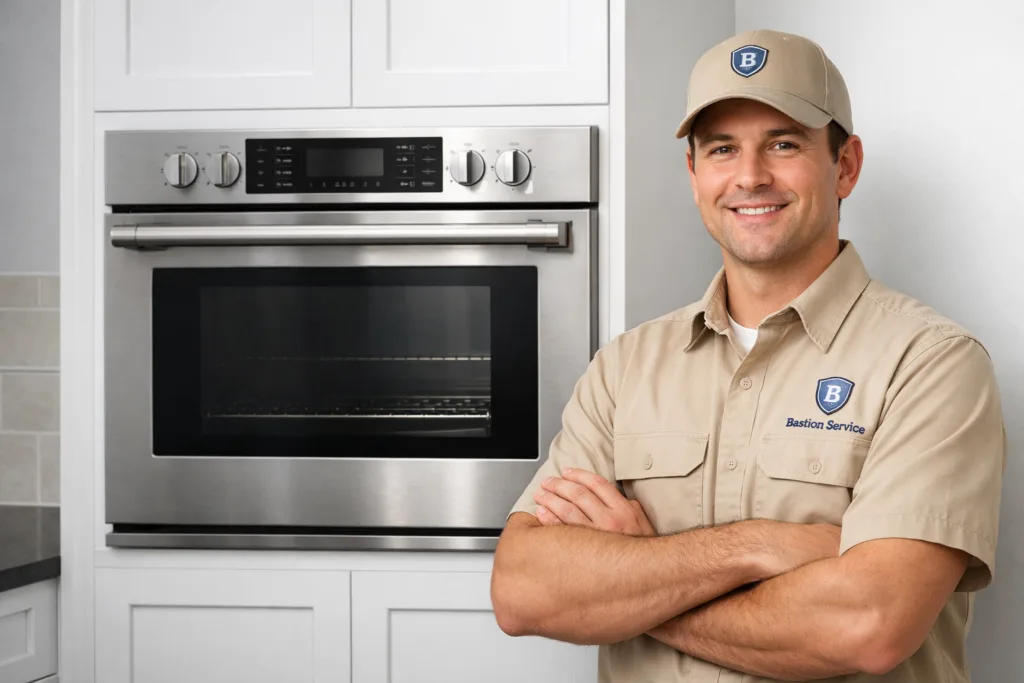
Common Viking wall oven issues homeowners notice first

Wall oven problems often show up gradually before they become impossible to ignore. You might notice longer preheat times, baking that suddenly seems inconsistent, a control panel that responds intermittently, or a door that does not latch the way it should. With Viking units, those symptoms can point to very different failures, so the most useful starting point is to match the repair path to the way the oven is actually behaving.
In Mid-City homes, built-in ovens are used heavily for everyday cooking, weekend meals, and holiday baking, which makes even a small performance issue frustrating. An oven that is only slightly off temperature can still spoil results, while an intermittent electrical or control problem can leave the appliance unreliable from one use to the next.
What specific symptoms can mean
Not heating at all
If the oven powers on but never gets hot, the failure may involve the bake element, broil element, sensor circuit, control board, thermal protection component, or wiring connection. Some ovens appear normal at the display while the heating circuit is not engaging properly. That is why a lit screen does not always mean the oven is functioning.
Slow preheat
Slow preheat is one of the most common complaints with wall ovens. A weakened heating element, inaccurate sensor reading, failing relay, or partial heating problem can all lead to long wait times. In some cases, the oven eventually reaches temperature but only after much longer than normal, which usually signals that a part is deteriorating rather than failing all at once.
Uneven baking or roasting
When cookies brown unevenly, casseroles stay underdone in the center, or one rack cooks faster than another, the issue may be related to temperature sensing, calibration drift, convection problems, or inconsistent element cycling. This type of problem can be easy to dismiss at first, but it often means the oven is no longer maintaining heat accurately.
Temperature swings during cooking
Large swings above or below the set temperature can affect nearly everything you cook. Sensor faults, electronic control issues, relay problems, and intermittent heating can all cause unstable temperatures. If meals come out differently each time even when you use the same settings, the oven may not be regulating heat correctly.
Shutting off mid-cycle
An oven that starts normally and then loses heat or powers down may be dealing with overheating protection, electrical connection trouble, internal control failure, or a component that stops working once it gets hot. Repeated mid-cycle shutdowns are worth addressing quickly because they can become less predictable over time.
Control panel or keypad problems
If buttons stop responding, settings change unexpectedly, or the display works while cooking functions do not, the problem may be in the user interface, touch panel, electronic control, or related wiring. These issues can look minor at first but can interfere with safe and accurate operation.
Door lock or self-clean problems
Self-clean cycles place high heat stress on wall ovens. If the door stays locked, the oven will not restart, or an error appears after self-cleaning, the issue may involve the latch assembly, switches, fuse, or control system. Many homeowners first notice this when the oven seems fine before self-clean and unusable afterward.
Why the same symptom can have more than one cause
Wall ovens do not always fail in a simple, one-part way. A no-heat complaint can come from a bad element, but it can also come from a control that never sends power to that element. An overheating complaint may look like a sensor issue but can actually be caused by a control problem that misreads temperature or keeps a relay closed too long.
That is why symptom-based diagnosis matters so much with Viking wall oven repair in Mid-City. It helps separate a straightforward repair from a larger electrical or control issue and reduces the risk of replacing parts that were never the real cause of the problem.
Signs the problem should not be ignored
Some oven issues are mostly performance-related, while others can affect safe use. It is smart to stop using the oven and arrange service if you notice any of the following:
- Burning smells that do not clear quickly
- Visible sparking
- The breaker trips during operation
- The oven overheats far beyond the set temperature
- The door will not lock or unlock correctly
- The unit loses power during cooking
- Recurring error codes that return after reset attempts
Even when the oven still works part of the time, continued use with an unresolved electrical or heat-control problem can lead to additional part failures.
What usually makes repair worthwhile
Repair is often the better option when the oven is otherwise in solid condition and the failure is limited to a heating component, sensor, latch system, control-related part, or wiring issue that can be identified clearly. Built-in Viking wall ovens are significant appliances, so many homeowners prefer repair when the fix restores normal cooking performance without opening the door to repeated breakdowns.
Replacement becomes a more serious consideration when there are multiple major faults, signs of long-term electrical damage, repeated service history, or a repair cost that no longer makes sense relative to the oven’s overall condition. The useful question is not just whether the oven can be repaired, but whether the repair returns it to stable household use.
What to check before service
Before assuming the oven has failed completely, it can help to note a few details about what the appliance is doing:
- Whether the display is working normally
- If bake and broil both fail or only one mode has trouble
- Whether the issue started suddenly or gradually
- If the problem began after a self-clean cycle
- Whether the oven reaches some heat but not the correct temperature
- Any error code shown on the display
Those details can make the symptom pattern much clearer and help narrow down whether the problem is heat generation, heat regulation, control response, or door-lock related.
Built-in wall oven repairs require a careful approach
Unlike a freestanding range, a wall oven is installed into cabinetry, which means access and testing need to be handled carefully. Power supply checks, component inspection, and removal procedures all matter more when the appliance is integrated into the kitchen. That is especially true when a problem involves intermittent heating, control behavior, or heat damage after self-cleaning.
For households in Mid-City, the goal is usually straightforward: find out why the oven is acting up, understand whether the fix is reasonable, and avoid wasting time on guesswork. A careful diagnosis and a practical repair plan based on the exact symptom pattern is what usually gets the kitchen back on track.