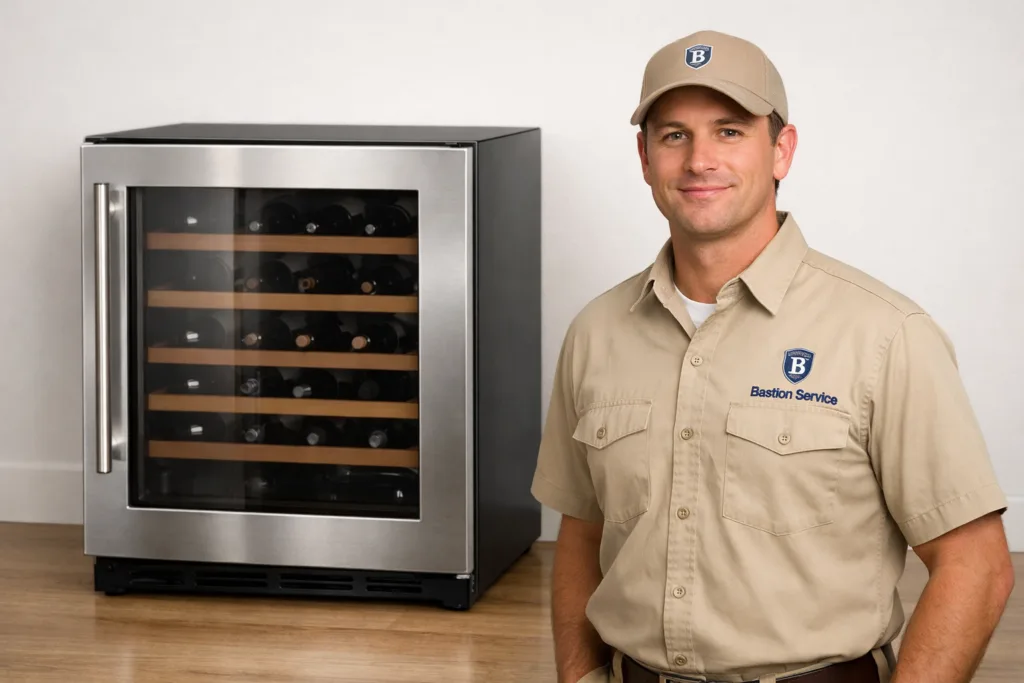
A Summit wine cooler that stops holding temperature, starts making unusual noise, or leaves moisture around the cabinet can put a household collection at risk quickly. Similar symptoms can come from very different causes, including airflow restrictions, sensor faults, door seal leaks, control problems, or a struggling cooling system. Pinpointing the failure before repair decisions are made helps avoid wasted parts, repeat breakdowns, and unnecessary replacement.
Common Summit wine cooler problems in Mid-City homes
Wine coolers usually fail in a few recognizable ways, but the visible symptom is not always the true cause. A unit that feels warm inside may have a simple circulation issue, or it may have a more serious sealed-system problem. Inspection typically focuses on temperature behavior, fan operation, door sealing, condensation patterns, and control response.
Not cooling enough or running warm
If your Summit wine cooler is no longer maintaining a steady interior temperature, several issues may be involved. Dirty coils, restricted airflow, a weak evaporator fan, a faulty thermostat or sensor, or a compressor-related problem can all show up as poor cooling. In some homes, the cooler still runs but struggles to recover after the door is opened, which can point to declining performance rather than a total failure.
Too cold or uneven temperature swings
When bottles feel colder than expected, or temperatures rise and fall without a clear reason, the problem may involve the control board, thermistor, temperature interface, or internal airflow. Stable storage matters more than simply getting cold. If the unit cycles erratically or freezes in sections, continued operation without service can increase wear on fans and the compressor.
Water buildup, condensation, or leaks
Moisture around or inside a Summit wine cooler can come from a worn door gasket, a leveling problem, high humidity around the cabinet, or a blocked drain path on models that manage condensation internally. Condensation on shelves or glass may look minor at first, but it often points to a sealing or airflow problem that can affect temperature control over time.
Noise, vibration, or constant running
Some operating sound is normal, but buzzing, rattling, clicking, or unusually long run times deserve attention. Vibration can come from leveling issues or loose panels, while clicking may point to start components or control trouble. If the unit seems to run almost nonstop, that can indicate poor heat exchange, a door that is not sealing well, or a compressor working harder than it should.
Why symptom-based diagnosis matters
On a compact appliance like a wine cooler, guessing often leads to the wrong repair. Replacing a thermostat will not solve a hidden fan failure, and changing a door gasket will not correct a cooling system problem. A proper service visit for a Summit wine cooler usually begins with confirming temperature accuracy, checking airflow, inspecting seals, testing electrical and control components, and evaluating whether the cooling system is operating as expected.
For homeowners in Mid-City, the real question is often not just whether the cooler can be fixed, but whether the repair makes sense for the appliance’s condition and expected lifespan. A careful assessment helps show whether the issue is isolated and repairable, likely to worsen soon, or serious enough that replacement should be considered.
Signs it is time to schedule service
It makes sense to schedule service when the cooler cannot hold the set temperature, shows repeated condensation, makes new or worsening noise, cycles abnormally, or stops responding to controls. Even if the unit still cools somewhat, partial performance loss is worth addressing early. A wine cooler that is cooling weakly often places extra strain on key components, and waiting can turn a manageable repair into a larger one.
- The cabinet feels warm even though the display appears normal.
- The interior light or controls act inconsistently along with cooling problems.
- The fan sound changes, becomes louder, or stops altogether.
- Restarting the unit only restores operation briefly.
- Condensation keeps returning after you wipe it away.
Short-term recovery after unplugging and plugging the unit back in usually suggests the underlying fault is still present.
When continued use can make the problem worse
Continued use may be reasonable for a minor cosmetic issue, but active cooling problems are different. If the unit is running constantly without reaching the target temperature, repeatedly clicking, building up moisture, or showing unstable temperatures, continued operation may increase wear and raise the chance of further component damage.
A failing fan can reduce airflow and force the system to overwork. A bad seal can keep the unit running longer than normal. Electrical or control issues can become less predictable over time. If stored wine is important to preserve, moving bottles to a stable temporary location while the cooler is being evaluated is often the safest choice.
Repair versus replacement for a Summit wine cooler
Repair is often the sensible option when the problem involves fans, controls, sensors, switches, lighting, door gaskets, or other accessible electrical components. Replacement becomes more likely when the unit has major cooling system trouble, recurring failures, or repair costs that approach the value of the appliance. Age, overall condition, noise level, and reliability history all matter in that decision.
The most useful approach is to base that choice on the actual fault rather than the symptom alone. Once the cause is identified, it becomes much easier to tell whether the cooler needs a targeted repair, whether continued use is hard on the system, and whether replacement is the better long-term step for the household.
What homeowners can check before service
Before scheduling, it helps to look at a few basics that can affect performance or help narrow down the cause:
- Make sure the door closes fully and is not being held open by bottle placement.
- Confirm the temperature setting has not changed accidentally.
- Check that vents inside the cabinet are not blocked.
- See whether the cooler is sitting level and stable.
- Listen for fan movement and note whether the display responds normally.
- Watch for patterns, such as cooling only at certain times or moisture appearing after the door stays shut.
These details can make troubleshooting faster and help separate a setup issue from a mechanical or electrical fault.
What to expect from a service evaluation
A service evaluation is usually most helpful when it focuses on the symptom pattern you are actually seeing at home. That may include checking real cabinet temperature against the setting, inspecting gaskets and hinges, testing fan and sensor operation, reviewing control response, and looking for signs that the cooling system is underperforming. In many cases, this is what clarifies whether the issue is a straightforward repair or a sign of broader wear inside the unit.
When a Summit wine cooler shows unstable cooling, repeated moisture, or worsening noise in a Mid-City home, prompt attention usually protects both the appliance and the contents inside it. Early service can reduce avoidable strain on the system and make the next step much clearer.