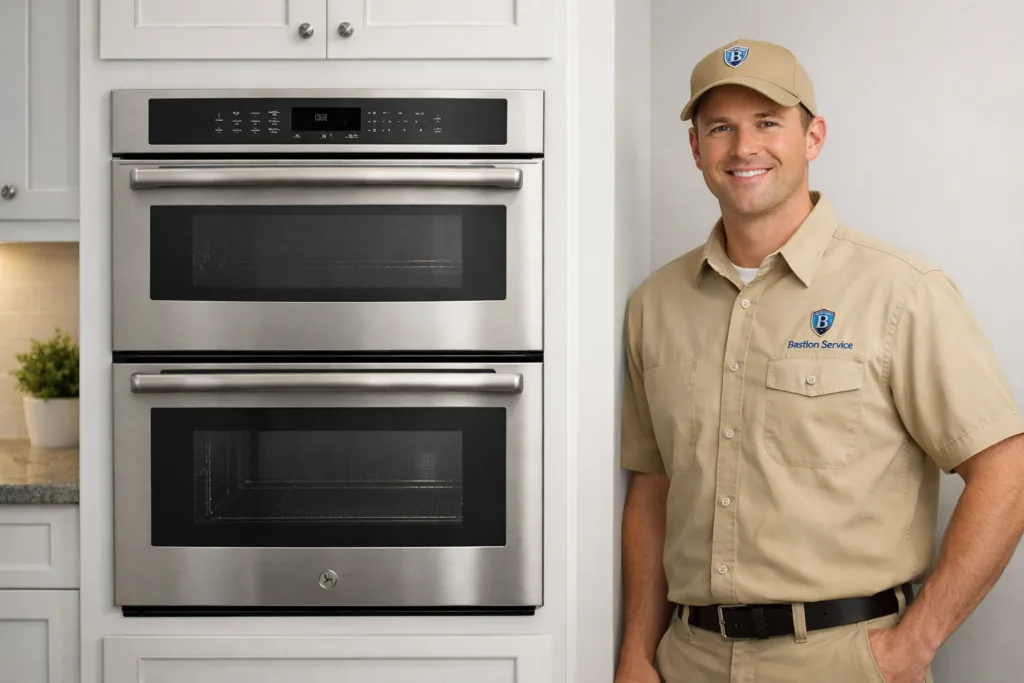
Wall oven problems usually show up in the middle of everyday cooking: preheat drags on, cookies brown unevenly, the display starts flashing, or the oven shuts off before a meal is finished. With GE built-in models, the same symptom can come from more than one failed part, so it helps to look at how the oven behaves across the full cooking cycle rather than assuming the first obvious cause.
Common GE wall oven problems in Mid-City homes
Most service calls come down to a handful of repeat issues. The details matter, though, because the pattern often points toward a different repair path.
Not heating at all
If the oven stays cold on bake or broil, the problem may involve a failed element, a blown thermal cutoff, a sensor issue, a damaged connection, or a control board fault. In some cases the display appears normal even though the oven is not actually sending power to the heating circuit.
Slow preheat
A GE wall oven that eventually gets hot but takes much longer than it used to may have a weakened bake element, a partially failing broil element, a sensor drifting out of range, or a control problem affecting how the oven cycles heat. Slow preheat often starts as an annoyance and then becomes a sign that a part is on the way out.
Uneven baking and temperature swings
If one side of a dish cooks faster, the top browns too quickly, or baked goods come out inconsistent from one use to the next, the oven may not be regulating temperature correctly. Common causes include a bad temperature sensor, a weak heating element, relay trouble on the control, or heat distribution issues caused by failing components.
Display errors and control issues
When the keypad does not respond, the clock resets, or the screen shows an error code, the fault may be electronic rather than mechanical. Depending on the GE model, that can involve the user interface, main control board, touch panel, sensor circuit, or communication between components.
Door latch or self-clean problems
If the door will not lock, will not unlock, or feels out of alignment, the issue may involve the latch motor, switch, hinges, or related controls. Self-clean cycles can also stress older components because of the sustained high heat, sometimes leading to failures that appear immediately afterward.
Power loss or breaker trips
An oven that trips the breaker, cuts out during preheat, or loses power while cooking should not be ignored. That can point to a shorted element, damaged wiring, an internal electrical fault, or a component drawing power abnormally under heat load.
How symptom patterns help narrow down the cause
One reason wall oven diagnosis can be tricky is that several faults create similar results. An oven that seems to run cool might have a bad sensor, but it could also have a relay that fails once the control heats up. A unit that bakes unevenly may not need calibration at all if one heating circuit is only working intermittently.
Looking at the full pattern is more useful than focusing on one moment of failure. Helpful details include:
- whether the problem affects bake, broil, or both
- if preheat finishes but cooking still seems off
- whether the issue started suddenly or worsened gradually
- if the display shows codes, resets, or loses segments
- whether the problem appeared after a self-clean cycle
- if the breaker trips only when the oven is fully heating
That kind of symptom history often makes it easier to separate a simple part failure from a larger electrical or control problem.
When to stop using the oven
Some wall oven problems are inconvenient but manageable until service is scheduled. Others are reasons to stop using the appliance right away.
It is best to discontinue use if you notice:
- a burning smell that does not fade quickly
- visible sparking or signs of overheating
- repeated breaker trips
- the oven shutting off unpredictably during cooking
- a door that will not unlock after a cycle
- error codes that prevent normal operation
For gas wall oven configurations, a persistent gas smell is a separate safety issue. Stop using the appliance and address the gas concern first before arranging appliance repair.
Why continued use can make the repair more expensive
Trying to cook around the problem can sometimes turn a limited repair into a broader one. A weak element may overheat terminals, repeated resets can stress controls, and electrical faults can damage wiring if the oven keeps being used under load. Even temperature issues matter, because prolonged overheating can affect insulation, sensors, and nearby components inside a built-in cavity.
If performance has become unreliable, reducing use until the problem is identified is often the safer and less costly choice.
Repair or replace?
Many GE wall oven issues are still worth repairing, especially when the problem is isolated to a part such as an element, sensor, igniter, latch assembly, or control-related component. Replacement becomes more likely when the oven has multiple active problems, significant wiring damage, or a repair cost that no longer makes sense for the appliance’s age and condition.
For Mid-City homeowners, the real decision usually comes down to four things:
- which part failed
- whether the unit has had other recent issues
- the overall condition of the oven
- how practical the repair is compared with replacement
A good service recommendation should explain not only what is wrong now, but whether the fix addresses an isolated failure or a broader pattern of wear.
What homeowners should expect from a GE wall oven service visit
Built-in ovens are different from freestanding ranges because access, mounting, and electrical configuration can all affect diagnosis. A useful visit should verify the fault, check whether the oven can be operated safely, and explain the next step in plain language. That matters when the symptom could involve heat generation, temperature sensing, controls, or the door system rather than a single obvious part.
For households in Mid-City that rely on a wall oven regularly, the most helpful outcome is knowing exactly what failed, whether the repair is sensible, and what to do next without guessing.