
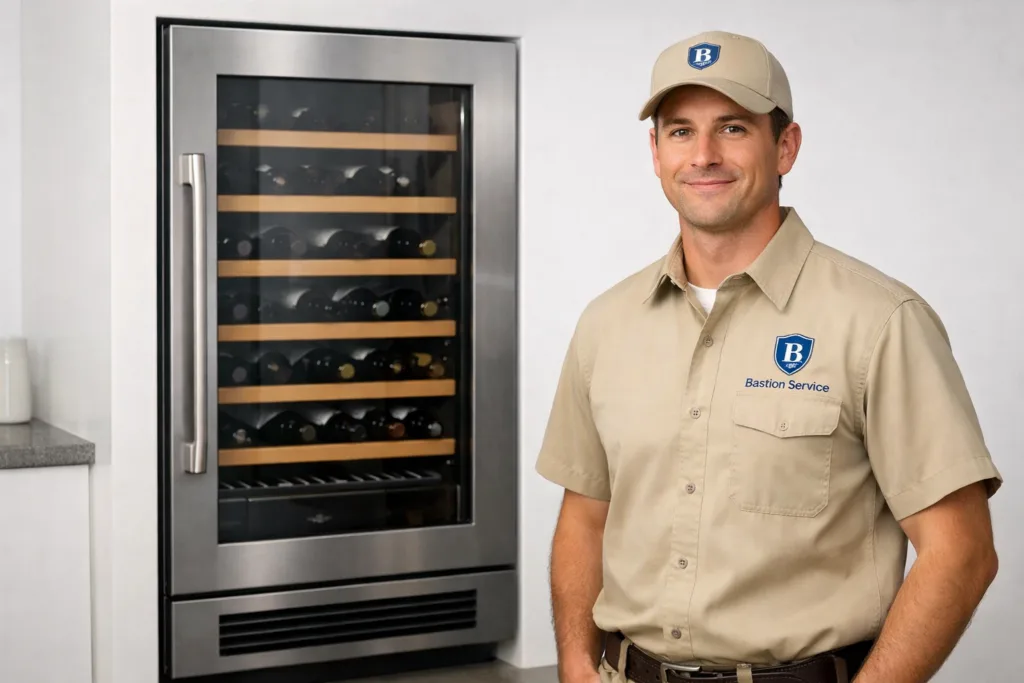




Wine coolers usually give warning signs before they fail completely. If your Fisher & Paykel unit is drifting above the selected temperature, running longer than usual, collecting moisture, or getting noisier, the symptom pattern matters. Problems that look alike from the outside can come from very different causes, including airflow restrictions, sensor errors, fan trouble, door-seal leaks, control faults, or a more serious cooling-system issue.
Related Fisher & Paykel and wine cooler service paths in Los Angeles include Fisher & Paykel Appliance Repair in Los Angeles, Wine Cooler Repair in Los Angeles, and Fisher & Paykel Refrigerator Repair in Los Angeles.
Common Fisher & Paykel wine cooler problems homeowners notice
In many Los Angeles homes, the first complaint is simple: bottles do not feel as cool as they should. From there, the issue may show up as uneven temperatures from shelf to shelf, cycling that seems nonstop, a control panel that does not respond properly, or condensation that keeps returning. Because these symptoms overlap, it helps to look at how the unit is behaving rather than assuming one part is at fault.
Not cooling enough
If the cabinet is powered on but the temperature stays too warm, the cause may be weak air circulation, a sensor reading incorrectly, a fan that is not moving air as it should, or a problem in the cooling system itself. In some cases, the cooler is technically running but cannot pull the temperature down far enough to protect the contents the way it should.
Uneven cooling is another clue. If one section of the cabinet feels warmer than another, the issue may be tied to airflow inside the unit rather than a total loss of cooling. That distinction matters when deciding what kind of repair makes sense.
Temperature swings or slow recovery
A wine cooler should recover within a reasonable time after the door is opened. If it takes too long to return to the set temperature, or if the temperature rises and falls more than usual, there may be a problem with sensing, air movement, or warm air entering through a loose seal. Repeated swings can undermine proper storage even when the appliance still seems to be working most of the time.
Running constantly
A unit that rarely shuts off is usually struggling to keep up. That can happen when heat is not being released efficiently, when the door gasket is letting room air in, or when a control issue keeps the system from cycling normally. Constant operation adds wear to the cooler and can push a smaller fault into a larger repair if it is left alone too long.
Fan noise, buzzing, or clicking
Not every sound means the same thing. A rattle may point to a loose component or vibration, while a louder fan sound can suggest restricted airflow or a failing fan motor. Buzzing or repeated clicking near the compressor area may indicate the unit is struggling to start or operate correctly. Changes in sound are useful because they often narrow the diagnosis much faster than “not cooling” alone.
Condensation, moisture, or frost
Moisture around the door, water inside the cabinet, or frost buildup where it should not be can all signal an air leak or airflow problem. When warm household air gets into the cooler, condensation often follows. Over time, frost can interfere with circulation and make temperature control worse. If the same moisture issue keeps coming back after wiping the unit down, the underlying cause likely still needs attention.
Display or control issues
If the display is blank, the settings do not respond, or the controls behave erratically, the problem may involve the user interface, a control board, power-related components, or wiring connections. A cooler that appears dead is not always suffering from a simple outlet issue. Testing is important because electronic symptoms can imitate more basic failures.
What often causes these symptoms
Fisher & Paykel wine coolers depend on several systems working together: temperature sensing, interior airflow, door sealing, control response, and heat removal. When one area falls out of spec, the symptom may look bigger than it really is. Common causes include:
- Worn or damaged door gaskets letting warm air into the cabinet
- Blocked or restricted airflow inside the unit
- Condenser areas that are dirty or unable to release heat well
- Evaporator or condenser fan problems
- Faulty sensors or thermostatic controls
- Control board or interface failures
- Compressor or sealed-system problems in more serious cases
The reason accurate diagnosis matters is that these issues can produce nearly identical complaints. A cooler that runs constantly might need a gasket, a fan, a sensor, or a major cooling-system repair. Guessing usually costs more time and money than identifying the fault properly from the start.
When to schedule repair
It is smart to schedule service when the cabinet no longer matches the setting, when noise changes suddenly, when moisture keeps returning, or when the appliance is always running. You should also pay attention if the display is acting strangely, the door does not close firmly, or the cooler cools only part of the cabinet.
Even if the unit is still somewhat cold, a partial failure is worth addressing. Wine coolers are meant to hold a controlled environment, so “almost working” is not really the same as working well. Small issues, especially fan and airflow problems, can put added strain on major components if the appliance keeps operating in that condition.
Simple checks before service
Before arranging a visit, a few observations can help speed up the process:
- Check whether the display is on and responding to adjustments
- Note whether the interior light works
- See if the door closes flush and seals firmly all the way around
- Listen for clicking, buzzing, rattling, or louder-than-normal fan noise
- Notice whether the cabinet is evenly cool or warm in certain spots
- Look for recurring condensation, frost, or water inside the unit
- Think about whether the issue started after a recent power interruption
These details often help separate a control issue from an airflow problem, or an intermittent electrical symptom from a deeper cooling failure.
When continued use can make the problem worse
Continuing to run a struggling wine cooler can increase wear on the system. A unit with a failing fan may keep operating long enough to create more serious cooling trouble. A poor door seal can force the appliance to run for extended periods. Moisture and frost can interfere with normal air circulation and make temperature performance less predictable. If the cabinet is no longer staying stable, the contents may be at risk even before the unit stops altogether.
For households in Los Angeles, this becomes especially important during warmer periods when room conditions already make the appliance work harder. If the cooler is hot around certain areas, clicking repeatedly, or clearly losing control of cabinet temperature, waiting is rarely the better option.
Repair or replacement?
Some Fisher & Paykel wine cooler problems are straightforward and often make sense to repair, especially when the issue is tied to a fan, sensor, gasket, switch, or control-related component. Other cases are more substantial. If testing points to a sealed-system failure, compressor trouble, or multiple faults in an aging unit, replacement may deserve consideration.
The better decision depends on the actual condition of the appliance, not just the symptom on the surface. A cooler that seems finished may turn out to have a manageable airflow or control problem. On the other hand, one that only appears slightly warm may have a larger cooling-system failure behind it. A symptom-based evaluation gives homeowners a more realistic path forward.
What good wine cooler repair should accomplish
The goal is not simply to make the display light up again or to get the cabinet temporarily colder. The real objective is restoring stable storage conditions so the unit can maintain temperature consistently, cycle normally, and operate without excessive noise or moisture problems. For a household appliance designed to protect a collection, performance matters as much as basic operation.
If your Fisher & Paykel wine cooler is showing signs of trouble, addressing the issue early usually gives you more options and a better chance of avoiding a larger failure.


