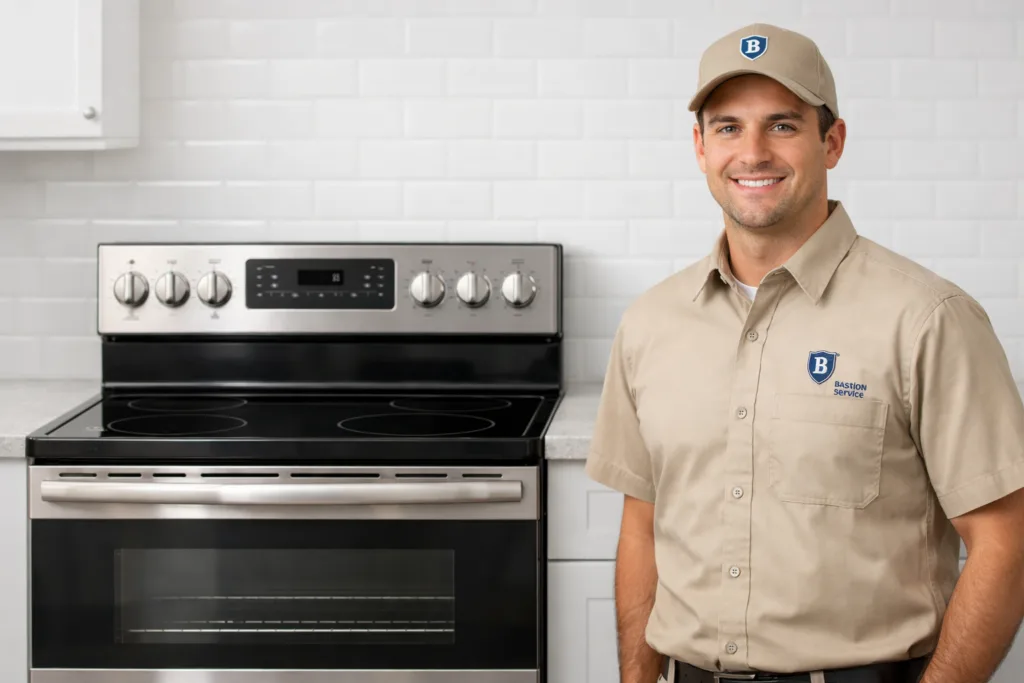
Common GE range problems in West Los Angeles homes
Burners that will not ignite or keep clicking

If a surface burner clicks repeatedly, lights slowly, or does not light at all, the cause may be as simple as burner cap misalignment or as involved as a failed ignition switch, worn spark module, or moisture affecting the ignition path. On many GE ranges, one burner problem stays isolated, while another symptom points to a shared ignition issue affecting multiple burners. If clicking continues after the burner is turned off, or ignition becomes unreliable, it is best to stop normal use until the fault is identified.
Oven not heating, heating slowly, or baking unevenly
An oven that stays cold, takes too long to preheat, or cooks unevenly can have several different root causes. Gas models often develop weak igniters that glow but do not pull enough current to open the gas valve properly. Electric models may have a failed bake or broil element, damaged wiring, or a control problem interrupting heat. Uneven browning, long preheat times, and inconsistent cooking results usually mean the problem is already affecting performance beyond simple calibration.
Temperature that runs too hot or too cold
When oven temperature drifts from one use to the next, the issue may involve the sensor, control board, relay response, or intermittent heating. Homeowners sometimes notice this first through overbaked cookies, underdone casseroles, or recipes that suddenly take much longer than expected. A temperature problem that seems minor at first can become more noticeable as components continue to weaken.
Display, keypad, or controls not responding
If the control panel is blank, flashing error codes, or failing to accept commands, the fault may be in the user interface, main control, incoming power path, or wiring harness. Some GE ranges will show partial failures, such as a working clock but nonresponsive bake settings, while others lose multiple functions at once. Because electronic symptoms can overlap, replacing one board without testing can easily miss the actual cause.
What different symptoms often point to
One of the most important parts of GE range repair in West Los Angeles is separating the visible symptom from the actual failure. The same complaint can come from very different components.
- Single burner not heating: often tied to a surface element, burner head, igniter, switch, or local wiring issue.
- Multiple burners acting up: may suggest a shared electrical, ignition, or control problem.
- Oven preheats slowly: commonly linked to a weak igniter, failing element, or reduced power to the heating circuit.
- Food cooks unevenly: may involve sensor drift, relay problems, partial heating failure, or poor heat cycling.
- Intermittent operation: often points to a loose connection, failing control, or component that works only when cold.
This is why symptom-based explanation matters. A burner that “works sometimes” and an oven that is “usually close enough” can still be signs of parts that are already failing under normal household use.
When to stop using the range
Some issues are inconvenient, while others should be treated as safety or damage-prevention concerns. It is smart to stop using the appliance and arrange service if you notice any of the following:
- Burners clicking continuously
- Ignition that becomes delayed or unpredictable
- Breakers tripping during oven or burner use
- Burners heating only in certain positions
- Oven temperatures swinging enough to affect safe cooking
- Signs of overheating around knobs, terminals, or the control area
Continuing to use the range with these symptoms can turn a smaller repair into a more expensive one. A weak connection can overheat further, repeated misfires can wear ignition components, and unstable oven heating can place additional stress on sensors and controls.
Why diagnosis matters before parts are replaced
GE ranges combine ignition parts, heating components, temperature sensing, relays, wiring, and electronic controls. Because those systems interact, visible symptoms do not always identify the failed part on their own. For example, an oven that will not maintain temperature could have a sensor issue, a control problem, an igniter that is too weak under load, or a hidden wiring fault.
Replacing parts by guesswork often leads to repeat service and unnecessary cost. A service-focused diagnosis helps determine what failed, what related parts should be checked, and whether the repair is likely to restore reliable day-to-day cooking.
Repair or replacement: what usually makes sense
For most West Los Angeles households, the decision comes down to the overall condition of the GE range and the type of failure involved. Straightforward repairs are often worthwhile when the issue is limited to one part or one system, such as an igniter, temperature sensor, infinite switch, surface element, or burner ignition component.
Replacement becomes more likely when the appliance has repeated electronic failures, extensive wiring damage, multiple major faults at once, or a repair cost that no longer matches the value of the range. The useful question is not simply whether the unit can be fixed, but whether the fix is likely to restore stable daily use without chasing a chain of additional problems.
What homeowners often want checked first
Most residential service calls start with a few practical questions:
- Is the oven reaching and holding the selected temperature?
- Is the ignition consistent on every burner?
- Is the problem isolated to one feature or affecting the whole range?
- Are the controls responding normally every time?
- Is the symptom getting worse, or has it stayed about the same?
Those checks help narrow the problem quickly and make it easier to judge whether the repair is simple, moderate, or a sign of broader wear inside the appliance.
Practical next steps for a GE range that is acting up
If the issue is new, note whether it affects the cooktop, the oven, or both. Pay attention to patterns such as delayed ignition, uneven baking, a control panel that fails only after the oven heats up, or a burner that works only occasionally. Those details can help isolate whether the problem is with heating, ignition, controls, or power delivery.
For homeowners in West Los Angeles, the best results usually come from addressing the symptom early rather than waiting for a partial failure to become a complete one. A range that still works some of the time is often the one most likely to cause confusion, because intermittent behavior can hide a developing component failure until normal cooking becomes unreliable.